The boy who kept ringing my doorbell at 3 a.m. and the message he finally whispered that made me pack a small backpack and leave my own house before sunrise.

The first time it rang, I thought it was the wind. Or some drunk neighbor pressing random buttons. I checked the time: 03:07. My heart pounded in that strange, hollow way it does when the night feels wrong.
The bell rang again. Longer this time.
I slid out of bed, wrapped my old gray sweater around me and crept down the hallway. I live alone, at the very end of a quiet street. No one ever comes here uninvited, especially not in the middle of the night.
Through the peephole I saw him: a small boy in a red jacket, maybe eight or nine, hair sticking to his forehead, eyes too wide for that hour. He wasn’t shivering, but there was a stillness about him that frightened me more than if he had been crying.
I opened the door on the chain.
“Are you lost?” I asked, my voice barely above a whisper.
He shook his head. “No.”
“Where are your parents?”
He glanced past me, into the darkness of my hallway, as if trying to see something inside.
“I can’t find my mom,” he said finally. “Can you help me?”
The words struck a place in me I thought had already turned to stone. Three years earlier, my own son, Daniel, had wandered off in a supermarket. They found him less than ten minutes later, standing in the toy aisle, completely fine. Ten minutes. Long enough for my world to collapse and rebuild itself on shaking legs.
I unhooked the chain. “What’s your name?”
“Leo,” he answered.
His clothes were dry, his cheeks pale but not cold. There was no sign of injury. No car on the street, no frantic parents running around. Just him and the fog curling around the streetlights.
“Where do you live, Leo?”
He pointed vaguely toward the far end of the street. “Far. I got lost.”
I hesitated. Every instinct screamed that I should call the police, but the boy looked up at me with that particular kind of tired fear that children get only when they’ve been scared for a very long time.
“Come inside for a moment,” I said. “I’ll make a call.”
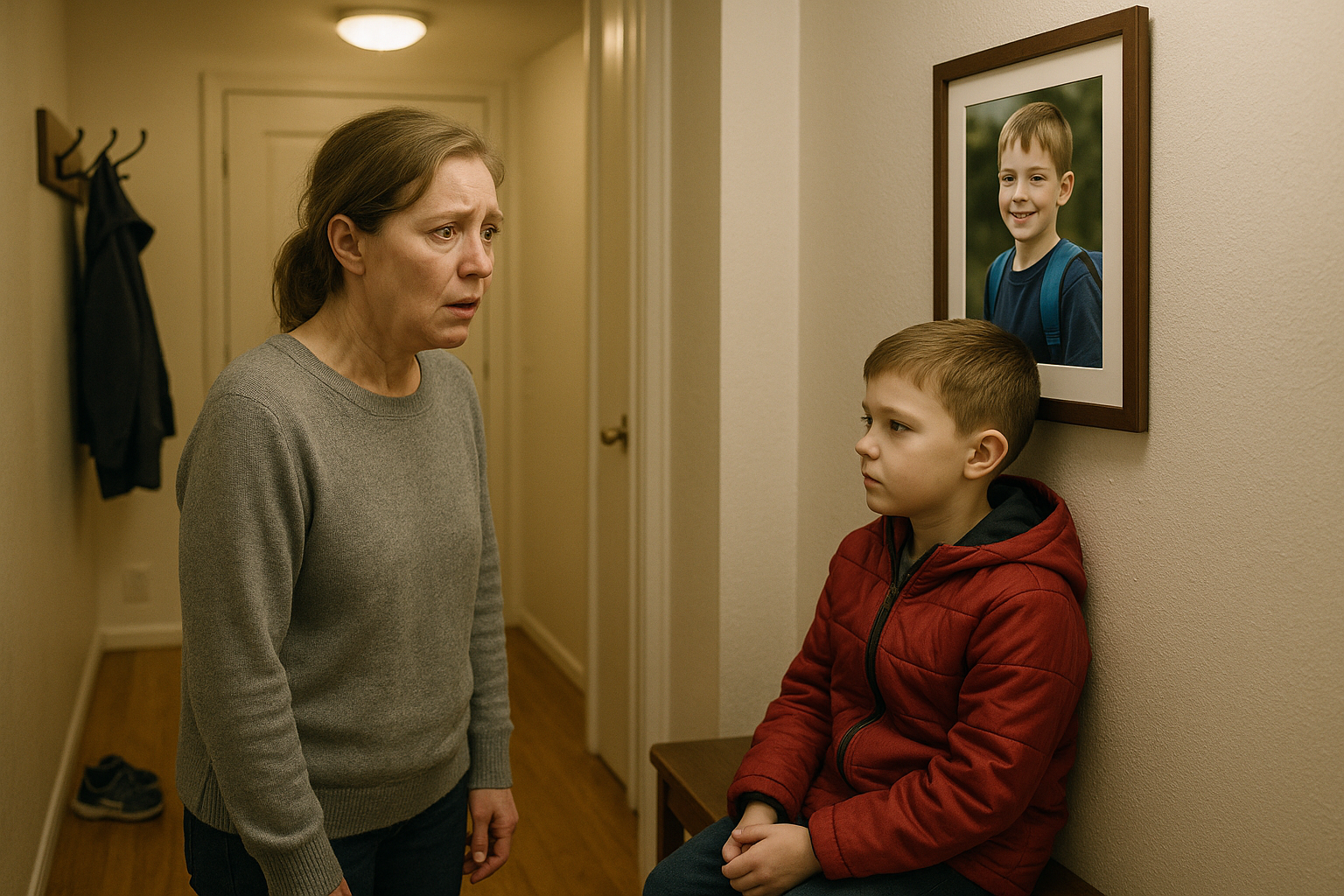
He stepped over the threshold and stopped, as if listening. His eyes swept the hallway, the framed photos on the wall, the pair of small sneakers still standing by the shoe rack — Daniel’s, the ones I could never bring myself to throw away.
“You have a son,” Leo said quietly.
“Had,” I corrected automatically, before I could stop myself.
The word hung in the air like smoke.
Leo didn’t ask what happened. Children usually do. He just lowered himself onto the hallway bench, his feet not quite touching the floor.
I walked to the kitchen to get my phone. When I came back, he was staring at the photo on the wall: Daniel at seven, missing front tooth, blue backpack.
“That’s him?”
“Yes,” I said, fingers tightening around the phone. “His name was Daniel.”
“He misses you,” Leo said.
I froze. “What did you say?”
“He misses you,” he repeated calmly, as if it were the most ordinary sentence in the world. “He says you sleep too much in the dark. He says you stopped laughing on Sundays.”
The phone slipped in my hand. Those were my words. The words I had sobbed into my pillow the first months after the accident, when Daniel didn’t wake up from the coma and the machines were turned off. Words I had never said aloud to any living soul.
My throat went dry. “Leo… who told you that?”
He didn’t look away from the photo.
“He did,” the boy whispered. “He comes to my room sometimes. At night. He cries because you don’t open the curtains in the morning. He asked me to come. To ring your bell. I got the address wrong the first nights.”
The first nights.
I remembered the faint doorbell sounds I had half-dreamed the past week, blaming old wiring, blaming my own imagination. I had wrapped the blanket tighter and refused to get up.
“Stop,” I said too sharply. “That’s not funny.”
Leo finally turned to me, and the look in his eyes was not one a child should ever have: the look of someone carrying a weight that isn’t his.
“He says he knows about the backpack in your closet,” the boy continued softly. “The one still with the candy wrapper inside. He says you touch it every Thursday and then wash your hands.”
My legs nearly gave out. No one knew that. Not my ex-husband, not my sister, not the therapist I stopped seeing two years ago.
I sank onto the opposite chair, my knees almost touching Leo’s.
“How do you know these things?”
“He shows me,” Leo said. “Like small movies in my head. He said if I tell you, you’ll believe me.” He swallowed. “He wants you to leave.”
“Leave where?”
“This house,” Leo answered simply. “Tonight. Before the morning.”

A cold shiver climbed my spine.
“This is insane,” I muttered, more to myself than to him. “Why would he want that?”
Leo’s gaze drifted to the ceiling. “He says the house is too heavy. It’s… pulling you down. He says he doesn’t like to see you here. Sitting in the dark kitchen with the clock that doesn’t work.”
My eyes shot to the clock on the wall. The battery had died months ago. It still showed 11:23 — the time the hospital had called.
Leo squinted. “He says that’s when everything stopped for you.”
I pressed my palms over my face. “I’m calling the police,” I said, but my hand didn’t reach for the phone. Instead, it reached for the old blue backpack I kept under the hallway bench, as if to shield it.
“Don’t be mad,” Leo whispered. “He says he can’t come again. Not like this. So he sent me. He says if you stay here, the house will swallow you. Not like a monster. Just… very slowly. Until there’s nothing left.”
A memory flashed in my mind: Daniel running through this very hallway, socks sliding on the floor, yelling, “Mom, let’s go! We’ll be late!” The day of the accident, I had snapped at him for being too loud. I never forgave myself for that.
“Why you?” I asked, my voice hoarse.
Leo shrugged, his small shoulders rising and falling. “My mom doesn’t hear me when I’m scared,” he said simply. “But I hear other people when they’re scared. Maybe that’s why.”
There was no drama in his tone. Just quiet, exhausted truth.
Outside, the first gray line of dawn crept over the roof of the opposite house. Birds started their timid, early chorus. The world was waking up. And I was sitting in my hallway with a stranger’s child, discussing messages from my dead son.
“Where is your home, Leo?” I asked again, gentler now.
He didn’t point this time. “I don’t know anymore,” he said. “But he does.” He tapped his temple. “He says you should pack the backpack. Only what you can carry. And leave before the sun hits the kitchen window. He says you’ll understand later.”
I looked toward the kitchen. The window faced east. In less than an hour, the light would spill across the counter where I had lined up unopened pharmacy bottles like soldiers.
Something inside me shifted. Not a sudden bolt of faith. More like a tired giving up. Giving up on the idea that I knew how grief was supposed to look.
I stood up.
In the bedroom, I pulled my old travel backpack from under the bed. I moved like someone in a dream: a few clothes, my wallet, Daniel’s photo, the tiny dinosaur keychain he had once insisted I keep “so you’re not alone when I’m at school.”
When I came back to the hallway, Leo was still there, hands folded in his lap, eyes on the dead clock.
“You’re really going,” he said, a small flicker of relief crossing his face.
“I’m really going,” I echoed. “But I’m taking you to the police first. Or at least to someone who can find your mother.”
For the first time, he smiled. It was so quick and narrow I would have missed it if I had blinked.
“He says thank you,” Leo murmured. “He says now he can go.”
“Go where?” I asked, but Leo only shrugged.
We stepped out into the chilly morning. I locked the door without looking back, the key heavy in my hand. My house — the place where I had collected every piece of my sadness and built walls with it — stood behind me, silent and small.
At the corner, I turned to check on Leo.
There was no one there.
The sidewalk was empty, wet with the thin layer of dew that turns everything silver. No red jacket, no small sneakers, no footprints leading away.
My heart hammered in my throat. “Leo?” I called, my voice cracking.
Only a bird answered, flapping from the telephone wire. Somewhere a bus hissed to a stop.
I stood frozen, backpack straps cutting into my shoulders.
For a wild moment I considered that I had finally lost my mind. That grief had folded in on itself and spat out a hallucination so detailed I could still feel the warmth of his presence in my hallway.
Then I felt it: the faintest tug on my backpack, as if a small hand had brushed against it in encouragement.
In the reflection of the bus window across the street, for half a heartbeat, I didn’t see just my own tired, lined face. Next to me, at knee height, there was the blur of a red jacket and a familiar blue backpack — the same one from the photo on my wall.
I blinked, and it was gone.
The bus doors opened with a sigh.
I stepped on.
As the bus pulled away, my house grew smaller in the distance, until it was just another shape among others. My chest hurt, but the pain was different, like muscles waking up after being still for too long.
I didn’t know where I was going yet. Maybe to my sister in another town. Maybe just away, far enough that the silence in my head could rearrange itself.
All I knew was that for the first time in three years, the sun rose and I wasn’t watching it from behind dusty curtains.
Somewhere deep inside, under the ruins and dust, a small, stubborn thought flickered:
If Leo could carry someone else’s pain through the night, maybe I could carry my own through the day.
And maybe, just maybe, that was the message my son had been ringing my doorbell to give me all along.