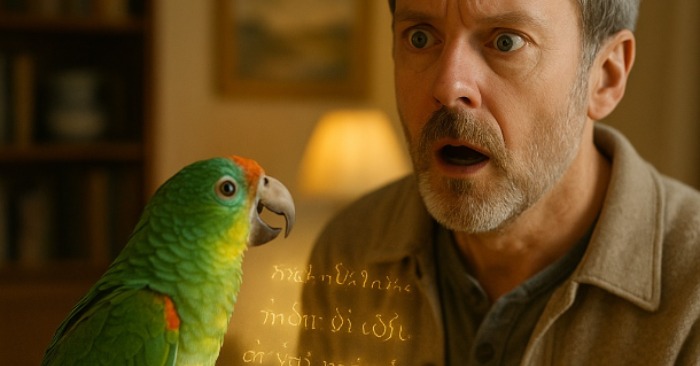
It was a gray, rainy afternoon when Mr. Keller’s parrot first startled him.
The bird had lived with him for years, chattering nonsense, mimicking doorbells and laughter. But that day, it spoke with a new voice. Not the clipped repetition of human speech — but slow, deliberate syllables that Mr. Keller had never taught it.
The sound was harsh, ancient, almost like chanting.
At first, he thought it was gibberish. But when his neighbor, a retired history teacher, heard it through the open window, her face drained of color.
“That’s Latin,” she whispered. “But no one speaks it like that anymore. It’s… older.”
The Impossible Language
The bird continued. Each day, it repeated phrases no one in the town could understand. The words rolled out of its beak with a fluency that sounded nothing like mimicry.
Mr. Keller began recording the sounds. He sent them to a local university, more out of curiosity than belief. Weeks later, he received a call that made his knees buckle.
The professors were stunned. The bird wasn’t speaking modern Latin — the kind still studied in classrooms. It was speaking a dialect of Latin that hadn’t been heard for nearly two thousand years.
The accent, the rhythm, the very construction of the sentences matched what scholars believed was spoken in ancient Rome.
But how?
The Visitors
Word spread quickly. Soon, linguists, historians, and curious strangers crowded into Mr. Keller’s small house to hear the parrot. Some came skeptical, expecting a trick. But when the bird opened its beak and recited a passage no one had taught it, silence fell.
One scholar wept openly.
“The bird is quoting lines from a Roman funeral hymn,” she said. “These words are carved on tombstones. But I’ve never heard them spoken before.”
Others leaned closer, scribbling notes furiously. The parrot didn’t just repeat. It seemed to respond. When asked questions in Latin, it answered — haltingly, but with meaning.
The bird wasn’t only reciting. It was conversing.
The Strange Memory
Mr. Keller began to notice something else. When the bird spoke, it often grew restless. Its feathers fluffed, its eyes darted, as though it remembered something it couldn’t quite place.
One night, as a storm raged outside, the parrot cried out a phrase louder than ever before. Mr. Keller, shaken, wrote it down and later asked a scholar to translate.
The words chilled him to the bone:
“I was not meant for cages.”
The Burden of Knowing
The more the parrot spoke, the weaker it seemed. Its once-bright feathers dulled. Its songs grew softer. Yet its eyes gleamed with a strange intelligence, as if something inside was burning itself out.
One evening, Mr. Keller sat beside the cage and whispered, “Who are you?”
The bird tilted its head, and in that ancient tongue, croaked a single answer:
“Remember.”
The Twist
Weeks later, the parrot fell silent. No more chants. No more ancient words. It became an ordinary bird again, chirping softly, mimicking the creak of doors, whistling old jingles.
Some claimed it had been a trick of coincidence, or a projection of human imagination onto meaningless sounds.
But Mr. Keller knew better. He still had the recordings, the translations, the unmistakable words that had once poured from a creature that should never have known them.
At night, he sometimes plays those tapes, listening to the echoes of a tongue that time had buried.
And when the parrot sits quietly on his shoulder, Mr. Keller cannot shake the feeling that perhaps — for a brief, impossible moment — the voice of someone long dead had spoken through its small, fragile body.