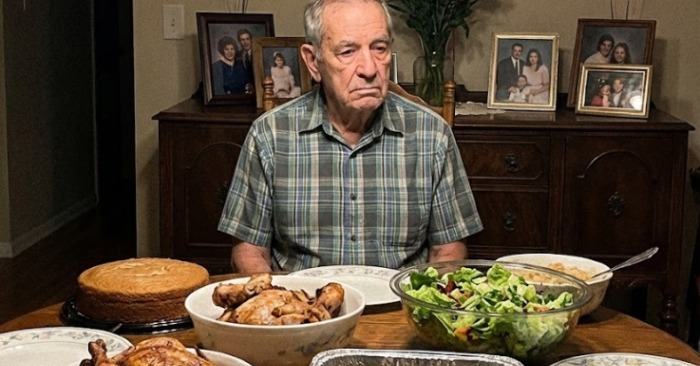
Eleven years I turned down my grandfather’s birthday calls, convincing myself that I was too busy for his old-fashioned ways. Then came a June when the call didn’t come. When I finally drove to his house, soot-stained walls and shattered windows told a story that broke my heart.
Hey everyone, I’m Caleb, 31 years old. Telling this story is hard, but I have to let it out, because maybe someone out there is making the same mistake I made.
My Grandpa Arthur raised me after my parents died in a car accident when I was seven. That’s why I hardly remember them.
I only remember the smell of my mother’s perfume and my father’s deep laugh echoing from the garage, where he worked on old cars.
But Grandpa Arthur? He became everything to me.
He was gruff and old-fashioned, the kind of man who believed in firm handshakes and hard work. But he was also the center of my entire childhood world.
Every morning, I woke to the smell of his strong black coffee wafting through our small house. He would sit on the porch in his favorite wooden chair, waiting for me to stumble out in my pajamas.
“Morning, sleepyhead,” he’d say, ruffling my hair. “Ready for another adventure?”
AND YES – WE HAD THEM.
And yes – we had them. Real adventures. He taught me how to fish in the creek behind the house, and how to tend to his vegetable garden.
“Plants are like people, Caleb,” he’d say, kneeling beside me in the dirt. “Each one needs something different to grow. Your job is to look and give them what they need.”
But what I remember most are his stories.
Every evening after dinner, we’d sit on the same porch, and he’d tell stories about our family, his own childhood, and the adventures he had as a young man.
Those were the golden years of my life. I felt safe, loved, completely grounded in the world we built together – in that little house with the creaky floors and faded wallpaper.
But then I turned 17, and something shifted. Maybe it was normal teenage rebellion, maybe I just started realizing how different our life was compared to my friends. Their parents were younger, they drove newer cars, and they lived in houses that didn’t smell like old wood and mothballs.
Eventually, I started to feel embarrassed.
When friends wanted to come over, I suggested we meet somewhere else. When Grandpa wanted to pick me up from school in his ancient pickup truck, I asked him to drop me a block away.
WHEN I GRADUATED HIGH SCHOOL AND LEFT FOR COLLEGE, I CONVINCED MYSELF IT WAS NORMAL.
When I graduated high school and left for college, I convinced myself it was normal. Kids grow up and move away… that’s just how life goes, right?
But deep down, I knew I was running away from something. From the shame of our simple life, from his old-fashioned ways, and from the house that suddenly felt too small and too old for the person I thought I had to become.
And that’s where I started turning down his birthday invitations.
Every June 6th, like clockwork, my phone would buzz.
“Caleb, boy, it’s your old Grandpa,” he’d say. “Just wanted to invite you over for my birthday dinner. Made your favorite pot roast. Hope you can make it.”
And every year I had an excuse. College exams. Work deadlines. Plans with friends. A friend’s party. There was always something more important than spending an evening with the man who raised me.
“Sorry, Grandpa,” I’d write back. “I’m totally swamped this weekend. Maybe next time.”
Eleven years. Eleven birthdays. Eleven missed opportunities, each time convincing myself they weren’t that important because life was moving forward and I was building my future.
COLLEGE CAME AND WENT.
College came and went. I graduated, found a decent job in the city, dated a few women, and built what I thought was a successful adult life. But every June 6th, when that familiar number appeared on my phone, something tightened in my stomach.
“Hey, Caleb, it’s Grandpa Arthur. Hope you’re doing well, boy. I’m turning 78 today. Made the pot roast you loved as a kid. The house has gotten pretty quiet lately. Would love to see you if you can make it.”
Every message sounded a little more tired than the last. A little more hopeful – but also a little resigned. And each year, my excuses grew more elaborate.
“Can’t make it this year, Grandpa. Big presentation at work.”
“Sorry, I’m out of town this weekend.”
“Would love to, but I’m helping Sarah move.”
Sarah and I broke up two months after that last excuse. I never told him.
But you know what? The guilt was always there, like a stone in my chest that I couldn’t swallow. I had gotten so good at pushing it down and convincing myself that missing a birthday wasn’t the end of the world.
AND GRANDPA UNDERSTOOD. HE HAD TO UNDERSTAND.
And Grandpa understood. He had to understand. After all, I was busy building a career.
Then something changed a few months ago. June 6th came and went, and my phone stayed silent.
At first, I felt relief because I didn’t have to come up with a new excuse or have an uncomfortable conversation.
But as the days passed, that relief turned into something else. Something that felt eerily like panic.
What if he was sick? What if something had happened? What if he had finally gotten fed up with my excuses and decided to stop trying?
That thought haunted me for weeks. I grabbed my phone to call him – and put it down again. What would I even say?
“Hey, Grandpa, I just wanted to know why you didn’t invite me to your birthday this year?”
How pathetic would that have been?
BUT THE FEELING DIDN’T GO AWAY.
But that feeling didn’t go away. It gnawed at me in meetings, kept me up at night, and followed me through the day like a shadow I couldn’t shake off.
Finally, I couldn’t take it anymore. One Saturday morning in late July, I threw a few things in a bag, got in the car, and drove off.
I didn’t call ahead. I made no plans. I just drove the two hours back to the small town where I grew up, down roads I knew by heart, though I hadn’t driven them in years.
As I turned onto the familiar dusty road that led to Grandpa’s house, nostalgia hit me like a ton of bricks. I saw myself again as a child, riding my bike down this very path, coming home from school and seeing him standing on the porch, a glass of cold lemonade in his hand. I remembered the feeling when his house came back into view after summer camp – that knowing: I’m almost home.
But as his house finally came into view around the corner, I gasped. I couldn’t believe what I saw.
The white siding was blackened with smoke. Windows were shattered, glass scattered across the front yard like deadly confetti. Part of the roof had collapsed inwards, and jagged wooden beams stuck up into the sky like broken ribs.
With trembling hands, I pulled into the driveway and sat there for a moment, just staring at the ruins of my childhood home.
This can’t be real, I thought. This must be a nightmare.
I GOT OUT WITH UNSTEADY LEGS AND WALKED TOWARD THE PORCH.
I got out with unsteady legs and walked toward the porch. The wooden steps were charred and partially collapsed, and the rocking chair where Grandpa had sat every morning was gone.
The smell hit me as I got closer. Ash and burnt wood – and underneath, something metallic, sharp, that tightened in my throat.
“Grandpa?” I called, my voice breaking. “Grandpa, are you there?”
The only answer was the wind whistling through the broken windows.
I stepped cautiously onto what was left of the porch, testing each board before shifting my weight onto it. The front door hung open, twisted on its hinges.
Through the doorway, I saw the devastation inside.
“Grandpa!” I called louder, panic rising in my chest. “Where are you?”
Nothing. Only the echo of my own desperate voice bouncing off the damaged walls.
THEN I FELT A GENTLE HAND ON MY SHOULDER.
Then I felt a gentle hand on my shoulder. I spun around, my heart hammering in my chest.
“Take it easy, boy,” said a calm, familiar voice.
It was Mrs. Harlow, Grandpa’s neighbor from next door.
She looked older than I remembered, her gray hair now completely white, but her kind eyes were just the same.
“Mrs. Harlow,” I gasped. “What happened? Where’s Grandpa? Is he—”
“He’s alive, dear,” she said quickly, seeing the terror on my face. “But you didn’t know, did you? About the fire?”
I shook my head, unable to form words.
She sighed deeply. “It was three months ago. An electrical fire, they think. It started sometime around midnight in the kitchen. Your grandfather… he almost didn’t make it out.”
MY KNEES WENT WEAK.
My knees went weak. “But he’s okay? Really?”
“He’s been in the hospital since then. Smoke inhalation, a few burns on his hands and arms. He’s recovering, but it’s slow. He… he’s not as strong as he used to be, Caleb.”
The way she said my name made my chest tighten with shame. How long had it been since I’d spoken to Mrs. Harlow? How long since I’d spoken to anyone from this part of my life?
“The hospital tried to reach you,” she continued gently. “There were several calls to your number. Your grandfather listed you as his emergency contact. And when no one picked up…”
The unknown numbers. All those calls I didn’t recognize and sent straight to voicemail without listening to them. They weren’t telemarketers. They were people from the hospital, trying to tell me my grandpa was fighting for his life — and I was too busy to pick up the phone.
“Oh God,” I whispered, pressing my hands to my face. “I ignored them. I ignored all the calls.”
Mrs. Harlow didn’t look at me accusingly, but with an understanding that almost hurt more. “He never stopped asking for you. Even when he was barely conscious, he kept saying your name. The nurses said he asked if his grandson was coming.”
I felt like I was drowning in my own guilt. Eleven years of missed birthdays suddenly seemed insignificant compared to this. I had missed the moment when he needed me the most.
CAN I… CAN I SEE HIM?” I ASKED, NO MORE THAN A WHISPER.
“Can I… can I see him?” I asked, no more than a whisper.
“Of course, dear. That’s what he’s been waiting for.”
Before we drove to the hospital, Mrs. Harlow walked me through what was left of the house. Inside, it was worse than I imagined.
The kitchen, where Grandpa had cooked countless meals, was completely destroyed. The living room, where we used to watch old westerns together, was just a skeleton of charred furniture and melted electronics.
But in the back bedroom, something had survived. In the corner, half-protected by a fallen beam, stood a small wooden box I instantly recognized. Grandpa’s memory box, where he kept old photos and letters.
Mrs. Harlow carefully lifted it out of the rubble. “He asked the firemen to save this,” she said. “Told them it was the most important thing in the house.”
Inside were dozens of photos. Pictures of my parents I had never seen before. Pictures of me as a child, grinning toothlessly while Grandpa taught me how to ride a bike. Pictures of us fishing, gardening, and baking cakes.
And at the very bottom, a stack of birthday cards.
MY BIRTHDAY CARDS TO HIM.
My birthday cards to him. Every single one I had sent over the years instead of visiting. Even the regular, generic cards with hasty signatures that barely counted as personal messages. He had kept them all.
“He reads them when he misses you,” Mrs. Harlow said quietly. “And that’s most days.”
Twenty minutes later, we walked through the sterile halls of the hospital. The smell of disinfectant couldn’t completely mask the lingering scent of smoke that seemed to cling to me, as if I had brought it from the house.
Room 237.
Mrs. Harlow gently knocked on the doorframe.
“Arthur? There’s someone here who wants to see you.”
I stepped into the room — and there he was. My grandfather, the man who had been invincible in my childhood, now small and fragile in the hospital bed. His face was thinner than I remembered.
But when he looked at me, his eyes lit up with a joy so pure and complete it almost tore me apart.
“Caleb,” he whispered, his voice hoarse but full of wonder. “You came. You really came.”
I rushed to his bed, tears streaming down my face. “Grandpa, I’m so sorry. I’m so, so sorry. I should have been there. I should have picked up the phone. I should’ve—”
He reached out his unbandaged hand and took mine. “You’re here now,” he said simply. “That’s all that matters.”
In the next week, I hardly left his side. I listened to stories about meeting my parents, about his own childhood during the Great Depression, and about the dreams he had for our family.
I learned he had been keeping a journal for years, documenting family history and memories he wanted to pass down to me.
“Some things are worth holding on to,” he said one afternoon. “Stories, memories, love… those are the things that really matter. Houses can be rebuilt, but when a story is lost…”
He trailed off, but I understood. I almost let his stories disappear forever. I almost lost the man who raised me, who loved me unconditionally — without him ever knowing how much he meant to me.
Today, Grandpa Arthur lives in a small apartment near the hospital. I visit him every weekend, and we’re rebuilding more than just our relationship. We’re rebuilding our family history, one story at a time.
And every June 6th, I’m there for his birthday.
Some people die twice. Once when their body fails, and a second time when their stories are forgotten. I almost let my grandfather die that second death — through neglect, distance, and my own stubborn pride.
But it’s not too late. It’s never too late to come home, to listen, and to love the people who made us who we are.
And every time I smell smoke or see a charred building, I remember the lesson that almost cost me everything: The people who love us don’t wait forever — but sometimes, if we’re very lucky, they wait long enough.
I was lucky that Grandpa waited for me, and that I recognized his worth in my life before it was too late.