The old man kept sitting on the same park bench every day, clutching a tiny blue backpack, until one afternoon a stranger recognized it and quietly said: “I think this belongs to my brother”.

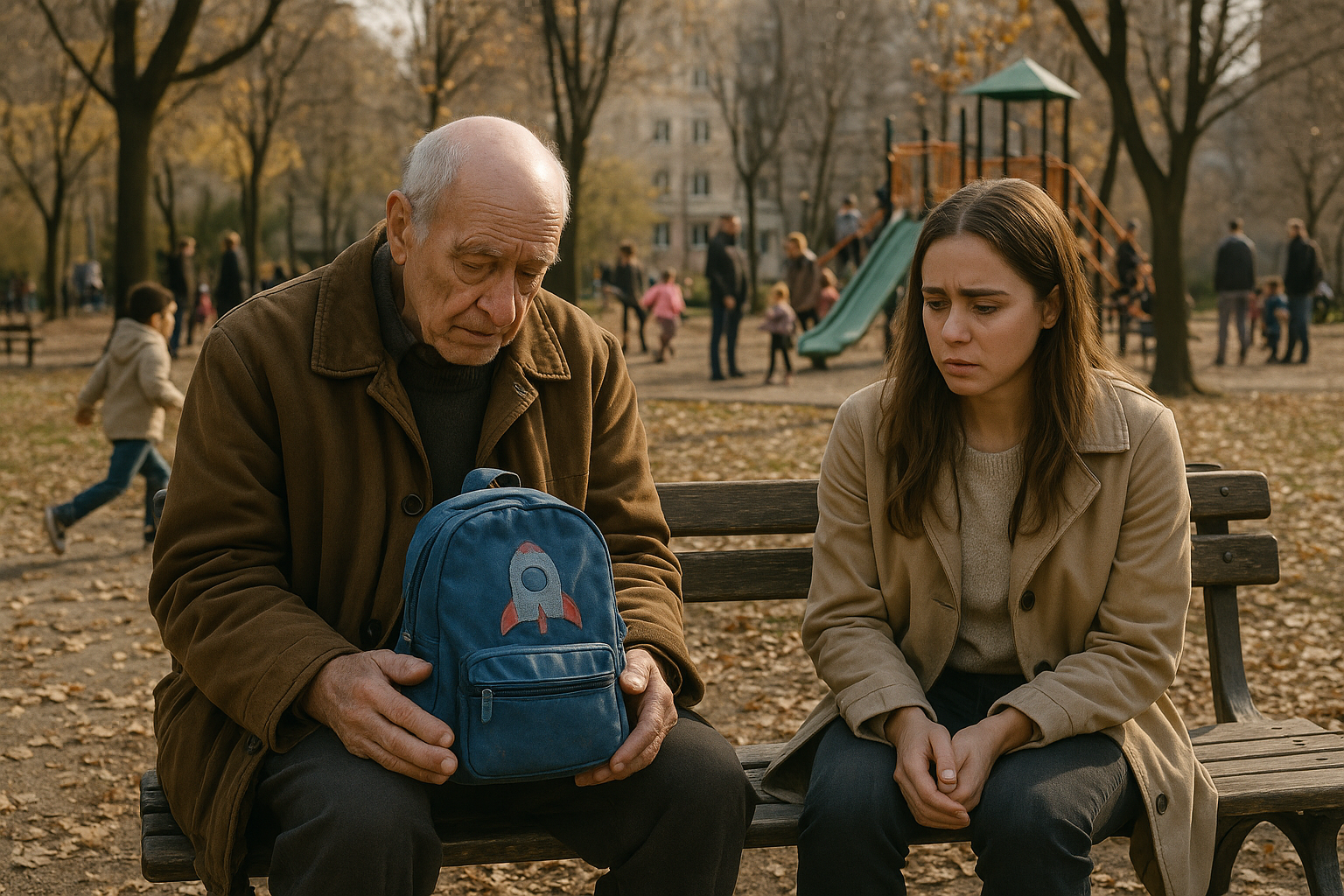
For three months, neighbors had grown used to him: thin, stooped, always in the same worn brown coat, gray hair carefully combed back. His name was Daniel, but people in the area simply called him “the bench man”. He rarely spoke. He just watched the playground across the path, eyes following the children as they climbed, fell, laughed, and ran to their parents.
The little blue backpack never left his hands. It was a child’s backpack, with a faded rocket ship on the front and a broken zipper. Sometimes he would unzip it carefully, take out a tiny yellow T-shirt, press it to his face for a moment, then put it back as if it were made of glass.
Parents whispered. Some thought he was strange, others felt sorry for him. Only the kids seemed unafraid. They waved to him from the swings, and he would raise his hand in a shy, almost guilty greeting.
One cold afternoon in late autumn, a young woman named Emily sat on the bench opposite him. She had seen him dozens of times, but that day her curiosity overpowered her hesitation. Her younger brother had disappeared in this very city eight years ago, and since then she’d noticed every lonely face, every lost look, every forgotten toy.
“Is it okay if I sit here?” she asked, nodding to the empty space beside him.
Daniel shifted, as if waking from a dream. “Yes, of course,” he said quietly, moving the backpack closer to his chest.
They sat in silence for a while, watching a boy in a red jacket chase a pigeon.
“Your grandson?” Emily finally asked, nodding at the backpack.
Daniel’s fingers tightened on the straps. He hesitated, then shook his head.
“My son,” he said. “Ethan.” The name came out like a prayer and a wound at once.
“I’m sorry,” Emily murmured. “Is he…?” She couldn’t finish.
Daniel gave a small, tired smile. “He was four. We were in this park. I looked away for a second to answer a phone call. When I turned back, he was gone. Just… gone.”
Emily’s heart stuttered. “How long ago?” she whispered.
“Ten years,” he replied. “I stayed here until midnight that day. I thought he would come running back crying. He didn’t. The police came, the neighbors helped. Flyers, news, everything. People stopped calling after a while. But I still come. If he ever finds his way here, I want him to see me on this bench. I promised him I would always be here.”
His voice broke on the last words. Emily stared at the backpack. The faded rocket. The frayed strap. Something in her chest twisted painfully.
“My brother disappeared in a park,” she said faintly. “Not this one, another across town. He was six. His name was Adam. We never found anything. Not a shoe, not a toy.”
Daniel looked at her properly for the first time. There was a shared emptiness in their eyes, like two mirrors facing each other.
“I’m sorry,” he said. “No one understands this kind of hole unless they have it too.”
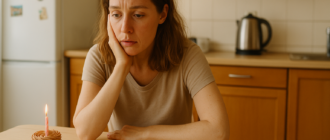
They talked for an hour. About the way birthdays become days you dread. About the guilt that never lessens. About the way people say, “You have to move on,” as if grief were a suitcase you could leave at a station.
When the wind grew colder, Emily shivered. Daniel noticed and, for the first time, placed the backpack between them instead of hugging it to himself. The gesture felt huge, like sharing a secret.
“Can I see it?” she asked softly.
He nodded. She opened the zipper with care. Inside was the tiny yellow T-shirt, a small plastic car with a missing wheel, and a photograph, edges bent from being held too often.
She picked up the photo. A boy with bright brown eyes, front teeth slightly apart, hair sticking up as if he’d just taken off a hat. He wore the yellow T-shirt. Behind him, a woman laughed, caught mid-motion. Daniel stood slightly apart, looking at his son with a pride that almost glowed.
Emily’s fingers began to tremble.
“Is something wrong?” Daniel asked.
She swallowed. “That T-shirt,” she whispered. “The car… The rocket on the backpack.” Her breathing quickened. “My brother had the same backpack. The same rocket. And that car… My dad stepped on one just like it the day before Adam disappeared. He yelled, and Adam laughed and laughed.”
Daniel frowned. “They sold millions of these toys,” he began, but his voice lacked conviction.
Emily turned the photo over. On the back, in black marker, was written: “To Ethan, love Uncle Mark, 2013.” Under it, a phone number, half-smudged but still readable.
Her face went pale.
“My uncle’s name is Mark,” she said slowly. “And that’s his old phone number.”
The world seemed to tilt. The sounds of the playground faded into a distant hum.
Daniel took the photo from her with shaking hands, staring at the back as if the letters might rearrange into something sensible. “There must be some mistake,” he whispered.
Emily’s voice went flat, as if it didn’t belong to her. “My uncle moved abroad the year after Adam disappeared. He always bought him presents with rockets. He said Adam was going to be an astronaut.”

They sat frozen, two strangers connected by a thin, terrible thread.
“May I take a picture of this?” Emily asked, gesturing to the back of the photo. “I need to call my mother.”
Daniel nodded numbly.
Emily moved away to make the call. Daniel watched her, the backpack on his lap suddenly feeling heavier than his whole body. He heard fragments: “Mom, listen… Uncle Mark… phone number… another child…” Then a sharp, muffled sob.
When she returned, her eyes were red, but her voice was steady in a way that frightened him.
“My mother says Uncle Mark took Adam to the park that day,” Emily said. “He said he lost him near the ice-cream stand. He was hysterical, the police believed him. We all did. But she remembered something else just now. A week before, he told Adam he’d bought a ‘matching rocket backpack’ for a friend’s little boy.”
Daniel felt as if someone had punched the air out of his lungs.
“My brother may have been with your son that day,” Emily continued. “Or… taken for the same reason. I don’t know. But this backpack, this number, your photo… They connect our children through the same man.”
Silence pressed down on them.
“So he took my Ethan,” Daniel said hoarsely. “Your uncle. He took him, gave him this backpack, this car, this shirt. Called him his ‘friend’s boy’.”
“And maybe he took Adam too,” Emily replied, her voice breaking. “Or sold him. Or… I don’t know. But this is more than coincidence. The police need to see this. Both our cases. Together.”
For the first time in ten years, Daniel’s grief shifted. It didn’t lessen; it changed shape. Underneath it, something cold and sharp rose up: purpose.
They went to the police the next morning. The detective on duty listened, at first politely, then with growing intensity. The old missing person files were pulled, dust shaken off, names and dates compared. The same name, Mark, appeared twice, once as a “concerned uncle”, once as “family friend”.
Weeks passed. Daniel and Emily met often, sometimes at the bench, sometimes at the station. They shared coffee, silent hours, and the unbearable ticking of time.
One day, the call finally came.
A man using the name Mark had been arrested in another country two years earlier, suspected of being involved in child trafficking. Several children had been found and returned home. Records were incomplete. Some names were missing. But among the documents was a photograph of a group of children in a small, dim classroom.
The officer slid the picture across the table.
Emily leaned forward, her hand over her mouth. “That’s Adam,” she choked, pointing at a boy in the corner, older, thinner, but unmistakably her brother. Alive. Or at least, once alive.
Daniel’s eyes scanned the faces desperately. Then he saw him: a boy with brown eyes and slightly spaced front teeth, hair stubbornly sticking up. Older than in Daniel’s memory, but still, undeniably, Ethan.
His vision blurred. Ten years of frozen hope cracked open and poured out of him in a sound that was half sob, half laugh.
The officer’s face was grim. “This photo is from six years ago,” he said gently. “We are still searching. Now that we know they were together, we have much more to work with. It will take time. But this is not the end of the road anymore.”
That evening, Daniel returned to the park. The bench was the same. The trees, bare now, rustled weakly in the wind. Children’s laughter floated across the cold air.
He sat down slowly, the blue backpack on his knees.
Emily arrived a few minutes later, carrying a small framed copy of the classroom photo. She placed it carefully between them on the bench.
“For years we sat alone with our pain,” she said. “Now at least we’re not alone.”
Daniel nodded, tears sliding down his face without shame this time.
“I used to think this backpack was all I had left of my son,” he whispered. “Now I know it’s also a clue that might lead him back to me. To us.”
He looked at the playground, not searching for a small, familiar face anymore, but watching in a different way. Every child there could have been lost. Every parent could have been him.
“I’ll keep coming,” he said. “But not just to wait. To remember. To fight. For Ethan. For Adam. For all of them.”
Emily leaned forward, elbows on her knees, eyes on the photo.
“If my brother is still alive, we’ll find him,” she said quietly. “If your son is still alive, we’ll find him too. And if we don’t… they will at least know that somewhere, someone never stopped looking.”
The wind picked up, but the bench felt less cold.
In the fading light, two broken strangers sat side by side, tied together by a blue backpack, a name on the back of an old photo, and a stubborn, aching hope that refused to die.