The old man who returned my lost son without ever leaving his broken chair — that’s how I will remember Michael, the neighbor I barely greeted for five years, until the day everything in my life fell apart.

I used to hurry past his door with my six‑year‑old, Daniel, pulling at my hand. Michael’s apartment always smelled of old books and boiled potatoes. He sat by the window in his threadbare gray sweater, a walking cane leaning against his knee. I knew only that he lived alone and his pension was tiny. Sometimes I heard him coughing at night.
“Don’t stare, Danny,” I would whisper when my son turned his head. “He’s just an old man.”
Just an old man.
Then came the Tuesday I can’t forget. I worked late at the supermarket because a colleague called in sick. The kindergarten closed at five, and I was half an hour away with no one to pick up Daniel. My phone battery was dying. The bus was late. My chest was tight with that familiar panic I had lived in since my husband, Mark, walked out two years earlier.
When I finally ran into the kindergarten yard, breathless and sweating, the teacher was locking the gate.
“Where’s Daniel?” I gasped.
She frowned. “His grandfather picked him up. He said you’d be late.”
I felt the ground tilt.
“Daniel doesn’t have a grandfather in this city,” I whispered. “You let him go with a stranger?”
The next six minutes were a blur of sirens in my head. We called the police. The teacher tried to describe the man: tall, gray hair, walking stick, old coat. My stomach twisted.
Michael.
I ran home, ignoring the cars and the people. I only remember the cold air burning my lungs. Our apartment door was unlocked. My hands were shaking so badly I almost dropped the key.
“Daniel!” I screamed, stepping inside.
Silence.
His backpack wasn’t on the hook. His shoes weren’t by the mat. I grabbed my phone to call the police when I suddenly heard muffled laughter from the end of the hallway.
From behind Michael’s door.
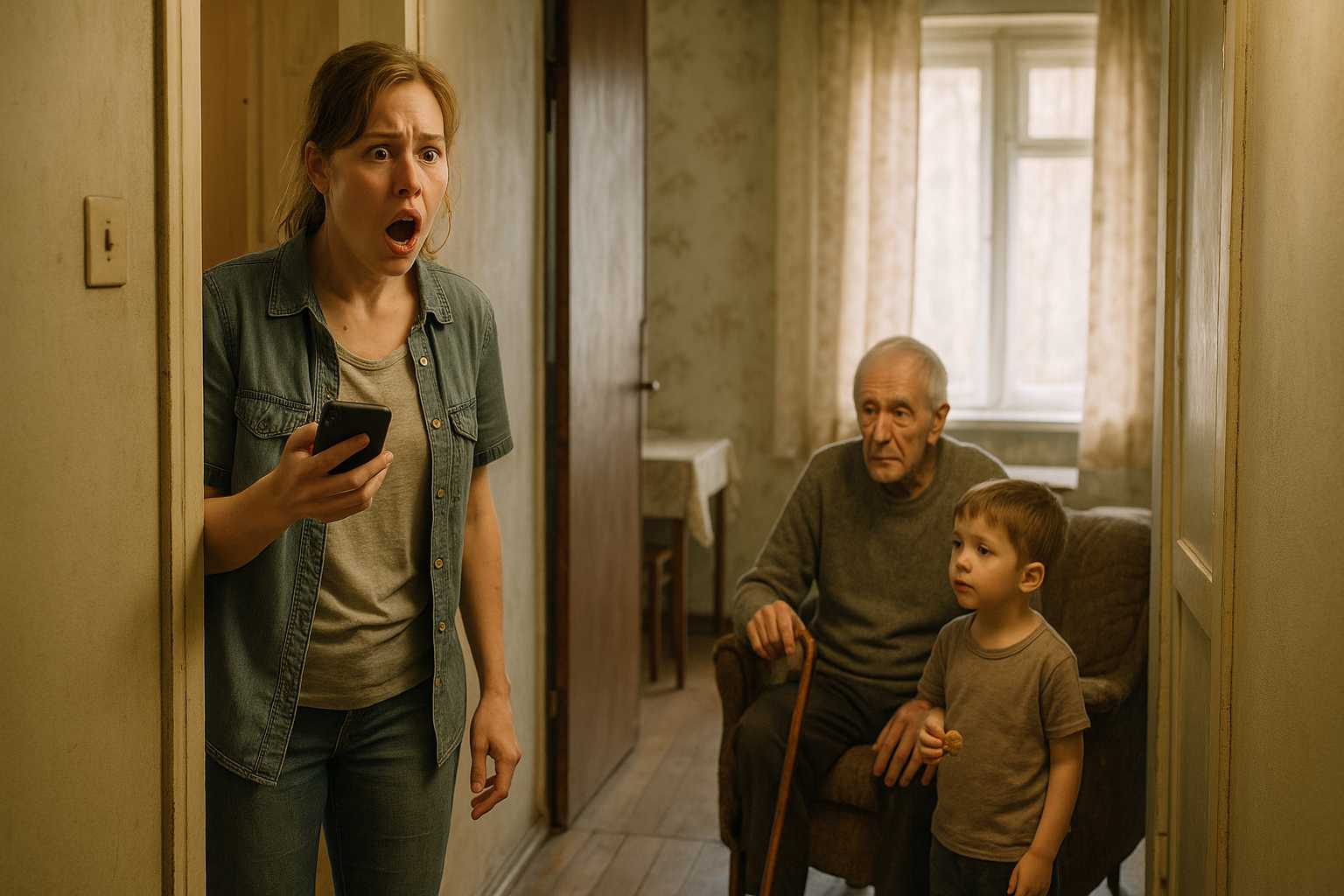
I rushed out and banged on it so hard my knuckles hurt. It opened slowly, and there was Daniel, socks sliding on the floor, a cookie in his hand. Behind him, on the same broken chair by the window, sat Michael.
My voice exploded.
“What have you done? How dare you take my child? I’ll call the police!”
Daniel shrank behind the old man’s chair, eyes wide with fear — not of Michael, but of me.
Michael raised his hands, a tremor in his fingers.
“Please, Anna,” he said softly. “Let me explain.”
“How do you know my name?” I hissed.
He gave a dry, sad smile. “Walls here are thin. I’ve heard you crying at night more times than I can count.”
The shame hit me like a wave, but anger was still louder.
“You had no right—”
“Mom, don’t be mad,” Daniel interrupted in a small voice. “He knew the secret word.”
I turned to my son, confused. “What secret word?”
Daniel bit his lip. “The one you told me… if someone else ever came to pick me up. So I’d know you sent them.”
I froze.
A year earlier, after seeing a news report about a kidnapped child, I had taught Daniel we’d always use a secret word if anyone except me came for him. A word no one could guess.
“Sunflower,” I whispered.
Daniel nodded. “He said it before I left with him.”
I stared at Michael. His eyes were shining with something between guilt and determination.
“How?” I managed.
He looked down at his hands. “That night you lost your job at the bakery, you cried for hours. You told your sister on the phone about the secret word. You said it out loud three times. You never think anyone is listening to you, Anna.”
The room went quiet, except for the ticking clock on his wall. The police siren I expected outside never came; I had run home before giving the dispatcher our address.
“I know it was wrong to go there,” Michael continued, voice rough. “But I heard you on the phone today, in the stairwell, begging your boss not to fire you if you were late. I heard you say you were stuck and had no one to help with the boy. So I went.”
“You can barely walk,” I said, more to myself than to him.

He chuckled weakly. “That’s why we took the bus. Daniel held my arm all the way. He told me about his favorite dinosaur and how he wants to be a firefighter. We bought bread and milk together, with my last few coins, so there would be breakfast tomorrow. I wanted you to come home to your son safe, and to a full fridge, just once.”
My anger crumbled, leaving something much heavier behind.
“You could have called me,” I whispered.
“I don’t have a phone,” he said simply. “The landline was cut last year. Bills.”
Daniel came out from behind the chair and tugged at my sleeve.
“Mom, we made mashed potatoes,” he said. “Like Grandpa used to make. Can we eat together?”
The word hung in the air.
“Grandpa.”
I watched Michael’s face as he heard it. For a second, the old man’s eyes closed, and his jaw tightened.
“I had a grandson once,” he murmured. “His name was Lucas. He would be Daniel’s age now. They moved abroad. I haven’t seen him in four years. But that’s not your problem.”
He shifted in his chair as if to stand.
“I’m sorry I scared you, Anna. You can take Daniel home. I won’t… interfere again.”
He reached for his cane with a trembling hand and almost lost his balance. Instinctively, I moved forward and grabbed his elbow.
“Sit,” I said quietly. “Please. We’ll eat the potatoes.”
We ended up around his tiny table: my son swinging his legs, me staring at the faded tablecloth, and Michael carefully putting an extra spoonful of potatoes on Daniel’s plate and almost nothing on his own. The room smelled of butter and something old, like memories that refused to leave.
“Why didn’t you ever knock on my door?” I asked suddenly.
He smiled, eyes on his plate. “Pride is a stupid thing for lonely people. And fear. I was afraid you’d think I’m just a nosy old man. Or worse.”
“You listened to me cry,” I said. “And I never even asked if you needed anything.”
His shoulders lifted a little. “You had enough to carry.”
The twist came a week later.
I knocked on his door with a bag of groceries and a printed paper in my hand. Daniel was at my side, holding his drawing of a house with three windows.
There was no answer.
The building manager let us in after I begged. Michael was in his chair, head bent forward as if he had just fallen asleep watching the street.
The paramedics said it must have been quick. Heart, age, loneliness wrapped around his chest like a tight belt. On the table lay his pension envelope, unopened, and a sheet of paper covered in shaky handwriting.
It was a letter to me.
He had started it the night we ate mashed potatoes.
“Dear Anna,
If you are reading this, I have finally gone to see my wife and my little grandson in my dreams. Do not be angry that I took Daniel that day. I know I had no right. But I wanted, just once more, to feel that I was useful to someone. That I could protect a child, even with my weak legs and my empty pockets.
I have heard you cry many nights. I wished I could knock and say, ‘You are not alone.’ But words are heavier than my cane sometimes.
If there is anything I can leave you, it is this: don’t wait five years, like I did, to knock on the door next to yours.
Please, tell Daniel that an old fool loved him like a borrowed grandson for one bus ride and one bowl of potatoes. That was the happiest day of my last years.
With respect,
Michael.”
My tears blurred the last lines. Daniel stood on tiptoe, trying to read.
“Where is he, Mom?” he whispered.
I swallowed hard. “He went to see his family.”
Daniel was quiet for a moment. Then he carefully placed his drawing on Michael’s table.
“Now he has us too,” he said.
We left the apartment as it was: the broken chair by the window, the cane leaning against it, the clock still ticking. The landlord wanted to clear it out, but I begged him to wait.
For months, I kept catching myself pausing at Michael’s door, listening for his cough. The silence was louder than any sound.
But I changed the way I walked through our building. I started greeting the woman with the heavy bags on the second floor, offering to carry them. I knocked on the door of the young man who always looked tired and asked if he needed help writing his CV. I invited the widower from the third floor for tea with me and Daniel.
Sometimes, at night, I still cry. Life is still hard, the bills still arrive, my ex‑husband still sends nothing but empty promises.
Yet now, when I cry, there is always someone who might be listening — and someone I can listen to in return.
Because an old man who never left his broken chair taught me the cruelest and kindest lesson: loneliness can kidnap people just as silently as any stranger in a schoolyard. And sometimes, the bravest thing we can do for each other is to simply knock on the door next to ours and say, “I’m here.”