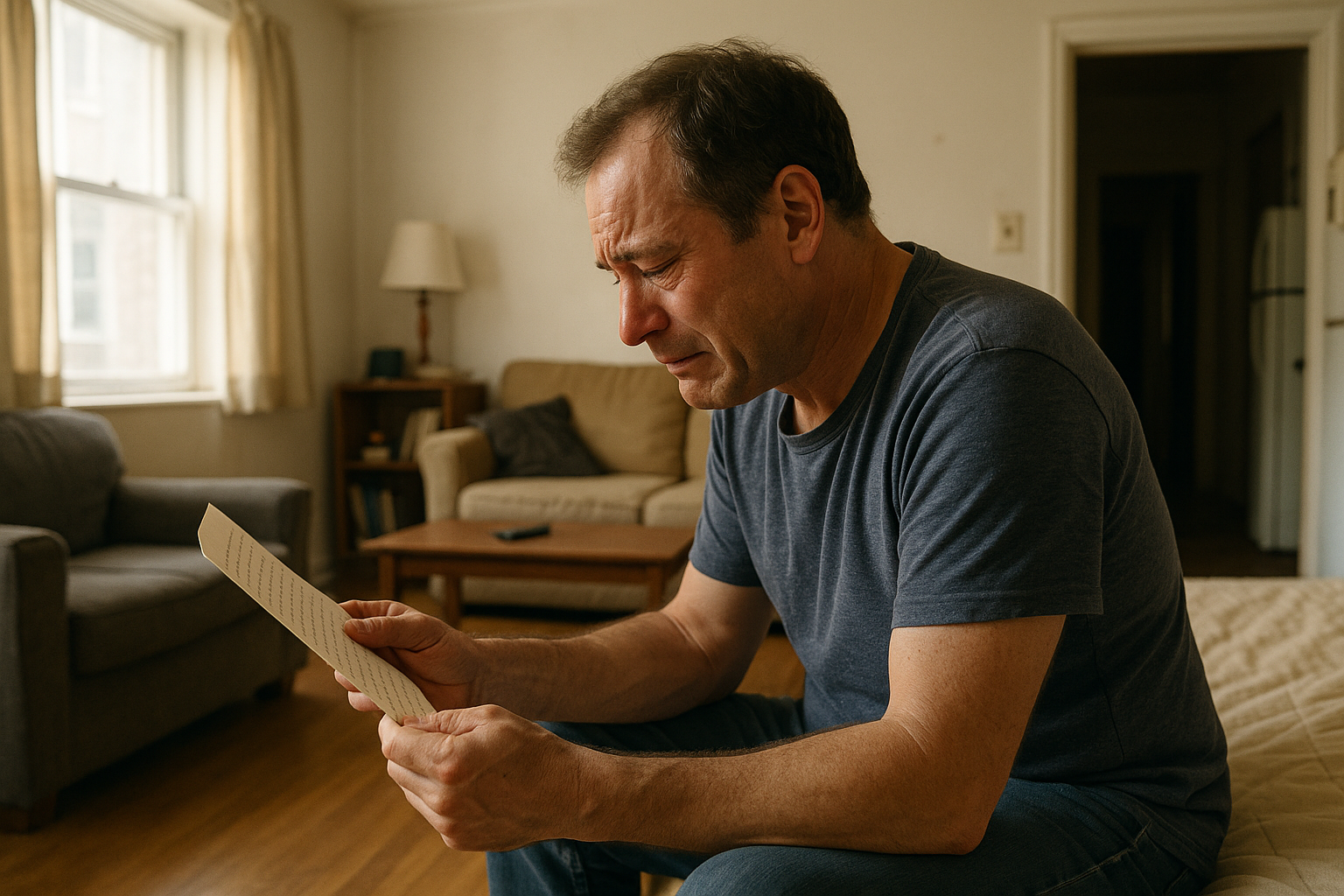
The letter the old man brought to my door at 6 a.m. was addressed to my son, who died two years ago, and the sender’s name was my own.

For a few seconds, my brain simply refused to understand what I was seeing. The envelope trembled in my hand. On the yellowed paper: “To Daniel Harris, from Michael Harris.” My name. My son’s name. Same handwriting as mine—only I had never written it.
The old man shifted his weight on the doorstep. “Found this in the mailbox of the house I just moved into,” he said softly. “Next street over. Looked… important.”
I wanted to slam the door, to tell him it was some sick joke. Instead I nodded, mumbled thanks and shut the door with the gentleness of a man afraid to wake a ghost.
Daniel’s room was exactly as he had left it—because I never had the courage to change anything. His sneakers by the bed, his crooked poster on the wall, the sweater he hated folded on his chair. I sat on his bed, the springs creaking under my weight, and turned the envelope over in my fingers.
No stamp. No date. Just our names.
My hands felt clumsy as I tore it open.
Inside was a single sheet of lined paper, torn from a notebook. The first line made my chest tighten until I could hardly breathe.
“Dad, if you’re reading this, it means you finally came back.”
I read the sentence three times. Came back from where? He was the one who never came back that day. The day the car went into the river. The day the phone call broke the world into before and after.
I forced myself to keep reading.
“I know you don’t like talking about feelings,” the letter went on, “and you always pretend everything is fine. So I wrote this instead. I’m hiding it in the old blue house on Mayfield Street, under the loose floorboard in the hallway. One day you’ll sell that house and someone will find this and bring it to you. I hope, anyway.
If you’re reading, it means you didn’t forget me.”
The old blue house on Mayfield. The one my ex-wife and I sold after the divorce, when Daniel was twelve. The one we left in a hurry, shouting and slamming doors. I remembered a hallway, a loose board I kept promising to fix.
I swallowed, the room blurring.
“I’m not mad at you about the divorce,” the letter continued, the loops of the handwriting uneven, like he’d been writing too fast. “I was. A lot. I thought you chose to leave me and Mom. But then I realized you left yourself too. You were like… an empty house with the lights off.”
My vision burned. I could almost hear his voice, the way he used to struggle to explain things, waving his hands in the air.
“I don’t know what will happen to me when I’m older,” the next paragraph said. “I’m scared sometimes that I’ll turn into you. Cold and quiet. Saying ‘I’m fine’ when I’m not. But I also know you love me. I see it when you think I’m not looking. Like when you stand in my doorway and just stare for a second, then close the door really slow.”
I covered my mouth with my hand. He’d noticed.
He’d always noticed.
“In case something happens to me,” the letter went on, the words that followed cutting like glass, “I don’t want you to think it’s your fault. You always blame yourself for everything. I can tell. So I want you to promise me something.
Promise me you won’t disappear again.”
I stopped reading. My heart was pounding so hard my ears rang. The house was silent, except for the refrigerator and my own ragged breathing.
“I know you think you’re protecting people by staying away,” the letter said. “But I don’t need a perfect dad. I just need a dad who is there. Even if he’s sad. Even if he’s broken.”
The next line had been written darker, as if he’d pressed the pen too hard.
“Don’t wait for another house to fall apart before you come back.”
Below that, his name. “Daniel.” And then, an uneven postscript.
“P.S. If I’m wrong and you never read this, that’s okay. I still wanted to say it somewhere.”
I stared at that last line until the words bled together.

The accident had happened three years after we sold the blue house, when Daniel was fifteen. He’d been on the school trip I’d promised to drive him to and then backed out of at the last minute because I “had work.” I hadn’t been in the car. I hadn’t even been on the road. Yet the guilt had rotted me from the inside out.
I had moved into this small apartment alone, turned my phone to silent, stopped visiting my ex-wife because every line on her face looked like an accusation, stopped talking to my own mother because she cried every time she saw me.
And now my dead son was asking me, from under a floorboard of the past, not to disappear.
The twist came suddenly, sharp and physical: a knock on the door. I flinched, stuffing the letter against my chest as if someone might snatch it away.
It was my neighbor, Laura, in her pajamas, her little girl Lily peeking from behind her leg. “Sorry, Michael,” Laura said. “Lily had a nightmare and says she heard you crying. We wanted to check if you’re okay.”
Lily looked up at me with wide, serious eyes. She was about the age Daniel had been when we left the blue house.
“I’m fine,” I started to say, the old reflex ready on my tongue.
But the paper in my hand crinkled. Don’t wait for another house to fall apart before you come back.
“I’m… not fine,” I heard myself answer instead. The words felt heavy, unfamiliar, like a language I hadn’t spoken in years. “But I will be. Can you… give me a minute?”
Laura nodded, relief and concern mixing on her face. “We’re right next door if you need anything. Coffee. Or just… company.”
“Maybe later,” I said. “Thank you.”
When the door closed, the apartment no longer felt like a sealed cave. It felt like a small, fragile boat I might still be able to steer.
I sat at the table and read the letter again, slower this time. I noticed things I’d missed—the way he’d crossed out words instead of rewriting the line, the little doodle of a lopsided basketball in the corner. I could almost smell his shampoo, hear the thud of his footsteps running down the stairs.
Promise me you won’t disappear again.
I took out my own pen and a sheet of paper. My fingers trembled as I wrote at the top: “To Daniel, from Dad.”
I told him everything I had never said. That I was scared all the time when he was little, scared I would break him the way my father had broken me with silence. That I had loved him so much it felt like standing too close to the sun. That the day he died, something in me had decided I didn’t deserve to be anyone’s father ever again.
And then, at the bottom, I wrote the only promise I could honestly make.
“I can’t come back to you. But I can come back to the living. I will try, every day, to be present for the people who are still here. I won’t pretend I’m fine when I’m breaking. I will not disappear again. This is my promise to you.”
My handwriting shook, but the words were legible. Real.
I folded the letter and slipped it into the same envelope that had carried his words to me. I didn’t know what to do with it—there was no mailbox that led to where he was.
So I walked to his room, still holding the envelope, and finally did the one thing I had not done in two years.
I opened the curtains.
Light flooded the room, sudden and almost painful in its brightness. Dust motes danced in the sun like tiny ghosts. The air felt different, as if the room had taken a deep breath.
I placed the envelope on his pillow.
“I’m here,” I whispered into the emptiness, my voice cracking. “I’m still your dad. And I’m going next door for coffee.”
As I left the room, closing the door gently behind me, I knew the ache would never fully go. Grief had moved in and unpacked its bags.
But somewhere, under an old floorboard on Mayfield Street, a boy had believed in a future version of his father—a version who would one day return to the world.
For the first time, I decided to try to be the man my dead son had written to.