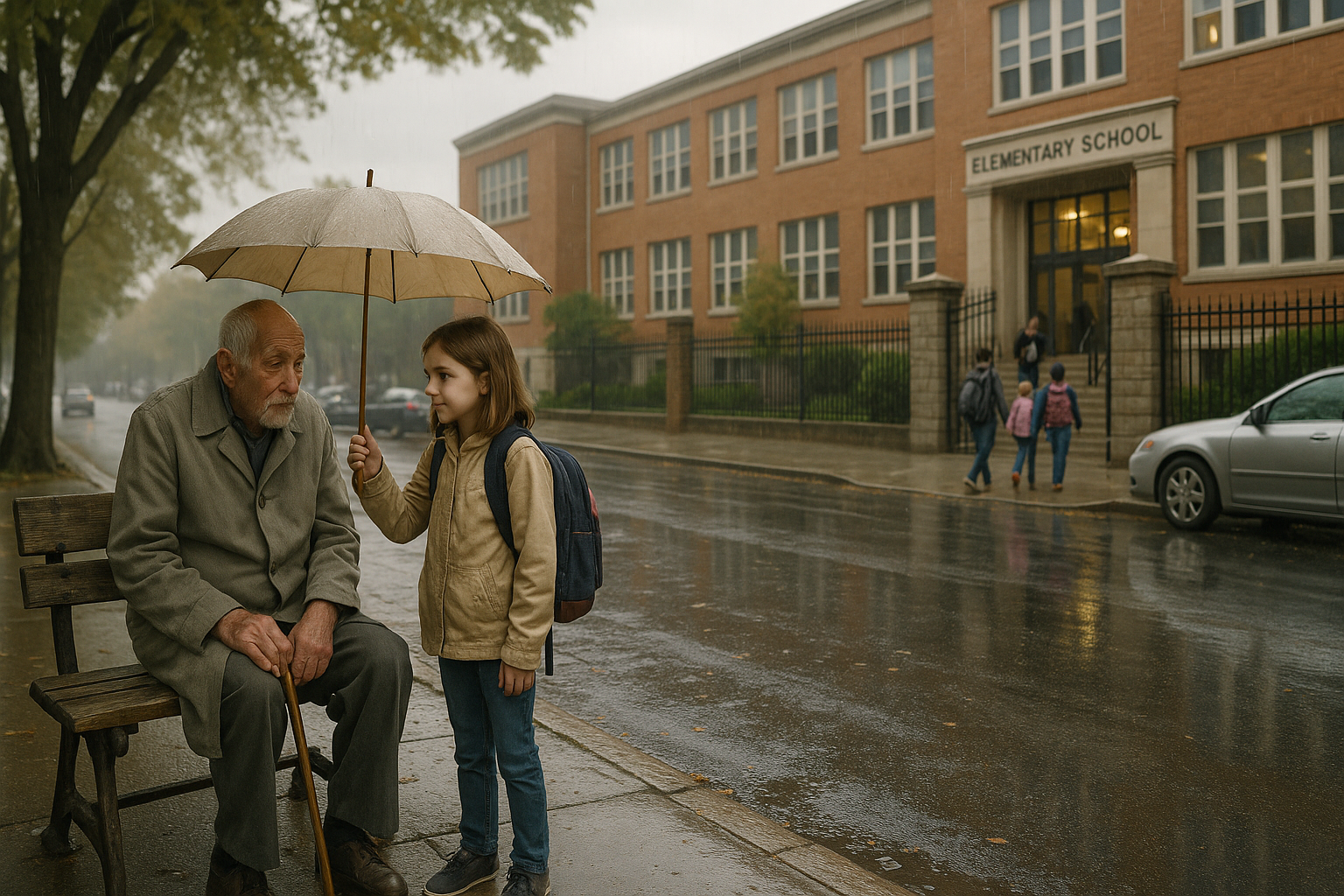
The old man kept staring at the school gate every afternoon, until one rainy day a girl finally walked up to him and asked the question no one else dared to ask.

He sat on the same broken bench across from the school, a thin figure in a washed-out gray coat. Children rushed past him every day, laughing, pushing, arguing about homework. Parents checked their phones, honked from cars, waved backpacks in the air. Only he stayed still, hands folded on a wooden cane, eyes glued to the gate like he was waiting for someone who was always late.
At first, everybody thought he was just another lonely neighbor. Then the rumors started. Some parents said he was strange. A few warned their kids not to go near him. Teachers watched from the windows, worried, but he never moved closer, never spoke to anyone. He simply sat and waited.
Mia noticed him on her first week at the new school. Eleven years old, a backpack too big for her narrow shoulders, she walked home alone because her mother worked double shifts at the hospital. Every day at 3:30, the old man was already there; every day, when the last child disappeared, he stayed, staring at the gate a few minutes longer, then slowly stood up and walked away.
One Thursday the sky turned heavy and dark. By the last bell, rain was pouring like it had been waiting all day too. Parents ran with umbrellas, children squealed and jumped over puddles. Through the blur of water, Mia saw the old man on his bench, his thin coat already soaked.
She hesitated under the school entrance roof. Her mother was late; the message on her phone said, “I’m sorry, sweetheart, 20 minutes more, emergency at work.” The security guard pulled his hood up and locked the side gate, glancing suspiciously toward the bench.
“He’s still there,” Mia muttered.
“Who?” her classmate Noah asked, zipping his jacket.
“That man. He’ll get sick,” she said.
Noah shrugged. “My dad says not to talk to him. Says he’s weird. Maybe he likes watching kids.”
The word stuck under Mia’s ribs like a splinter. She thought of her grandfather, who had died the year before, sitting by the window every day, waiting for a son who never came to visit.
“Weird doesn’t always mean bad,” she said quietly.
Noah rolled his eyes and ran to his father’s car. Within minutes, the parking lot emptied. The rain grew louder. The old man still hadn’t moved.
Mia felt the cold creeping into her sneakers. She looked from the bench to the road, then back again. Her heart thumped too fast for such a small decision.
She took a breath and ran across the street.
Up close, he looked even older. Deep lines marked his face; his eyes were pale but clear. Drops of rain clung to his sparse white hair. His coat smelled faintly of medicine and wet wool.
“Sir,” Mia said, voice shaking more from nerves than from cold, “you’re getting soaked.”
He blinked in surprise, as if he hadn’t seen her approach. Slowly, his gaze focused on her.
“I’m fine,” he answered hoarsely. “You should stay under the roof, child. You’ll catch a cold.”
“You will too,” she insisted stubbornly. “Why don’t you wait somewhere dry?”
He looked back at the gate. For a moment, something flickered in his eyes—hope, fear, both at once.
“She might come,” he whispered.
Mia frowned. “Who?” she asked, though deep down she already guessed.
“My granddaughter,” he said. “Her name is Lily. She is ten. Or maybe eleven now. She used to go to this school.”
Mia’s heart clenched.
“Used to?” she repeated.
He nodded. “My son moved away after my wife died. Said it would be easier. New city, new start. They didn’t leave a number. I only had the name of the school. So I come here. Every day. Just in case.” He smiled apologetically, as if embarrassed by his own hope.
Mia swallowed. “How long have you been coming?”
He looked at his spotted hands. “Two years,” he said softly.
For a moment, the rain was the only sound between them.
“What if she doesn’t study here anymore?” Mia asked gently.
He nodded. “Maybe she doesn’t. But if she ever… if she ever comes back, I want her to know I was here. That I tried.”
The simplicity of his words hit Mia harder than any cruel rumor. She thought of the empty chair at her kitchen table, where her father used to sit before he left “for a while” and never returned. No one had waited for him. No one had sat on a bench.
“What does she look like?” Mia asked.
His eyes brightened. “She has hair like the sun. Always messy. She laughs with her whole face. She used to draw me pictures of princesses riding bicycles.” He chuckled, then coughed.
Mia took off her backpack and dug out the small folding umbrella her mother made her carry. It was barely big enough for one.
“Move a little,” she said.
He scooted over as far as his stiff legs allowed. She opened the umbrella and held it above both their heads. Her shoulder immediately ached from stretching, but she didn’t lower her arm.
He stared at her profile. “You don’t even know me,” he murmured.

“You’re someone’s grandpa,” Mia answered. “That’s enough.”
They sat in silence, listening to the rain hit the umbrella’s thin fabric.
The twist came the following week.
By then, Mia had learned his name—Daniel—and that he lived alone in a one-room apartment three bus stops away. Every day she would wave to him from the gate. Sometimes, if her mother was late, she would sit with him for a few minutes, sharing crackers, stories about school, and the weight of waiting.
One Monday, a black car stopped near the bench. A woman stepped out, holding the hand of a slim girl with light brown hair.
The girl froze when she saw Daniel.
“Mom,” she whispered, “that’s him. The man from the picture.”
Mia, standing near the gate, felt her breath catch.
The woman’s face was tight, guarded. She approached slowly. Daniel, lost in his thoughts, didn’t notice until the girl let go of her mother’s hand and walked right up to him.
“Grandpa?” she asked.
The cane slipped from his fingers and clattered onto the wet pavement. He stared at her like he was afraid she would vanish if he blinked.
“Lily?” he said, voice breaking.
The girl nodded, tears already spilling down her cheeks.
Mia watched, chest aching, as they looked at each other—no dramatic hugs, just two pairs of eyes that had been empty for too long and were suddenly too full.
The woman cleared her throat. “My name is Anna,” she said stiffly. “I’m Lily’s mother. We moved back last month. I… I saw you from the car last week. Lily recognized you from old photos. I wasn’t sure if…” Her voice faltered. “I wasn’t sure you wanted to see us.”
Daniel let out a broken laugh. “I have been sitting here every day for two years,” he said. “Of course I wanted to see you.”
Anna looked down, ashamed. “Your son—my ex-husband—he didn’t tell you we moved. He said you were better off without us. I… I believed him for too long.”
Mia’s stomach twisted. So it had been a lie. Not a simple drifting apart, but a deliberate cutting of ties—like someone had hidden all the letters, blown out all the candles, and then told the old man the world had gone dark on its own.
Lily stepped closer. “Grandpa, can… can we start again?” she asked.
He nodded, tears streaming openly now. “If you still want an old man who sits on benches,” he whispered.
Lily smiled through her tears. “I do.”
Anna’s shoulders finally dropped. She exhaled as if she had been holding her breath for years.
Mia realized her own cheeks were wet. She wiped them quickly when she saw her mother’s car pull up.
“Mia!” her mother called. “Sorry I’m late again. Who are you looking at?”
Mia turned back to the bench. Daniel was surrounded now: Lily talking fast with the desperate joy of a child afraid the moment might disappear, Anna asking soft practical questions about doctors and medicine and rent. The bench didn’t look so broken anymore.
“Just… a grandpa who finally stopped waiting,” Mia said quietly.
On the drive home, her mother glanced at her in the rearview mirror. “You’re very quiet. Everything okay at school?”
Mia looked out at the passing streets, at all the windows and doorways where someone might be waiting for someone else.
“Mom,” she said, carefully, “if I ever get lost… will you wait for me like that?”
Her mother’s hand tightened on the steering wheel. “I will spend my whole life waiting for you, if I have to,” she answered. “But I’ll also spend every minute trying to find you, so I don’t have to wait at all.”
That night, Mia took a piece of paper and wrote three sentences very neatly:
“Dear Dad,
There is a grandpa who waited two years on a bench for his granddaughter. She came back. Maybe you can come back too. I’ll be waiting at the window.”
She didn’t know where to send it. She folded it anyway and slid it under the sugar jar on the kitchen counter.
The next afternoon, when she left school, the bench was no longer occupied by a lonely old man. Daniel sat between Lily and Anna, three backpacks at their feet. He saw Mia and lifted his hand.
This time, when he looked at the school gate, it wasn’t with empty hope. It was with quiet gratitude—for the girl who had dared to ask a question in the rain, and for the child he had finally stopped waiting for.
Mia waved back, hugged her backpack to her chest, and walked home a little slower, imagining a day when maybe, just maybe, someone would ring their doorbell and ask if Mia still lived there.
Until then, she decided, she would keep the letter under the sugar jar and her heart open like an umbrella over a stranger on a broken bench.