The boy everyone thought was stealing bread from the school cafeteria was actually trying to save his father, but nobody bothered to ask him why.

Liam was twelve, thin as a pencil, with those big, watchful eyes that always seemed older than his classmates’. Teachers said he was quiet, distant. Kids said he was weird. The only person who used to say he was “just tired” was his mother, Emma. But she wasn’t there anymore.
She had died suddenly the previous winter, leaving Liam and his father, Daniel, alone in a small apartment that still smelled faintly of her shampoo. Daniel, who had once come home with paint on his hands and jokes on his lips, now came home with hospital wristbands and a cough that rattled the walls.
Money disappeared faster than Emma’s clothes from the closet. First went the television, then the good chairs, then the car. Daniel had lung disease that made every breath sound like tearing paper. He could no longer work at the construction site; some days he could barely stand. The tiny disability payment was swallowed by rent and medication. Food was whatever was left.
Most nights, it wasn’t much.
Liam started to notice how his father’s hands shook when he stood up too quickly, how his cheeks hollowed, how he quietly pushed the last slice of bread toward his son and pretended he wasn’t hungry.
“I’m fine, champ,” Daniel would say, staring at the empty table. “You eat. I had something earlier.”
But the trash can stayed empty. The fridge, too.
At school, the smell of the cafeteria hit Liam like a punch. Warm bread, soup, something with cheese. He ate his standard free lunch in a few quick bites, the taste of guilt coating his tongue. At home, half of a sandwich waited, if he was lucky. For his father, nothing.
The first time he slipped an extra bread roll into his backpack, his hands wouldn’t stop shaking. He had watched the older boys do it for fun, laughing as they stuffed pockets with cookies and fries. No one shouted at them. No one dragged them aside.
He told himself he was just copying them.
That night, when he placed the slightly crushed roll on the table, Daniel frowned.
“Where’d you get that?”
“They gave us extra today,” Liam lied, heart hammering. “Some kids didn’t want theirs.”
Daniel hesitated, then tore the roll in half, pushing a piece back to his son. But when Liam pretended to be full, his father, too tired to argue, finished it. His eyes closed for a second, as if that small piece of bread had reached somewhere deep inside him.
The next day, Liam took two rolls.
It went like that for weeks. Bread, sometimes an apple, once a small carton of milk carefully hidden in his backpack between notebooks. He never took much, only what he could carry without being noticed, only what he thought would keep his father from collapsing.
He didn’t see the cafeteria worker watching.
Mrs. Greene had worked at the school for fifteen years. She believed in rules and order, in neat lines and counted trays. She also believed children lied. When she saw the skinny boy with the too-big backpack hover a little too long over the bread basket each day, her mouth tightened.
On a rainy Thursday, when the sky was the color of old steel, she decided it was enough.
Liam slipped the roll into his bag like always. He tried to act normal, but he could already picture his father’s face when he saw it, the small, shy smile that had started to come back. He turned toward the exit.
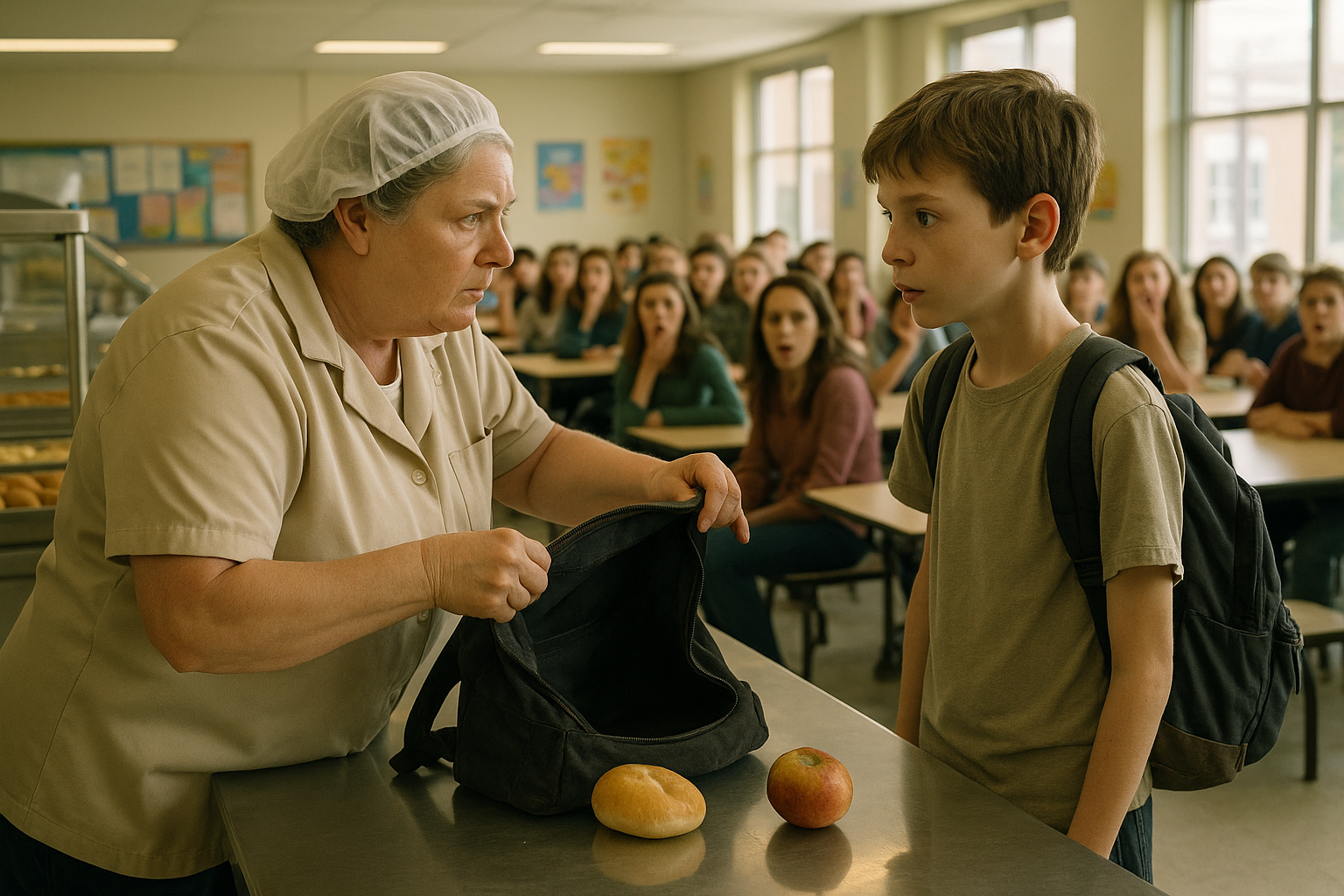
“Liam Walker,” Mrs. Greene’s voice sliced through the clatter. “Come here.”
The entire cafeteria seemed to lean in.
His legs felt heavy as he walked toward her. She reached for his backpack before he could react, unzipping it with sharp, angry movements. The roll tumbled out onto the counter, followed by a bruised apple.
“There it is,” she said loudly. “You’ve been stealing from the school.”
Heat flooded Liam’s face. The room filled with whispers and stifled laughs. Someone at a nearby table muttered, “Knew it. Freak.”
“I—I’m not—” he started, but the words shrank in his throat.
She didn’t ask why. She didn’t ask anything.
By afternoon, he was sitting in the principal’s office on a hard chair, his backpack at his feet like a guilty pet. Mr. Harris, the principal, sighed behind his desk, fingers steepled.
“Liam, this is serious,” he began. “We have cameras, you know. This isn’t the first time.”
Liam stared at his shoes. A dark spot on his sneaker reminded him of the leak above his bed. He thought of his father at home, counting his pills, waiting.

“Stealing is wrong,” Mr. Harris continued. “You could have asked if you were still hungry. We have resources. But hiding food in your bag—”
“I wasn’t hungry,” Liam blurted, surprising himself.
Mr. Harris paused. “Then why?”
Liam’s eyes burned. For weeks, he had carried this secret like a stone. Saying it out loud felt dangerous, like stepping off a roof and hoping for wings.
“For my dad,” he whispered. “He’s sick. He doesn’t eat.”
There was a silence so deep he could hear the ticking of the clock on the wall.
Mr. Harris frowned, the practiced disappointment on his face faltering. “Where is your father now?”
“At home. He—he can’t work. We don’t… we don’t always have food.”
The principal opened his mouth, then closed it again. He looked down at the file in front of him, at the attendance records, the notes from teachers about a “tired, distracted” boy, at the emergency contact line with only one number.
“Why didn’t you tell anyone?” he asked, softer now.
Liam’s throat tightened. “You were all… busy. And when Mom died, everyone came for a week. Then they stopped. I thought if I said something, you’d just look at me like… like I was a problem.”
Those words landed heavier than any accusation.
That evening, while Liam sat on his bed, bracing himself for whatever punishment would come, there was a knock at their apartment door. Daniel, pale and unsteady, opened it.
On the threshold stood Mr. Harris and Mrs. Greene, each holding a heavy grocery bag.
“Good evening, Mr. Walker,” the principal said, clearing his throat. “We… need to talk.”
Liam stepped into the hallway, eyes wide. Mrs. Greene couldn’t look at him at first. Her usually pinched face was strangely soft.
“I didn’t know,” she said in a low voice. “I should have asked. I just saw… what I expected to see.”
On the kitchen table, the bags spilled over with bread, pasta, fresh fruit, vegetables, canned soup. More food than Liam had seen in their home since his mother’s funeral. Daniel gripped the back of a chair as if it were the only thing holding him up.
“I can’t accept—” he began, but his voice cracked.
“You can,” Mr. Harris said firmly. “This is from the school’s emergency fund and some staff. And there will be more. We’ve arranged meal deliveries and a home visit from a social worker. Liam should never have had to solve this alone.”
Liam stared at them, at the food, at his father’s trembling shoulders. Something in his chest, wound tight for months, loosened until a sob escaped before he could stop it.
He expected anger. He expected lectures. Instead, he felt his principal’s hand hover near his shoulder, not quite touching, but there, solid and steady.
“You’re not in trouble anymore,” Mr. Harris said quietly. “But you have to promise me something. Next time… don’t steal. Just knock on my door.”
Liam nodded, tears blurring the room into soft shapes.
That night, they ate warm soup and fresh bread at a table that finally looked like a place where a family lived, not where it had once lived. Daniel watched his son across the bowl, his eyes shining.
“I’m sorry you had to be the adult,” he whispered.
Liam shook his head. “You’re still my dad.”
Outside, the building was the same. The world was still hard and unfair and loud. But somewhere between the cafeteria and the principal’s office, between a stolen roll of bread and two grocery bags on a worn-out table, something had shifted.
For the first time in a long time, someone had finally asked him why.
And for the first time, when he answered, someone had listened.