A sentence that shattered two families
The trial stretched on for weeks — witness testimonies, timelines built from body camera footage, and expert reconstructions followed one another. In the end, the verdict was clear: the officer was guilty of professional negligence during an operation that ended in tragedy. Seven years. There was no celebration. Just a judgment that sounded like a door slamming shut for two families at once.
A request no one expected
When he was given his final word, the officer didn’t defend himself. He didn’t blame anyone. In a hoarse voice, he said only this: “Let me say goodbye. Let me ask him — and you — for forgiveness.” The judge hesitated for a moment, then nodded to the guards. Permission was granted — under supervision.
Rain at the cemetery
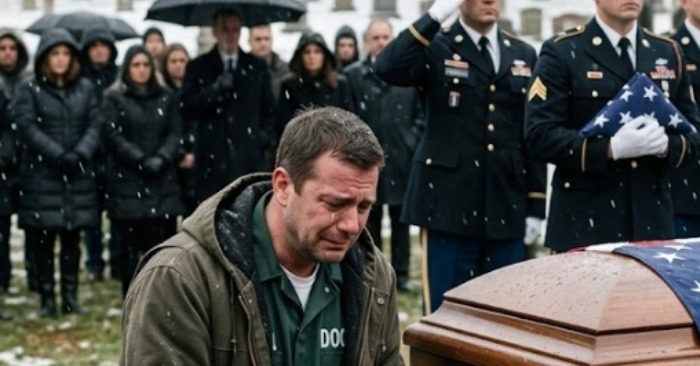
The sky seemed to grieve with them. A thin, cold rain fell over black coats and folded flags. Fellow officers stood at attention. Friends clutched handkerchiefs. The officer’s mother remained at the back, pulling her scarf tightly around herself, her lips forming her son’s name as if that alone could keep him there for one more heartbeat.
The man in orange
Engines idled softly, doors opened. The man stepped out in prison attire, steel cuffs on his wrists, his head lowered. Whispers moved through the crowd: his decision… his mistake… his responsibility. The escort cleared a path. He stopped before the coffin, where a badge and a cap rested — like a promise.
WORDS AT THE COFFIN
He knelt. Rain and tears merged on his face. “My brother… I’m sorry. If I could, I would trade places with you. I wake up with your name and fall asleep with your laughter. If there’s any way to make this right, show me — and I will walk it.” No one moved. Even the rain seemed to quiet.
A mother steps forward
Then the fallen officer’s mother stepped out of the crowd. One step… then another, until she reached the kneeling man. She held a damp handkerchief in her hand and looked at him the way only a mother can — seeing both the worst day of someone’s life and the boy he once was.
The moment that changed everything
She lifted the handkerchief and gently wiped the rain from the man’s face. “Look at me,” she said softly, but firmly. The man obeyed. The cemetery held its breath.
“My son chose this profession because he wanted to serve — not to hate,” she said. “I will not bury him with bitterness. I cannot carry that weight, and I will not call it love.”
She turned to the guards. “One minute,” she asked. The commander looked at the chaplain, then nodded. The handcuffs clicked open.
THE MOTHER TOOK THE MAN’S HAND, PLACED HER SON’S MEDALLION INTO HIS PALM, AND CLOSED HIS FINGERS AROUND IT. “WHAT YOU WILL CARRY OF HIM IS WHAT YOU DO NEXT,” SHE WHISPERED. “STAND UP. COME WITH US. YOU WILL CARRY ONE CORNER OF THE COFFIN.”
Silence — then a different kind of respect
At first, stunned gasps. Then complete silence. The honor guard adjusted. The mother took her place. The widow nodded through tears. And the man everyone had blamed stepped forward — not as a scandal, but as a bearer of weight.
Together, they lifted the coffin. Together, they walked that slow, measured path — the shortest and longest road at the same time.
After the shock
No speeches were given. No cameras flashed. Only the rain tapped against the wood, and the first dull sound of earth falling was heard. Later, the mother wrote to the court and the department — not to erase responsibility, but to ask for a path that not only punishes, but also heals.
Expanded trauma training, better preparation, mentorship programs for young officers, and the possibility of restorative service — when the time comes.
A different kind of justice
IN THE MONTHS THAT FOLLOWED, NEW RULES WERE INTRODUCED FROM HARD-LEARNED LESSONS. THE SENTENCE REMAINED — BUT SO DID THE MOTHER’S REQUEST. THE MAN TOOK PART IN TRAININGS, CREATED SAFETY MATERIALS, AND WHEN POSSIBLE, SPOKE TO RECRUITS ABOUT THE PRICE A SINGLE DECISION CAN CARRY.
A scholarship was established in the fallen officer’s name — focused on communication, conflict management, the parts that never make headlines, yet save lives.
What we carry forward
People still talk about that day when the handcuffs came off in the rain. Some remember the shock. Others remember the silence. But the mother holds on to something else: the shared weight.
And the man carries the warmth of a coin in his palm — and the first step toward a life that might one day be worthy of the one he could not save.
A quiet lesson
Forgiveness is not the absence of consequences. It is the refusal to let grief turn to stone. On that rainy afternoon, a mother chose love — the kind that can hold two truths at once: this should never have happened… and we will not let this be the only thing that defines us.
Remembering with love
MAY WE BUILD COMMUNITIES WHERE COURAGE MEANS RESPONSIBILITY, EMPATHY IS A LEARNED SKILL, AND THE STRONGEST HANDS ARE THE ONES THAT HELP CARRY THE BURDEN.