The day Daniel carried his mother into the school cafeteria, everyone started whispering — but nobody knew it was the only way he could keep her from starving.

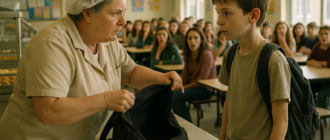
He felt their eyes before he saw them. Phones half-raised, trays stopping midair, the sharp metal sound of a fork dropping. It was lunchtime at Westbrook High, loud and bright, but as Daniel stepped through the doors with his mother in his arms, the noise thinned to a stunned, nervous buzz.
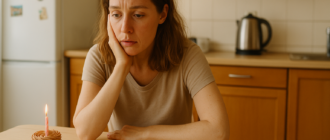
His mother, Laura, buried her face in his shoulder, fingers clawed into the fabric of his hoodie. Her hair, once thick and chestnut, hung in brittle, uneven strands. The wheelchair they couldn’t afford waited outside in the hallway; today, she hadn’t been able to push herself even that far.
“Just a few minutes,” Daniel whispered, adjusting his grip. “Then I’ll take you home, okay?”
She nodded, lips pressed tight, trying not to cry in front of the cluster of teenagers who pretended not to stare.
Two months ago, she would have walked in by herself, laughing too loudly, embarrassing him with jokes. Two months ago, there had still been a job at the bakery, still been a father who came home at night. Two months ago, cancer had been just a word other families whispered.
Now his father was gone — one suitcase, a muttered apology, and a closed door — and the only steady sound in their apartment was the oxygen machine in the corner.
“Daniel, you can’t,” the principal had said that morning in his office. “Having your mother here during school hours is… it’s against policy.”
“Policy doesn’t feed her,” Daniel had answered, surprising himself with the steel in his own voice. “We have no food left at home. Her disability check is delayed again. This is the only place where I can get her a hot meal today.”
The principal had looked away then, jaw tight, fingers tapping his desk. “One day,” he finally said. “Just today. And she must stay in the cafeteria.”
So here they were.
Daniel lowered Laura carefully into the nearest chair. Her hands shook as she tried to smooth her thrift-store skirt. He set his backpack on the table, unzipped it, and pulled out two plastic containers he’d begged from the lunch lady.
Anna, the lunch lady who had watched him grow from a scared eleven-year-old to this tall, tired seventeen-year-old, appeared at his side with a tray.
“I added a little extra,” she murmured, placing down two plates loaded with soup, bread, and something that almost looked like chicken. Her eyes were red. “Eat while it’s still hot.”
“Thank you,” Daniel said, the words too small for the ache in his chest.
He pushed one plate toward his mother. Her hands hovered above the spoon, hesitating.
“They’re looking,” she whispered. “I don’t want you to be ashamed of me.”
He swallowed hard. “I’m not ashamed. I’m angry. That’s different.”
She let out a broken laugh, then lifted the spoon. He watched her eat, slow and careful, as if each bite had to be negotiated with her body.
At the next table, someone snickered. Daniel turned just in time to see a girl — he thought her name was Megan — nudge her friend and whisper, eyes pointed at Laura’s thin arms and borrowed scarf.
Heat rushed up his neck. For a second, he wanted to shout, to tell them about nights spent counting pills, about overdue bills taped to the fridge like threats. About the way his mother apologized every time she coughed, as if sickness itself were a personal failure.
Instead, he stared back until Megan dropped her gaze.
Then, halfway through the meal, the twist came.
A voice from behind him said, shaky but loud enough for everyone to hear, “I know her.”
Daniel turned. Mr. Harris, the history teacher who always wore wrinkled shirts and mismatched ties, stood in the cafeteria doorway, his tray trembling in his hands.
His eyes were fixed on Laura.
“Laura?” he breathed.
Laura looked up, soup spoon halfway to her mouth. Her eyes widened. The color drained from her face.
“Ethan?” she whispered.
The cafeteria dissolved into white noise as they stared at each other. Daniel’s mind raced — Ethan? Who was Ethan?
Mr. Harris set the tray down with a clatter and took a hesitant step forward. For the first time since Daniel had known him, the teacher looked completely unmoored.
“I thought…” he started, voice breaking. “I thought you moved away.”
“We did,” Laura said, her voice paper-thin. “After they… after we lost them.”
Them? Daniel’s pulse pounded in his ears.

“Mom?” he asked. “What is going on?”
Laura squeezed her eyes shut for a moment, then opened them, forcing herself to look at both men — the boy she had raised and the man she had clearly once known very well.
“Ethan and I…” she began, then stopped, breath hitching. “We used to work together. At the old hospital. Before you were born, Daniel.”
Mr. Harris swallowed. “We didn’t just work together, Laura. We were engaged.” He looked like the room was tilting under his feet. “You disappeared. No note. Nothing. I thought you… I thought something terrible had happened.”
The words hit Daniel like ice water. “Engaged?” he repeated.
Laura’s hands shook so violently the spoon clinked against the bowl.
“Your grandmother,” she said hoarsely, “she hated Ethan. Said he wasn’t stable, that we would never be safe with him. I was young. Scared. She made me choose — him or my family. So I left. And then I met your father. I told myself I did the right thing.”
Mr. Harris took another step closer, eyes glistening. “And now I find you here, like this. Sick. Struggling. Alone.”
“Not alone,” Daniel snapped, even as the ground seemed to shift beneath him. “She has me.”
Laura reached for his hand, but her fingers barely brushed his.
“I’m sorry,” she whispered to both of them, the apology years too late and yet somehow still not enough.
Silence wrapped the table, thick and suffocating. Around them, the cafeteria slowly remembered how to breathe — conversations stuttered back to life, trays scraped, chairs moved. But a thin ring of distance remained, an invisible circle around the three of them.
Then Mr. Harris straightened, wiping his face quickly with the back of his hand.
“Daniel,” he said, voice steadier now, “how long has it been like this?”
The boy hesitated, then gave up on pride. He told him. About the diagnosis, the job lost, the father who had vanished when the word “oncology” appeared on the bill. About skipped meals, about pretending he wasn’t hungry so his mother would eat. About carrying her up three flights of stairs when the elevator broke.
By the time he finished, Anna the lunch lady was standing a little closer, and the school nurse had quietly moved from the doorway into the room, listening with a hand pressed over her mouth.
Mr. Harris looked at Laura, then at Daniel. Something in his expression shifted — from shock to resolve.
“I’m so sorry I wasn’t there then,” he said softly. “But I can be here now. If you let me.”
Laura flinched, tears spilling over. “Ethan, you don’t owe us anything.”
“Maybe not,” he answered. “But I owe that girl I loved more than my own future. I owe her son, who is carrying her into a school cafeteria because the world failed both of you.”
He turned to Anna. “Can we set up something? A way for them to pick up extra food every day? No questions asked.”
Anna nodded immediately, jaw set. “We’ll make it work.”
The nurse stepped closer. “There are patient assistance programs. Hospital charities. You shouldn’t be handling this alone, Daniel. I’ll help with the paperwork.”
Daniel blinked fast, throat too tight for words.
In the days that followed, the story spread through the school — what had really happened that day in the cafeteria. The whispers changed. Megan, the girl who had snickered, left a bag of groceries on Daniel’s doorstep with a note that said only, “I’m sorry.” Teachers quietly pooled money for medicine. The principal “found” a scholarship for students in difficult situations.
And every afternoon, when the final bell rang, Mr. Harris would walk with Daniel to the bus stop, talking not just about history, but about power bills, treatment plans, and how to stretch a bag of rice for three days.
One evening, as they helped Laura from the bus to the apartment, she paused on the landing, breathing hard.
“I never wanted you to see me like this,” she said to both of them. “Weak. Needing help.”
“Mom,” Daniel said gently, “you carried me for years. It’s my turn.” He looked at Mr. Harris, then back at her. “Our turn.”
Her eyes filled again, but this time there was something softer in them, something like release.
The world had not suddenly become fair. The treatments still hurt, the bills still came, and some nights Daniel still lay awake, counting fears instead of sheep. But he no longer did it alone.
Sometimes, when the cafeteria was noisy and bright and full of life, a tired history teacher would glance at the doorway, half-expecting to see a younger version of Laura walk in, laughing, unbroken. Instead, he would see Daniel passing through with a tray, setting aside an extra bowl of soup to take home.
And every time, Mr. Harris would feel the same sharp twist in his chest — regret for the years lost, and a fierce, aching gratitude that on the day the boy carried his mother into the school cafeteria, he had been there to see it, and to finally step forward instead of turning away.