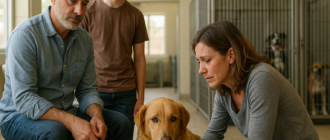
The boy who kept returning the same dog to the shelter every Sunday wrote one short note that made the volunteers burst into tears.

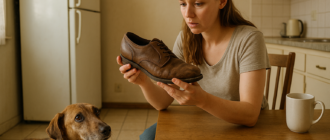
At first, the staff thought it was some kind of cruel game. Every Monday morning, Lena, the volunteer coordinator, would open the shelter door and see the same picture: a small brown dog named Lucky, sitting quietly by the entrance, and next to him a torn plastic bag with a few dog treats and a folded piece of paper.
The first note was simple: “Please take care of him for a week. I will bring him back home soon. – Adam.” The handwriting was clumsy, childlike. There was no phone number, no address.
On Tuesday afternoon, a skinny boy of about twelve came to the shelter. He stood in the doorway, clutching a backpack to his chest, and asked in a hoarse voice:
“Is Lucky here?”
When the dog saw him, he exploded with joy – jumped, whined, licked the boy’s hands through the bars. Adam’s face lit up, but his eyes stayed strangely adult, heavy.
“You know, you can adopt him officially,” Lena said carefully. “We’ll just need your parents to sign some papers.”
Adam’s fingers froze on the dog’s fur.
“I can’t,” he whispered. “Not yet. But I will. I promise.”
He took Lucky home that day. The volunteers watched them leave: the boy in an oversized gray hoodie, the dog glued to his leg, checking every step.
On the next Monday, Lucky was back at the door.
This time the note said: “He was a very good boy. He didn’t bark at night. He even licked my grandma’s hand when she cried. Please keep him for a few days. I’m sorry. – Adam.”
Lena frowned. Something was wrong. She asked her colleagues if anyone had seen where the boy went, but no one had noticed. The shelter cameras weren’t working that week.
The pattern repeated itself. Adam would appear on Tuesdays or Wednesdays, take Lucky, disappear with him for a few days, then the dog would reappear at the door on Monday morning, always with a new note.
“He helped me fall asleep when I was scared.”
“He listened when I talked about my dad.”
“He didn’t touch the food I left for later, even when he was hungry.”
Each message was like a little fragment of a life that none of them could see.
After the fifth Monday, the director of the shelter suggested they stop giving the dog to the boy.
“It’s not normal,” she said. “The animal is stressed. The boy might be unstable. We have responsibility here.”
Lena agreed, in theory. But when Adam came again – thinner, with blue shadows under his eyes – and Lucky howled at the sight of him, pressing his whole body against the bars, she couldn’t say no.
“Adam,” she tried again, “we need to talk to your mom or dad. We can’t keep doing this without an adult.”
“My mom is… busy,” he replied, staring at the floor.
“And your dad?”
He shrugged.
“He went away. To another city. For work.” The pause before “for work” was too long.
“Where do you live?”
“Close,” he said quickly. “Really close. I promise, Lucky is safe with me. I just… sometimes I need to bring him back here. Just for a while.”
“Why?” Lena asked softly.
He looked up. For a second, she saw sheer panic in his eyes.
“Because some days I don’t know if we will still have a home in the morning,” he blurted out. “When they knock on the door, Lucky barks, and they get angry. If they see him, they might take him away to somewhere bad. Here he is safe, right? You are good people.”
Lena’s throat tightened.
“Who is ‘they’, Adam?”
He bit his lip, then shook his head.
“Please, can I take him today? I brought food for him. And medicine for his ear. I asked the pharmacist what to buy.” He pulled a small crumpled box from his backpack.
Lena signed the temporary foster form again, this time writing her own phone number at the bottom and circling it.
“If anything happens, you call me. Any time. Day or night.”
He nodded seriously and carefully copied the number into his notebook.

The twist came two weeks later.
That Monday, Lucky didn’t appear.
The entrance was empty. No torn plastic bag, no note. The volunteers tried to convince themselves that maybe, finally, the boy had been able to keep the dog.
On Tuesday evening, just as Lena was closing up, she heard a scratching at the door. Lucky stumbled inside – dirty, trembling, with a frayed rope around his neck. There was a bandage on his side, clumsily taped. A note was stuck under the rope, folded many times.
The paper was damp, the ink smudged, some words almost unreadable.
“Dear shelter,” it read, “I’m sorry I couldn’t bring him myself. They came at night and told us to leave the apartment in the morning because we owe too much. Mom cried a lot. She said we can’t take Lucky. I waited until she fell asleep and took him out. I wanted to walk him to you, but I fainted in the stairs. The neighbor found us. She said I have to go to the hospital now with mom. I tied Lucky to a bench near your street and told him to go home. He knows the way. If he came, please don’t give him to anyone else yet. I will come back when we find a place to live. I promise. Please believe me. He is the only family I chose myself. – Adam.”
On the back of the note, in even shakier handwriting, it said: “If I can’t come back, can you tell Lucky that I tried?”
Lena pressed the crumpled paper to her chest. Her colleagues stood in silence. Lucky lay on the floor, his muzzle on his paws, as if he understood every word.
They called hospitals, social services, schools. But “a boy named Adam” without a last name was like a shadow. No one could find him.
Days turned into weeks. Lucky waited by the door every evening, ears pricked at every noise outside. He refused to sleep in his cage, choosing instead the cold floor by the entrance.
Potential adopters came and went. He was friendly, gentle, perfect for a family. But every time someone showed serious interest, Lucky would rush to the door, whining, and Lena would suddenly find a reason why this dog wasn’t quite right for them.
“He’s still under treatment.”
“He’s not good with children.” (He adored children.)
“We need to observe his behavior a bit longer.”
One Sunday, as the sun flooded the small shelter yard with warm light, a middle‑aged couple arrived. They had that tired kindness in their eyes that made Lena trust them immediately.
“We saw him on your website,” the woman said, pointing at Lucky’s photo. “The brown one with the white spot on his chest. He looks like the dog my brother had as a child. We would love to give him a home.”
Lucky wagged his tail politely, but kept glancing at the door.
Lena felt a sharp pain in her chest. This was exactly the kind of home every shelter dog dreamed of.
“You can meet him,” she said. “But… there is something you should know.”
She brought them inside, gave them water, and silently handed them the stack of notes Adam had left.
The couple read in silence. The woman’s lips trembled. The man cleared his throat several times.
When they finished, the woman carefully put the papers back on the table.
“We will take him,” she said firmly. “But we won’t change his name. And… if that boy ever comes back, you will give him our address. Lucky will always be his dog too. We can share.”
Lena suddenly realized she’d been holding her breath.
“Are you sure?” she whispered.
“I am,” the woman nodded. “Our house is big. Our table always has one extra plate. If he ever knocks on our door, we will say: ‘Welcome home.'”
They signed the adoption papers. Lucky hesitated at the exit, looking back one last time at the shelter door, then stepped forward, pressed against the woman’s leg.
Before he left, Lena knelt down and fastened a small metal capsule to his collar. Inside was a tightly rolled piece of paper.
“If you see him,” she murmured into Lucky’s ear, “you know what to do.”
The note inside the capsule was short:
“Adam, we found you a safe place. Lucky is waiting for you here. He never stopped. – The shelter people.”
Months passed. Every time the shelter phone rang after 10 p.m., Lena’s heart jumped. Every time someone young entered the yard, she caught herself searching for a too‑big hoodie and a skinny wrist clutching a backpack.
Adam never came.
But in the evenings, in a warm house on the outskirts of the city, a brown dog with a white spot on his chest would lie by the front door, ears twitching at every distant step. And on the sideboard in the hallway, under a simple wooden frame, there was a neatly smoothed crumpled note:
“He is the only family I chose myself.”
It reminded everyone in that house that somewhere out there, a boy was still fighting for a place where he and his dog could be together. And that, until the very last knock on the door, Lucky would keep waiting – just as stubbornly as Adam had kept his promises, even when the world around him was falling apart.