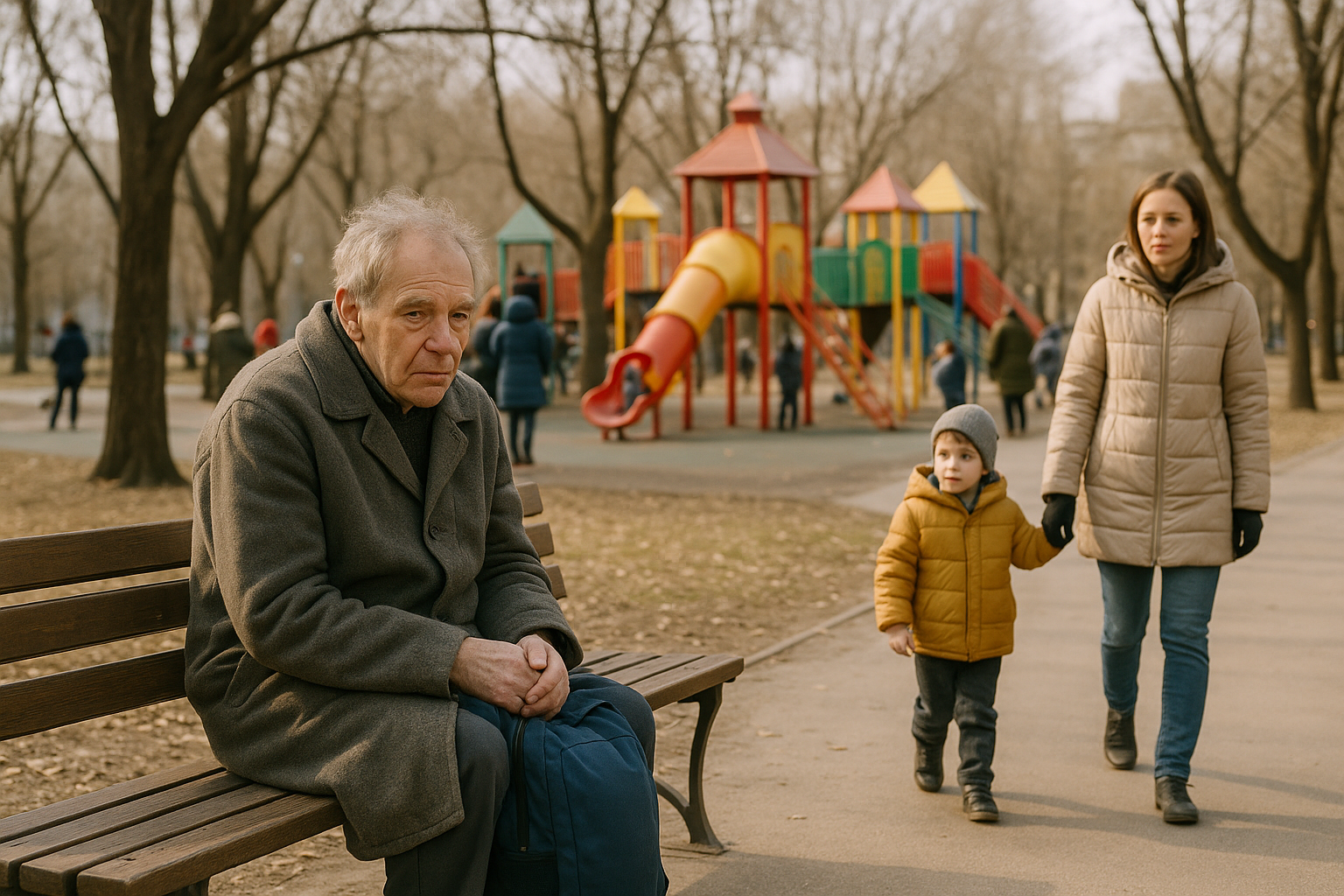
The old man kept sitting on the same park bench every afternoon, clutching a blue backpack and staring at the playground gate, until one day a little boy ran up to him and asked, “Grandpa, why are you waiting for me?”

For three weeks Emma walked through the park after work, pushing her five-year-old son Leo in a stroller half the way while he insisted he was “too tired” to walk. And for three weeks she saw him: an elderly man with a cane, in a worn gray coat, always on the same bench facing the playground.
He never talked to anyone. He just sat there with that faded blue backpack on his knees, watching the children like someone watching a movie he had seen a hundred times but could not stop replaying. Every now and then he would lift his hand, as if to wave at someone only he could see, then let it fall.
At first Emma barely noticed. The park was full of grandparents. But day after day, same bench, same backpack, same empty look fixed on the gate where parents led their kids in and out. Sometimes his lips moved silently, and once she saw him wiping his eyes when a little girl ran to hug her father.
One chilly Thursday, Leo tugged her sleeve. “Mom, that grandpa is here again. Is he waiting for his kid?”
“I don’t know, honey,” Emma said, pulling Leo’s hat over his ears. “Maybe.”
“But he’s always alone,” Leo insisted. “He looks sad.”
The word “sad” hung in the air. Emma looked at the man more closely. His coat was too thin for the season, the shoes too big, as if they belonged to someone else. The backpack’s zipper was broken and tied with a piece of string.
That night she lay awake, thinking about him. Her own father lived in another city and called once a week, always apologizing for talking too long, as if there was a limit to how much space an old man was allowed to take in someone’s life. She thought of missed calls she hadn’t returned, of messages left on read.
The next day she bought an extra sandwich at the bakery near her office and slipped a small chocolate bar into the bag. When she reached the park, the bench was occupied by the same hunched figure, the same blue backpack, the same fixed gaze.
“Leo, go play,” she said. “I’ll be right here.”
She sat down on the far end of the bench. The man glanced at her, startled, then quickly looked away.
“Good afternoon,” Emma said softly. “It’s a bit cold today.”
He nodded, clutching the backpack tighter.
“I brought too much food,” she went on, her voice casual. “Would you help me so it doesn’t go to waste?” She took out the sandwich and placed it between them, not too close, not pushing.
He stared at it, then at her, suspicious and shy at once. “I don’t take charity,” he muttered in a low, rough voice.
“It’s not charity,” Emma replied. “It’s… bad planning. I always overestimate how much I can eat.” She smiled, though her heart was pounding.
After a long pause he picked up the sandwich with trembling fingers. “Thank you,” he whispered.
They ate in silence, watching Leo climb the slide. The man chewed slowly, as if he had to remember how.
“Your boy,” he said at last. “What is his name?”
“Leo.”
“He laughs like…” The man’s voice broke. He swallowed, staring down at his hands. “Like someone I knew.”
Emma hesitated. “Do you… have grandchildren?”
He was quiet for so long she thought he would not answer. Then he unzipped the blue backpack with careful movements, like a ritual, and pulled out a crumpled photograph in a cheap plastic frame.
A little boy with dark hair grinned at the camera, missing one front tooth, holding a small toy car in his hand.
“His name is Daniel,” the man said. “Or was. I don’t know anymore what to say.”
Emma’s throat tightened. “He’s beautiful.”
The man nodded. “He used to play here. Every Saturday. His father—my son—would bring him. I worked a lot back then. I always said, ‘Next time I’ll come with you.’ Next time, next time…”
He pressed the photo to his chest. “Then my wife got sick. Hospital, medicines, appointments. I told my son I was busy. ‘Grandpa will come next week,’ I promised Daniel on the phone. He believed me.”
A gust of wind shook the bare branches above them.
“One Sunday there was an accident,” the old man continued, staring straight ahead. “A truck on the highway. My son, his wife, and Daniel were driving back from visiting her parents. Only my son survived.” His lips trembled. “They buried them on a Thursday. I arrived late; the train was delayed. I missed the speech, the last words. I missed everything.”
Emma felt her eyes burn. “I’m so sorry.”
“My son left the city after that,” he said. “He called once, told me not to look for him. Said I had always been too busy to be a father, so I didn’t need to start now. He changed his number. I never heard from him again.”
He took a shaky breath. “I come here because this is the last place I could have chosen differently. I could have been here with them. I could have said yes instead of ‘next time.’”
He looked at the playground gate as a group of children rushed in, laughing.
“I bring the backpack,” he added, patting it gently, “because it was a gift for Daniel. I bought it the day before the accident. I thought we’d go fishing together. I never gave it to him.”
Emma’s heart clenched. “What’s your name?”
“Michael.”
“Michael,” she said slowly, “how long have you been coming here?”
He considered. “Three years, maybe four. Time… is strange when you’re waiting for someone who will never come.”
At that moment Leo ran over, cheeks flushed. “Mom! Can I show my car to the grandpa?” He held out a little red toy, eyes shining.
“Ask him,” Emma said, her voice unsteady.
Leo stopped in front of Michael. “Grandpa, do you like cars?”
Michael blinked. “I… I used to. My grandson loved them.”
Leo climbed onto the bench without waiting for permission and placed the toy in Michael’s hand. “You can hold it while I play. So you’re not alone.”
Something in Michael’s face crumpled. He gripped the small car like it was made of glass.
“Thank you, Leo,” he whispered. “I will keep it safe.”

From that day on, their routine changed. Emma no longer just passed by. She sat with Michael, listening to stories about Daniel—how he hated broccoli, how he would line up his toy cars by color, how he had once cried because he thought the moon was following their car and would get tired.
Sometimes Michael repeated the same story word for word, and Emma listened every time as if it were new. Leo started calling him “Grandpa Michael” without being told to, and Michael never corrected him.
One afternoon, as they were leaving, Emma turned back and saw Michael trying to stand up, his hand slipping on the bench. For a second he swayed, and fear stabbed through her.
“Michael, are you okay?” she asked, rushing back.
He forced a smile. “Just old bones. They complain more than I do.”
“Do you live far?”
He hesitated, then shook his head. “A few streets away.”
“Let us walk you home,” Emma said. “It’s on our way.”
He started to refuse, but Leo had already grabbed his free hand. “Come on, Grandpa Michael! I’ll race you!”
They walked slowly through quiet streets. When they reached a small, crumbling building, Michael stopped.
“Here,” he said. “Thank you.”
Emma looked at the peeling paint, the broken intercom. “Do you have someone who visits you?”
He lowered his eyes. “No one. The neighbors change. People are busy. It’s normal.”
That night, after putting Leo to bed, Emma sat in the dark kitchen, phone in hand. Her father’s number glowed on the screen. She thought of unanswered calls, of “I’ll call you back later” that turned into weeks.
She pressed dial.
“Emma?” Her father’s voice was surprised. “Is everything alright?”
She swallowed. “Yes. I just… wanted to hear you. To ask if you ate. If you need anything.”
On the other end, silence. Then a soft, disbelieving laugh that sounded a little like a sob. “I’m fine, my girl. But… thank you for asking.”
Days turned into weeks. Winter crept in, but Emma brought an extra scarf for Michael, gloves for Leo, a thermos of tea for all three. The blue backpack was always there, but now it lay between them instead of being clutched like a shield.
One particularly bright, cold day, Leo asked, “Grandpa Michael, why don’t you give the backpack to me? I can use it for my toys. Then Daniel will still be playing with us, right?”
Michael froze, his hand on the worn fabric.
“I promised myself I would never give it to anyone,” he said slowly.
Leo’s face fell. “Oh. Okay.”
Emma was about to change the subject when Michael drew a long breath.
“But promises can change,” he whispered. He turned to Leo. “If I give it to you, will you sometimes think of a boy named Daniel who loved cars and thought the moon was following him?”
Leo nodded seriously. “I’ll think of him every time I play.”
Michael’s eyes filled with tears. With shaking hands he opened the backpack. Inside, carefully folded, was a tiny blue T-shirt, a plastic dinosaur still in its packaging, and a small notebook with empty pages.
“I kept these for him,” Michael said. “For stories we never wrote.”
He took out the dinosaur and placed it in Leo’s hands. “This is for you. And this…” He gave Leo the backpack. “…this is for the games you and Daniel will play together. In your head.”
Emma could barely see through her tears.
A week later the bench was empty.
At first Emma thought she was early. Then late. The second day, she told herself he must have gone to the doctor. The third day, the caretaker of the park approached her.
“Are you looking for the old man with the blue backpack?” he asked gently.
“Yes,” Emma said, her voice too loud in her own ears.
“He passed away two nights ago,” the caretaker said. “The ambulance took him from his building. He had your son’s name written on a piece of paper in his pocket, with this park’s address. I thought maybe you knew him.”
Something inside Emma broke quietly.
That evening, she sat on the empty bench, the winter air biting her cheeks. Leo played nearby, the blue backpack on his shoulders, the little red car in his hand.
“Mom,” he called, running up to her. “Look, I put my drawings in Daniel’s backpack. Today I drew the moon following our car. Do you think he can see it?”
Emma pulled him close, breathing in the scent of his hair. “I think he can,” she whispered. “And I think someone else is watching too.”
She looked at the space beside her, at the worn wood of the bench, at the playground gate Michael had watched for years.
Then she took out her phone and opened her father’s message thread. This time, she didn’t leave his last voice message unanswered. She pressed play, listening to his familiar, slightly shaky voice fill the empty park.
“Hi, Dad,” she said when the beep sounded. “It’s me. I’m… I’m sorry I kept you waiting.”
Her voice broke, but she didn’t stop.
“I won’t make you wait anymore.”
In the distance, Leo laughed, the sound carrying through the cold air. For a second, Emma almost saw another small boy running beside him, shadow-thin but bright, and an old man sitting on the bench, finally at peace, no longer waiting for a gate that would never open.