The old man next door died on a Tuesday, and only my eight-year-old son and a stray dog came to his funeral. No distant relatives, no old friends, just a bored priest, a cemetery worker, my boy Noah clutching a crumpled drawing, and a yellow dog shivering by the grave.

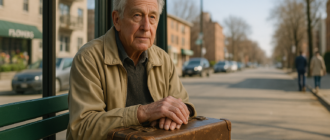
We had lived next to Mr. Harris for three years, and I had always thought of him as “the grumpy neighbor”. He shouted when the kids played too loudly, complained about the trash days, and once yelled at me because my leaves had blown into his yard. He never smiled. His curtains were always half-closed, his porch light always off.
I used to pull Noah away when he tried to wave at him. “He doesn’t like people, honey. Let’s not bother him.” I felt a vague guilt sometimes, but life was busy, and it was easy to decide that a lonely old man had chosen to be lonely.
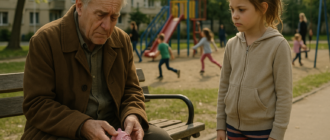
Then, last winter, I noticed Noah slipping out into the cold with a blanket from the linen closet. When I found him on the porch, he was gently wrapping it around a skinny yellow dog. The dog’s ribs showed, and one of its ears was torn. It leaned into his hands like it hadn’t been touched kindly in years.
“Mom, can we keep him?” Noah whispered.
“We can’t just take in every stray,” I sighed. “Someone might be looking for him.”
Behind us, Mr. Harris’ door opened with its usual creak. I braced myself for the complaints. Instead, his voice came out surprisingly soft.
“The dog’s been sleeping under my stairs,” he said. “I leave food sometimes. He doesn’t belong to anyone.”
I turned, caught off guard. Up close, he looked smaller, swallowed by an old brown cardigan, his hands trembling slightly on the doorframe.
“He needs a name,” Noah declared, ignoring the tension. “What do you think, Mister…?”
“Harris,” the old man replied. “Samuel Harris.”
“Okay, Mr. Harris. What about Lucky?”
The old man’s mouth twitched, almost a smile. “Lucky, huh? Poor thing doesn’t look very lucky to me.”
“You’re lucky if someone loves you,” Noah said simply.
Something shifted in Mr. Harris’ eyes. He looked at the boy, then at the dog, and his gaze grew wet. Without another word, he disappeared inside and came back with a faded blue towel.
“If you rub him down, he won’t catch cold,” he muttered, offering the towel to Noah.
That was the beginning.
I started seeing them together through the kitchen window: the old man, the boy, and the yellow dog. At first, they just sat on the steps—Noah talking, Mr. Harris listening with that stiff, unfamiliar patience of someone who had forgotten how conversations worked. Then one day I saw chalk drawings on his driveway: crooked houses, stick figures, a clumsy yellow dog with enormous ears. And right there, next to a small boy, a tall stick figure with a cane.
“Who’s that?” I asked Noah that night at dinner, pointing to the drawing on his pants leg.
“That’s Mr. Harris,” he said. “He said he used to be tall. Before he shrank.”
He said it like it was the most natural thing in the world.
Days turned into weeks. I found myself baking a bit more than we needed, then sending Noah over with a plate of cookies. The plate always came back washed, with a napkin folded precisely into a square. Sometimes there was a note in shaky handwriting: “Thank you. – S.H.”
Once, when I went to fetch Noah, I saw the door slightly ajar. Inside, the house was neat but bare, like a hotel room someone had stayed in for too long. On the table stood a single framed photograph: a young man in uniform holding a baby, a woman beside him laughing into the camera.
“Your family?” I asked before I could stop myself.
Mr. Harris stared at the photo for a long moment. “They… moved away,” he said finally. His voice broke on the last word. I didn’t press.
One rainy afternoon, Noah came home with red eyes.
“Mr. Harris fell,” he blurted. “He was in the kitchen and Lucky was barking and he couldn’t get up. I called you but you didn’t hear so I called the number on the fridge and the lady said an ambulance is coming.”
My heart stopped. I grabbed my phone and saw a missed call. Within minutes, we were at the small hospital on the hill.
Through the glass, I saw him: frail, pale, wires on his chest. Lucky wasn’t allowed inside; he lay by the hospital entrance, soaked, refusing to leave. Noah pressed his hand to the window.
“Is he going to die?” he whispered.
I wanted to say no. Instead, I squeezed his shoulder. “They’re helping him. That’s all we know.”
We visited when we could. Noah brought drawings; Mr. Harris pinned them to the flimsy hospital curtain with tape. One day, when Noah had gone to buy a juice, Mr. Harris beckoned me closer.
“You’re a good mother,” he said abruptly.
I shook my head. “I’m just trying.”
“My son stopped visiting years ago,” he continued, staring at his hands. “Said I was too hard on him. Too cold. I told myself he’d come around. Then I heard from a neighbor that he’d moved overseas. That he had a little boy. I’ve never seen my grandson.”
He swallowed.

“Your boy,” he added, “he comes in here like sunshine. Talks about school, about the dog, about… everything. If I’d known how to listen like that before…” His voice cracked and he turned his head away.
It was the first time I saw him cry.
Two weeks later, he was back home, thinner but stubbornly walking with a cane. The first thing he did was shuffle to the porch and whistle. Lucky came running like a bullet, nearly knocking him over. For the first time, I heard Mr. Harris laugh—a rusty sound, like old hinges finally moving.
Spring arrived. The three of them became a familiar picture: the old man in his chair, Noah on the steps, Lucky sprawled between them. I still kept a polite distance, hovering at the fence, pretending to weed the flowerbed while listening to their fragments of conversation—stories about a childhood farm, about the sea, about a boy named Daniel who used to ask too many questions.
“Who’s Daniel?” I asked casually, one evening when Noah came in.
“That’s his son,” Noah said. “He said he hopes Daniel’s boy has someone like Lucky. And someone like me.”
I froze with a dish in my hands.
On Tuesday morning, as I rushed to work, I noticed Mr. Harris’ curtains still drawn, no chair on the porch, no scratch of Lucky’s nails on the wood.
“Maybe he’s sleeping,” I told myself.
At noon, my phone rang. An unfamiliar, official voice told me there had been a welfare check. The neighbor, my name on the emergency contact list. No signs of struggle. Probably peaceful.
I left work without remembering to sign out.
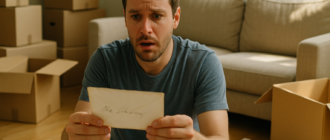
By the time we got to the funeral home, the arrangements were already made: a simple coffin, a date, a time. The woman at the desk apologized. “We called the number listed as family. It’s disconnected.”
On the day of the funeral, clouds stretched thin across a pale blue sky. At the entrance to the small cemetery, Lucky stood waiting, tail low, eyes searching. Noah ran to him, threw his arms around his neck.
“Of course he came,” he whispered into the dog’s fur.
There was no crowd, no murmuring line of mourners. Just us. The priest cleared his throat, glanced at the empty chairs, and began the service in a flat, practiced voice.
Noah stepped closer to the coffin, his hands trembling. He pulled out a drawing, folded and worn at the edges: three figures on a porch, a yellow dog at their feet, the sun huge above them.
“This is for you,” he said quietly, placing it on the coffin lid. His voice shook. “So you’re not alone.”
Lucky lay down beside the grave, head on his paws, watching as the coffin was lowered. As the first shovel of dirt fell, the dog let out a long, broken sound that didn’t sound like barking at all.
I felt something burst inside my chest. All those evenings I had decided I was “too tired” to say hello, all the quiet chances to knock on his door, bring over a real meal, ask a real question.
The priest finished quickly. The cemetery worker nodded to me, already thinking about the next task on his list.
“That’s it?” Noah’s eyes were wide, wet. “He just… goes in the ground and that’s it?”
I knelt in front of him, my own vision blurred.
“No,” I said. “That’s not it.” I pointed to the drawing. “He has this. He has Lucky. He has you. And he has us, remembering.”
It sounded small, but it was all I had.
On the way home, Noah asked, “Can we take Lucky? Mr. Harris would want him to be with someone who loves him.”
I looked at the dog in the rearview mirror, curled on the backseat, nose pressed to Noah’s knee. I thought of the old man’s empty house, the silent photo on the table, the disconnected number.
“Yes,” I said quietly. “He lives with us now.”
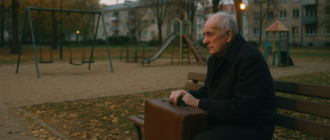
That evening, I stood on our porch and looked at Mr. Harris’ door. The house seemed even smaller, the windows darker. I imagined a younger version of him, standing where I stood, too proud to ask his son to stay an extra day, too stiff to say, “I’m sorry. I was wrong. I need you.”
I went inside, found an old notebook, and wrote on the first page: “Things I won’t regret not saying.” The list started simple: “I love you, Noah.” “I’m sorry.” “Please, stay a little longer.”
Later that night, I tucked Noah in. Lucky jumped on the end of the bed, circled once, and lay down with a sigh.
“Mom?” Noah murmured drowsily. “Do you think Mr. Harris is with his family now?”
I brushed his hair back from his forehead.
“I hope so,” I said. “And I think… if they see how much you loved him, they’ll be proud. Maybe they’ll miss him a little more. The way he deserved.”
As the house grew quiet, I heard a soft thump from the wall we shared with Mr. Harris’ empty home. Just the settling of old wood, I told myself. But in that moment, it felt like a goodbye.
He left this world with almost no one. But an eight-year-old boy and a stray dog refused to let him vanish without love. And somehow, that small, stubborn love made all the difference—for him, for them, and, most of all, for me.