The old man next door kept knocking on our wall every evening at 7 p.m., and we were ready to call the police, until one day my 6-year-old son opened the door and asked him a single question that made me ashamed of every complaint I ever had.

For three months, our evenings had the same soundtrack: a dull, stubborn knock from the other side of the thin apartment wall. Three slow hits. Pause. Three more. Always at 7 p.m. I tried to ignore it, to turn up the TV, to pretend it was pipes or wind. But it was too rhythmic, too human.
My wife Emma would sigh, rubbing her temples after a long day at work. Our son Leo would look up from his crayons, confused. “Is he angry again?” he asked once, and my stomach tightened with irritation. The knocking felt like an accusation, like someone blaming us just for living our life.
We had moved into this small building only half a year ago. The landlord had mentioned a “quiet elderly gentleman” living alone next door. I had seen him a few times in the stairwell: thin, hunched, with a neatly combed shock of white hair. His name was Mark. He nodded politely, but his eyes always seemed to be staring at something far away, somewhere I could not see.
The first time the knocking started, I thought we were too loud. Leo had dropped a toy car, it banged, and minutes later came the knock. Three times, measured, not frantic. I lowered the TV volume, told Leo to play softer. The next evening, right at 7, we heard it again. And then again. Even on days when we barely made a sound.
One night, exhausted, Emma snapped, “This is ridiculous. We’re not doing anything wrong.” She grabbed her phone. “I’m calling the landlord. Or the police. This is harassment.”
Leo looked worried. “Is the man bad?” he asked.
“He’s rude,” I muttered, more loudly than I intended. “He thinks he can control us just because he’s old.”
The next day at work, I complained to my colleague: the constant knocking, the disruption, the way it made our little home feel like a place under surveillance. “Some old people just get bitter,” my colleague shrugged. “Don’t let it get to you. File a complaint if you have to.”
That evening, Emma came home even later than usual, pale with a headache. I gave Leo dinner, helped him with his homework, tried to keep things calm. The clock on the microwave blinked 6:58.
I watched it like it was a bomb about to go off.
6:59.
7:00.
Right on cue: three slow knocks. Pause. Three more.
Something in me snapped. I slammed my hand on the table, making Leo jump. “That’s it,” I hissed. “I’m done.”
I marched to the door. Leo scrambled after me, clutching his stuffed lion. I flung the door open, ready with a speech about respect and boundaries.
But before I could say anything, Mark was already there in the dimly lit hallway, hand raised as if he had just been about to knock on our door instead of the wall. Up close, he seemed even smaller, his winter coat hanging loosely from his shoulders although it was warm outside.
His eyes met mine, and for a second I saw not anger but confusion, like someone who had walked into the wrong room and didn’t know how to leave.
I inhaled, ready to talk. Leo tugged on my sleeve, then squeezed past my leg. He tilted his head and looked at the old man with the fearless curiosity only children have.
“Mister,” Leo said softly, “why are you always knocking? Are you lonely?”
The hallway fell silent. The word hung in the air: lonely.
Mark’s raised hand trembled. He opened his mouth, but no sound came out. Then his shoulders slumped, and he leaned against the wall as if all the strength had drained out of him.

“I…” he whispered. “I’m sorry. I thought…” He swallowed, his eyes glistening. “My wife and I… we used to have dinner at 7. Every day. For 42 years. I would tap the wall to tell her I was ready. Our bedroom… used to be right there.” He pointed to the thin wall between our flats.
My anger evaporated so quickly it left guilt burning in its place.
“She passed last winter,” he continued, his voice shaking. “Sometimes I forget. I sit down, I look at the clock, and I… I knock. And then I remember she’s not there to knock back. So I… I listen to your voices instead. It makes the silence less… big.”
He looked at Leo, not at me, as if he were afraid of my judgment but trusted my child.
“I didn’t know you could hear it so loud,” he said. “I’m sorry. I didn’t want to bother you. I just… I don’t want to eat alone.”
Emma had come to the door, quietly, during his confession. I felt her presence behind me, felt my own face burn with shame. For weeks I had been building a story in my head about a bitter old man trying to control us. I had never once considered he might just be trying not to disappear.
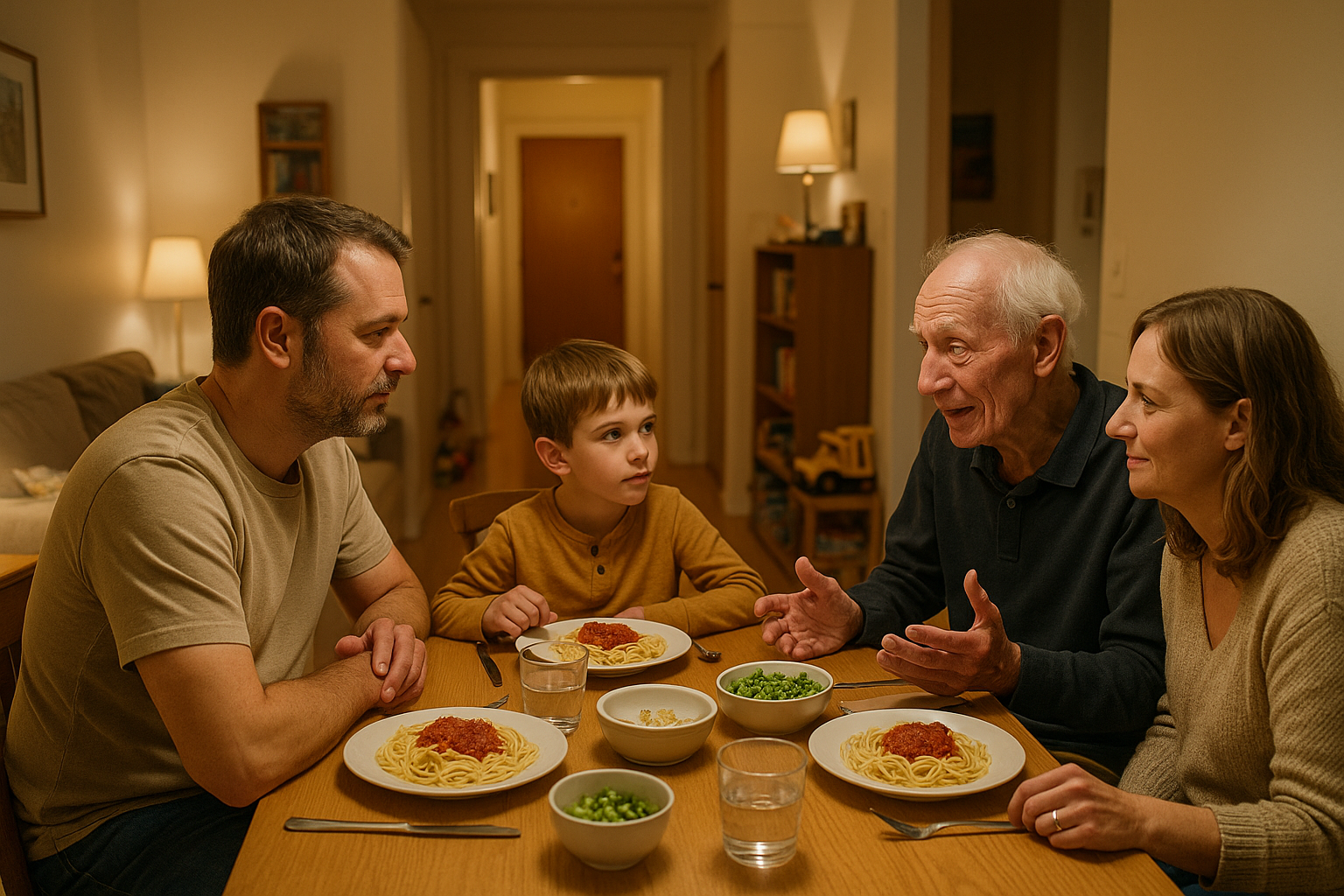
Leo stepped closer, his eyebrows knitted in that serious little way he had. “My grandma lives far away,” he said. “I talk to her on the phone so she’s not lonely. You can… eat with us. If you want. We have spaghetti today.”
I almost protested. Inviting a stranger into our tiny, messy apartment, on a workday, just like that. But before my adult brain could list all the reasons to say no, Emma spoke.
“Yes,” she said quietly. “We have plenty. Please, come.”
“Or every day,” Leo added. “Seven o’clock. You don’t have to knock. Just ring.”
That was the twist my life took that evening: not with a fight, but with a child’s simple invitation.
Mark ate very slowly that night, as if remembering how to move the fork. He told us about his wife, Anna: how she loved overcooked pasta and old songs on the radio; how they never had children because “life kept saying later until it was too late”. He apologized again for the knocking, and I apologized for the anger he had never seen but I had carried.
When he left, he stood in the doorway for a moment, listening to our little apartment noises: Leo humming, the clink of plates, the TV murmuring in the background.
“It sounds like a heart,” he said. “A house with a heart beating. Thank you for letting me hear it.”
He didn’t knock on the wall the next evening. Instead, exactly at 7, our doorbell rang. And then it rang the day after that. Some evenings he brought bread, or a small jar of homemade jam he still had from before Anna died. Some evenings he brought nothing but stories.
A month later, I came home later than usual. The apartment was full of laughter. I stood in the doorway and watched: Mark and Leo bent over the table, drawing cars and ships; Emma stirring a pot on the stove. No one noticed me at first. For a brief, piercing moment, I imagined our life without that knock, without that old man next door. It looked colder. Quieter. Smaller.
I felt that familiar shame again, but now it melted into something else: gratitude. For my son’s question. For the knock we had almost silenced with a complaint.
Sometimes, out of habit, Mark still taps the wall. Three quiet knocks. But now, Leo knocks back. Three times. Then we hear his soft chuckle through the plaster.
Whenever I catch myself getting annoyed at someone in the supermarket line, or at a neighbor’s barking dog, I remember the thin wall and the three slow taps of a man who just didn’t want to eat alone.
And I silently thank my little boy for opening a door I would have slammed shut.