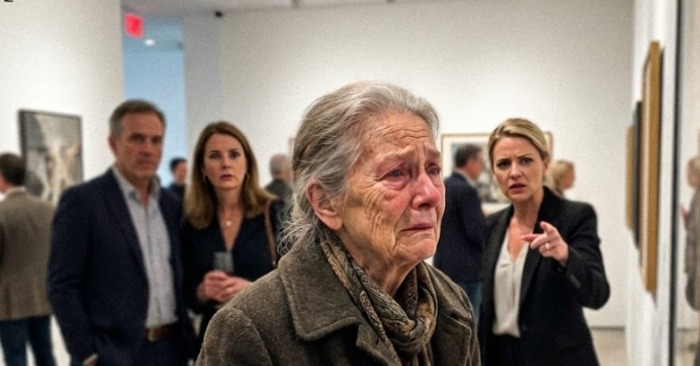
I let in the old woman whom everyone ignored — she stopped in front of one painting and whispered: “This is my life.” To this day I remember how she stood by the gallery doors, cold, worn, with eyes that had seen more than any of us would want to see. People passed her by as if she were air.
The security guard was already about to throw her out, because she looked like someone you don’t let into places full of art and expensive suits. But when I saw her look, something stopped me. I told him to let her through.
She walked in slowly, as if she were afraid of touching something she wasn’t allowed to. Her hands were trembling, and in her eyes there was a mixture of uncertainty and something else — as if she were returning to a place she hadn’t felt in a long time. I walked a few steps behind her, not knowing why
She stopped in front of a large canvas that hung on the main wall. The painting depicted a woman standing on a balcony, her gaze directed somewhere far away. People often said it was “beautiful.” But she looked at it differently, as if something had tightened around her throat.
Then she whispered: “This is my life.” So quietly that for a moment I thought I had misheard. But her trembling shoulders said everything — it was not a mistake or a figure of speech. It was a confession.
I asked whether she knew the author of the painting. She shook her head and said that she didn’t know her personally, but she knew the emotions that were there. “This is the moment when a woman sees that she has nowhere left to return to” — she added. Every word pierced into me like a pin.
People around began to stare. Some whispered that someone like her shouldn’t be here. Someone else shook their head, seeing her old coat and cracked hands. And I just watched as her eyes filled with tears.
She said that once she had a life that no one understood. A husband who said that everything was her fault. Children who looked at her like she was air. And a home that had stopped being a home long ago.
She said that one day she went out “just for a moment.” That she was supposed to come back, but she lacked the courage. She began to live however, wherever, putting off thinking about what she had left behind. And now she stands here, looking at a painting that reminds her of every decision she never explained.
Her voice broke with every sentence. People began to leave, because no one wants to look at someone else’s pain. And then she suddenly pulled a small, worn photograph out of her pocket. It depicted a young woman — the same one I had seen in the painting.
I looked at her questioningly. She nodded. I already knew that it was no coincidence. I also knew that the truth would be heavier than anyone would want to bear. Then she said something I will never forget for the rest of my life.
“This is not just my painting” — she began quietly. “It is my memory.” She took the photograph and brought it closer to the canvas. The features in the photo were almost identical — the same line of the nose, the same sideways glance, as if something were pulling her there.
She said that the painter who created the painting was her daughter. A girl who grew up watching her mother disappear every day, even though she was physically there. A daughter whom she was never able to give a sense of safety.
Her voice trembled as she told how she lost her daughter not through death, but through her own decisions. That the girl ran away from home as soon as she turned eighteen. That she never replied to any letters afterward.
Crying, she said that the last time she saw her was on the platform. Her daughter then had the same expression that the painter captured in the painting — a mixture of fear and freedom. The expression she now saw again, only made with paint and a brush.
Then she asked me whether I knew where the author was. I said that I didn’t, that the painting had been bought at an auction anonymously. I saw her body collapse from the inside. As if she had hoped that at least here she would get an answer that life had not given her.
She went on to say that for years she had wandered around the city, looking for something that reminded her of her daughter. That she tried to follow every trace, every lead. Until one day someone told her that in this gallery hangs a painting of a “girl on a balcony”.
When she saw it for the first time, she didn’t have the courage to enter. She stood under the doors for several days, until she gathered the strength. She knew that it was the only place where she could feel her even for a moment, even if only through a painting.
I listened to her, feeling that this was not a story about art. It was a story about loss that had not disappeared over the years. About a woman who spent her whole life trying to fix something, but no one ever allowed her to say what she really feels.
She asked me whether she could stay alone with the painting for a moment. I led people further away, giving her space. She stood there for a long time, in silence, with her hands clasped in front of her. As if she were praying to a memory that no one else understood.
When she came out, she looked different. Not calm, not happy, but like someone who had finally found a place where she could leave part of her guilt. She thanked me and said that she would return. That she had to return.
And I watched as she walked away slowly, with small steps. I know that people in the gallery saw only an old woman. But I saw a mother who for years carried a burden that no one should have to bear alone.
Today, when I pass by that painting, I no longer see art. I see the story she gave me that day. And although I don’t know whether she will ever find her daughter, I know one thing — some secrets carry a weight greater than life.
If you made it to the end of this story, write in the comments whether you think her daughter should learn the truth about her mother. I am curious about your thoughts.