For weeks, Mateo returned every afternoon to the same quiet square, blending into the crowd as if he were just another passerby pausing for a brief rest.
But he wasn’t there by chance.
In truth, Mateo was hiding.
Since his father’s funeral, the world had moved on around him with almost cruel speed. Business meetings still filled his calendar, his investments grew, and applause followed his name everywhere. Yet every evening, he returned to a vast house where only the echo of his own footsteps filled the space—a place too quiet to distract him from the emptiness he could no longer ignore.
Years earlier, his father had said something strange to him during a late-night conversation.
“If you ever feel empty,” he had said softly, “go to where life is raw. That’s where you’ll find the truth.”
Mateo hadn’t understood then.
Not until that afternoon, in the square.
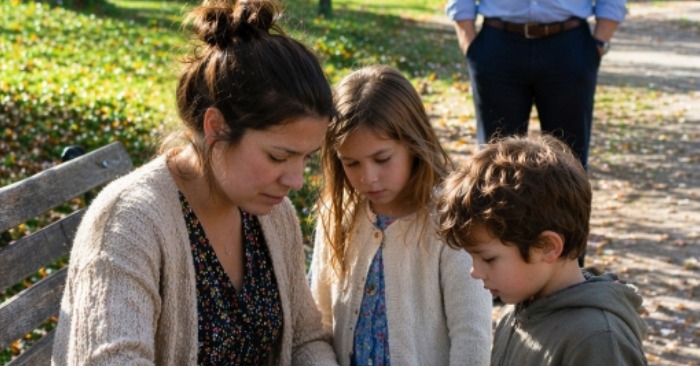
In one corner of the square, under a tired old tree that offered barely any shade from the dust and heat, a woman sat on a worn bench with two small children by her side. She held no cardboard sign. She asked for no money. There was only a dented metal tray in her lap.
Mateo slowed as he saw what she was doing.
First, she served the children.
Not equally.
She filled their bowls generously, heaping each one with food. What remained for herself was little more than the scraps clinging to the bottom of the tray.
Quietly, she scraped together what little was left and put it in her own bowl as if it were enough.
Mateo stopped.
The children ate slowly, savoring every bite, with a patience that showed food had never been taken for granted. The woman watched them with a gentle smile, one that never left her face even when her hands trembled slightly from exhaustion.
There was no pretense.
No begging.
Only sacrifice.
Mateo had spent years signing checks worth more than most people’s entire lives, attending charity galas accompanied by speeches, cameras, and applause—but none of it had moved him like this simple moment.
As he watched this mother, something opened inside him.
Then the little girl suddenly slipped from the bench.
Her body fell to the ground.
The square fell silent.
People looked on—curious, uncertain.
No one moved.
Mateo was already running.
A moment that changed everything.
At the hospital, the doctors spoke calmly, but their words weighed on him like stones.
Severe dehydration.
Malnutrition.
The mother trembled beside the bed, repeatedly apologizing—for things no one should ever have to apologize for. She apologized for not noticing sooner, for not feeding her children better, for the chaos in a place where she clearly felt like an outsider.
Mateo paid the bill before anyone could ask how it would be handled.
For the first time in his life, money didn’t feel like power.
It felt like responsibility.
That evening, they sat across from each other in a small café, the woman quietly, sincerely telling her life story.
How she had lost her job when the factory closed, how eviction followed, and how the man who had promised help disappeared. There was no drama, no self-pity.
Only reality.
Mateo watched.
And realized something that shook him.
While he grieved in a vast house, surrounded by every comfort, this woman fought for survival with almost nothing.
And still, she shared her food.
A house that began to breathe again.
That evening, Mateo made a decision.
He invited the woman and her children to live with him.
He didn’t call it charity.
It was simply a place to rest.
The house slowly transformed.
The silence vanished.
Laughter filled the rooms.
The children learned what it felt like to never have to count their bites.
And the woman did not remain idle.
Weeks later, she began sewing again.
Her work was beautiful.
Mateo didn’t see poverty in her.
He saw talent.
He set up a workshop for her.
And her creations began to sell.
The woman regained her confidence.
The children finally slept peacefully.
And slowly… something else formed between them.
Not rescue.
But companionship.
A different kind of promise.
Months later, under the starry sky in the garden, Mateo knelt.
But he didn’t speak only to the woman.
He spoke to the children too.
He promised no perfect life.
Only that he would stay.
That every day he would choose them.
That he would see them.
The children hugged him first.
The woman’s tears did not come from pain.
They came from relief.
Because the miracle was not a wealthy man.
It was a mother.
And a man who finally understood…
That money means nothing until it meets humanity.