The boy kept leaving a plate of food on the stairwell every evening, and when the landlord finally checked the camera, he realized who it was meant for.

It started after the rent increase.
Martin owned the old brick building on the corner, the one he always called “his retirement plan”. The pipes groaned, the paint peeled, and the tenants complained about everything from drafty windows to flickering lights. But Martin only saw numbers: repairs, taxes, mortgage. When the heating bill doubled, he raised the rent on everyone, including the quiet woman in 3B with the skinny boy who always carried a backpack almost bigger than himself.
Her name was Laura. The boy was Daniel. They never caused trouble. Rent came in late sometimes, but it always came. Until one month it didn’t.
When the payment didn’t show, Martin printed a polite but firm notice and slid it under their door. The next day, there was no reaction. On the third day, he heard a soft rustling in the hallway, opened his door a crack and saw Daniel on the stairwell, gently placing a chipped plate on the step between the second and third floors.
On the plate lay half a sandwich and a few carrot sticks, arranged carefully, like a small feast.
“Hey, kid,” Martin said, frowning. “You can’t leave food out here. It’ll attract rats.”
Daniel startled, then quickly nodded. “Sorry, sir.” His voice was thin, too serious for his age. “I’ll… I’ll take it away in the morning. I promise.”
Before Martin could say more, the boy gave him a timid smile and hurried back into 3B. The plate stayed.
That night, Martin lay in bed thinking about rats and stains on the stairs. In the morning, when he stepped out, the plate was empty. Not just the sandwich—clean. Someone had washed it and set it neatly by the door of 3B.
The same thing happened the next evening. Another plate, another small portion of food, placed on the same step. Martin grumbled but let it go. Kids were odd. Maybe he was feeding a stray cat.
On the fifth day, with still no rent paid, Martin’s patience snapped. He pulled up the new hallway camera feed on his phone, intending to catch whichever animal was being lured into his building.
The footage loaded: timestamp, quiet corridor, then small movements. At 7:03 p.m., the door of 3B opened. Daniel stepped out carefully, balancing a plate with two slices of toast. He placed it on the stair, straightened it as if it mattered, whispered something inaudible, and went back inside.
For almost an hour, nothing happened.
Then, at 7:58 p.m., the door of 3B opened again.
It was Daniel.
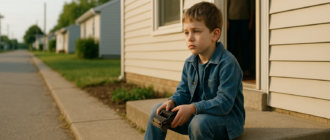
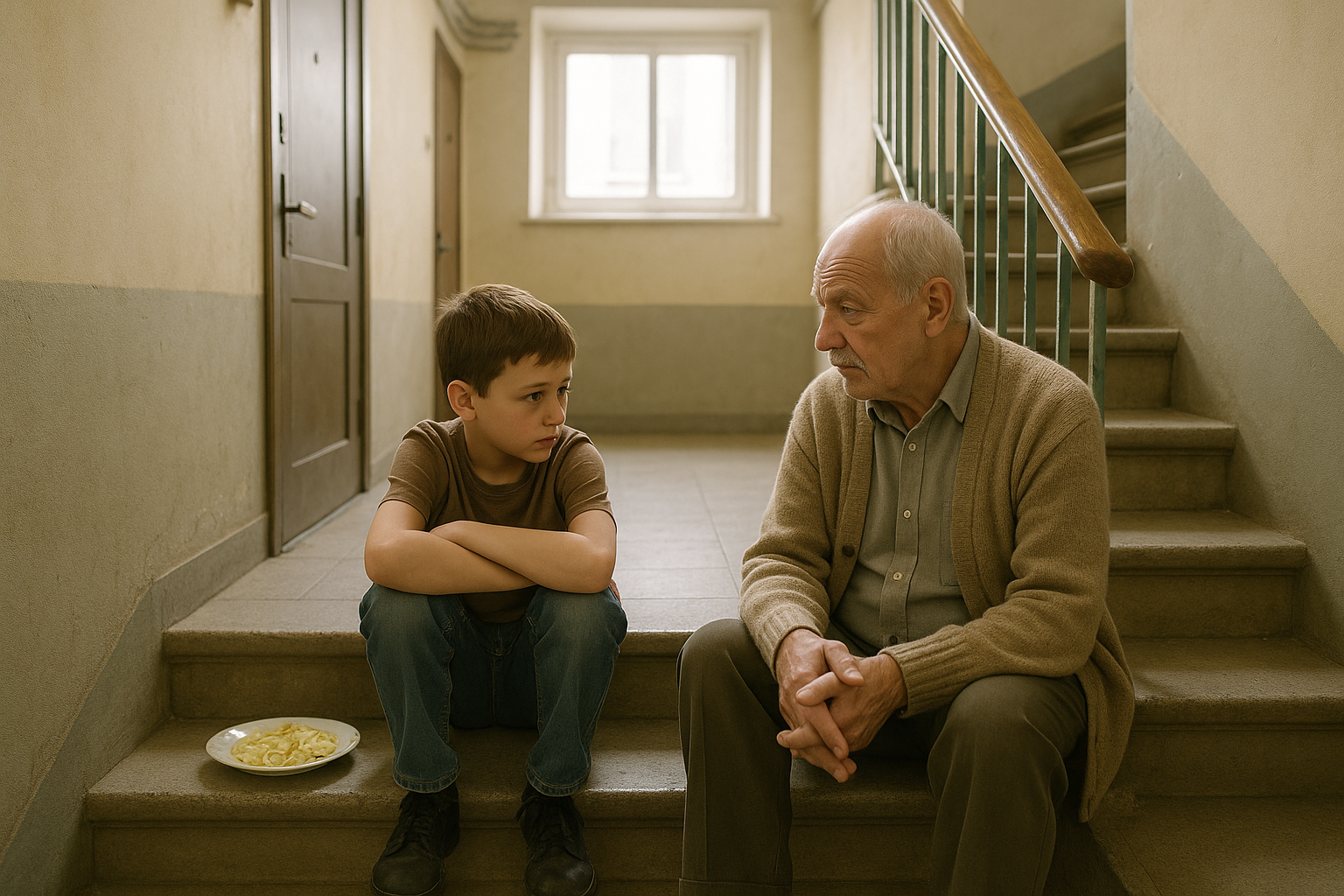
He looked around, making sure the corridor was empty, then slowly sat down on the step across from the plate. He stared at it for a long time, wrapping his arms around his knees. The camera caught his face clearly: tired, with dark circles that had no place on a child. His cheeks were hollow.
He slid the plate closer, picked up one piece of toast, and… put it back untouched.
Martin frowned, confused.
Then, with the kind of careful tenderness Martin had only ever seen in old war documentaries, the boy shifted sideways, leaving a space beside him on the step. He moved the plate into that empty space, like someone had just sat down there.
Daniel turned his head slightly, to the side.
“Mom,” he said quietly. The camera had audio. “I saved it. Like always.”
The boy’s lips trembled. He reached out, as if to touch someone’s hand that wasn’t there, then pulled his fingers back and clasped them tightly in his lap.
“They sent that paper again,” he whispered. “The one that says we have to go. I tried to pay the man downstairs, but we don’t have enough. I took back the milk, like you said. It’s okay, I’m not that hungry.”
On the screen, Daniel blinked rapidly, swallowing hard.
“If you were here, you’d talk to him. You always make people smile. Remember how you made the nurse laugh, even when—” He cut himself off, pressing his lips together.
He sat there in silence, then finally pushed the plate a little closer to the empty space.
“It’s for you, Mom. You didn’t get to eat much at the hospital. I’ll… I’ll just sit with you, okay?”
Martin suddenly realized his hand was shaking, the phone heavy and cold in his palm.
He rewound the footage. There, two weeks earlier, the same ritual. A plate. A small portion of food. A boy talking to emptiness.
In the tenant records, Martin had a note: 3B – single mother, part-time cleaner, recent surgery. He remembered her smile in the hallway, the way she’d always thanked him for fixing the leaky faucet, even when it took him weeks.
He also remembered the hospital envelope he’d seen once in her mailbox, with a red stamp that said “Final notice”. He hadn’t thought about it again.

Now, the hallway camera showed Daniel wiping his eyes with the back of his hand, then quietly eating one crust of the toast, as if afraid someone would tell him it wasn’t really his.
The next morning, Martin didn’t print an eviction notice. He climbed the stairs with a knot in his throat, a folder in one hand and a grocery bag in the other.
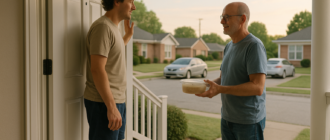
He knocked on 3B. After a long pause, the door opened a crack. Daniel peered out, eyes wary.
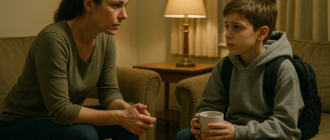
“Hi,” Martin said, suddenly aware of how harsh his own voice usually sounded. He cleared his throat, softened it. “Is your mom home?”
Daniel hesitated, then shook his head once. “She… she’s not coming back.”
The words were flat, like something he had repeated to himself until they lost all meaning.
Martin’s chest tightened. “I see,” he said quietly. “Listen, kid… I think we need to talk.”
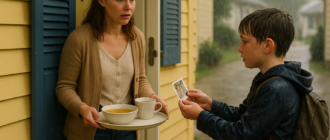
He handed Daniel the grocery bag. Inside were milk, bread, fruit, a few canned soups. The boy’s eyes widened.
“It’s not charity,” Martin blurted out, almost defensively. “It’s… an advance. On a job. You could, uh, help me with the mailboxes, maybe take out the trash for the building sometimes. We’ll call it your salary.”
Daniel’s fingers tightened around the bag handles. “But the paper… it says we have to leave.”
Martin opened the folder and pulled out the printed notice. In front of the boy, he tore it in half, then in half again.
“This paper was a mistake,” he said. His voice cracked on the last word, and he coughed to hide it. “I updated my records. From now on, 3B is… under special terms. Reduced rent. We’ll figure it out together. One step at a time.”
Daniel stared at the torn pieces, then at Martin, as if trying to solve a puzzle too big for him.
“Why?” the boy whispered.
Martin glanced at the stairwell. He could see, in his mind, the small figure sitting there every night, sharing imaginary dinners with a mother who would never come back.
“Because,” he said slowly, “no one should have to eat alone on the stairs and pretend somebody’s still there.”
For a moment, Daniel’s face crumpled, and Martin thought the boy would start sobbing. Instead, he straightened his shoulders and gave a small, serious nod.
“Okay,” Daniel said. “I can help with the trash. And I can sweep the stairs, so nobody slips.”
Martin nodded back. “Deal.”
That evening, when the hallway camera recorded the usual 7:03 p.m. movement, it saw something different.
The door of 3B opened. Daniel stepped out, holding a plate. This time, it was fuller: two slices of bread with cheese, a few pieces of apple. He set it down on the familiar step, then looked up at the camera, as if he knew someone was watching.
He smiled—not the timid, apologetic smile from before, but a small, grateful one.
Then he shifted sideways again, leaving space next to him.
But a moment later, heavy footsteps echoed on the stairs. Martin appeared, slightly out of breath, carrying his own plate—an awkwardly made sandwich and a banana.
“Is this seat taken?” he asked.
Daniel shook his head. “No. It’s for Mom. But… you can sit on the other side.”
So they sat there, three in a row: a boy, a plate meant for a ghost, and an old landlord who suddenly felt every year of his life.
They ate in silence at first, then Daniel started talking—about school, about the hospital, about the way his mother used to hum under her breath when she cooked. Martin listened, the ache in his chest growing and changing into something he hadn’t felt in a long time.
On the camera, it looked like nothing much: two figures on a stairwell, sharing a quiet meal.
But for the first time in weeks, the plate in the middle wasn’t a symbol of absence. It was a fragile bridge between what was lost and what, unexpectedly, might still be saved.