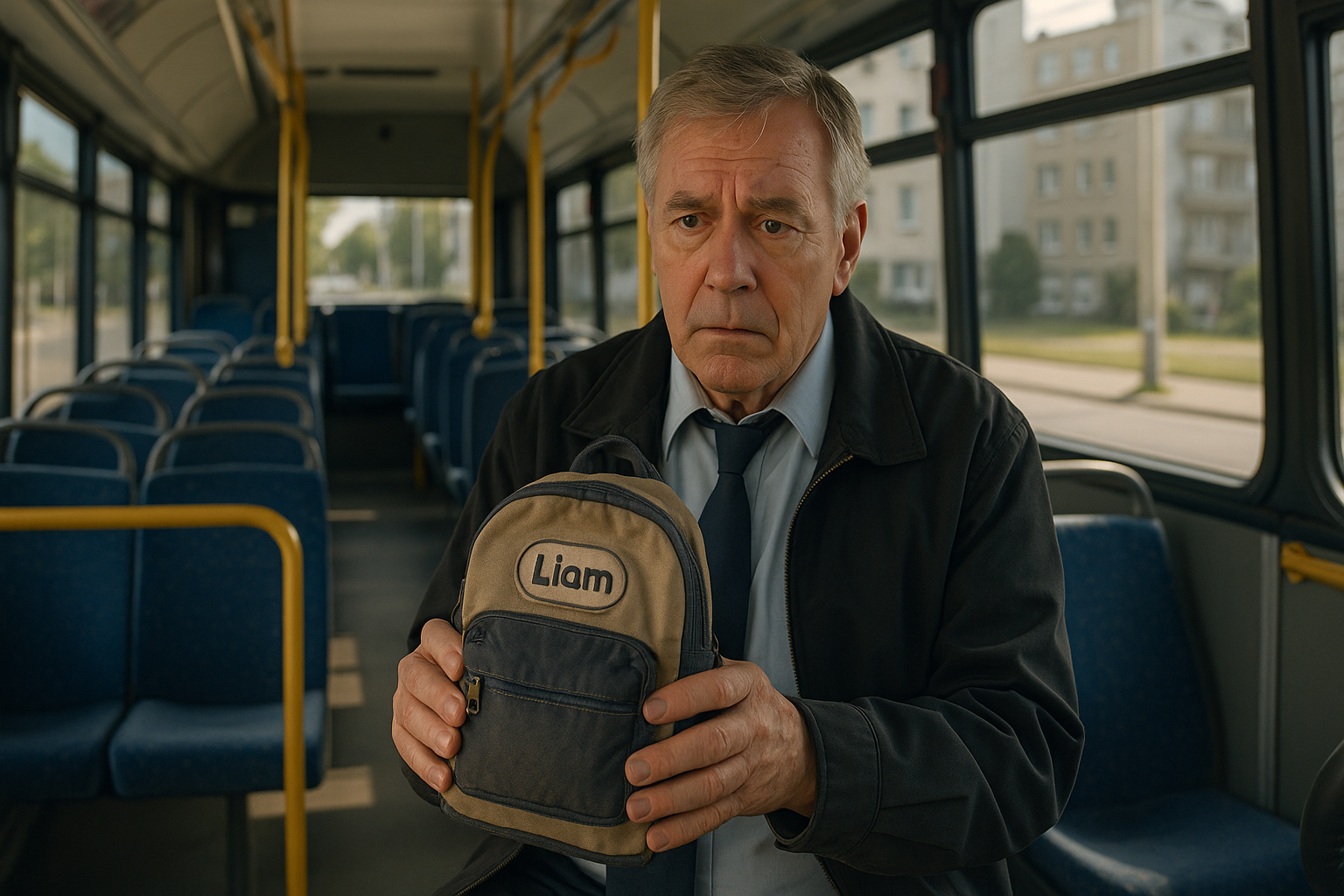
The boy who left his backpack on the bus every Friday and the old driver who finally followed him home. That was how people in the depot later retold it. But on that cold November afternoon, to 68‑year‑old Daniel it was just another forgotten bag and a familiar small figure hurrying away with shoulders hunched almost to his ears.

He had noticed the boy in September. Always the same seat near the middle, always alone, always looking out the window as if the world outside the glass belonged to somebody else. Thin wrists, sleeves a little too short. A name patch half‑hanging from the backpack: “Liam”.
The first time Liam forgot his backpack, Daniel jogged out of the bus with surprising speed for his age, calling after him. The boy spun around, eyes wide like he’d been caught doing something wrong, grabbed the bag, mumbled a quick “thank you” and ran off toward the gray apartment blocks.
The second time, it was a Friday.
Daniel found the backpack again on the same seat. He frowned. Kids forgot things, sure. But twice in two weeks? He opened his mouth to call out, then realized Liam was already halfway down the street, almost running.
He took the bag home that night, intending to hand it over on Monday. Inside, under schoolbooks with bent corners, he found a small plastic dinosaur missing an arm, a crumpled photo of a woman in a nurse’s uniform, and a folded note:
“Mom, I did the dishes and homework. Please come home soon. Love, Liam.”
The paper was worn, the pencil lines traced over many times, as if the message had been written and re‑written, handed and not handed.
On Monday, Daniel gave the backpack back. “You keep forgetting this, champ,” he tried to joke.
“Sorry,” Liam whispered, hugging it close to his chest. “It’s okay if I do. You don’t have to… It’s okay.” He said the last two words like he’d practiced them.
“Well,” Daniel replied, something heavy settling behind his ribs, “I’m on this route all week. I’ll keep an eye on it.”
Fridays became the same: the bus a little emptier, the light outside turning orange earlier. And always, after most children had climbed off with parents waiting, Liam would step down alone, glance back at Daniel as if about to say something, then hurry away.
And always, there it was on the seat: the backpack.
By the fourth Friday, Daniel stopped believing it was forgetfulness.
That evening he unzipped the bag with shaking hands. He found a sandwich wrapped in plastic, untouched, now slightly stale. A homework sheet with a red “Well done!” and a small star. The same photo of the woman in the nurse’s uniform. And a new note, on the back of the old one:
“If they take me, I will come back when you are better. Please don’t be mad. I am trying to be good. Liam.”
The next Friday, Daniel made a decision that bus drivers weren’t supposed to make.
When Liam stood up at his stop, Daniel called, “Hey, Liam. Wait a second. You forgot—”
The boy froze, one foot on the step. Then he did something Daniel didn’t expect at all: he looked him straight in the eye and said very quietly, “I know.”
He stepped off. He left the backpack on purpose.
Daniel watched him walk along the cracked sidewalk, small trainers white against the gray, until he turned toward the row of buildings. After a long moment, Daniel put the bus in gear and did something no one at the depot would have approved of—he pulled away from the route and, at the next corner, parked and killed the engine.
He picked up the backpack, heart hammering in his throat, and followed.
Liam’s building smelled of boiled cabbage and damp stairwells. The elevator was broken, of course, so Daniel climbed, gripping the railing. On the third floor, Liam was sitting on the floor in front of a door, knees pulled to his chest, head buried in his arms. No keys in his hands.
“Liam,” Daniel said gently.
The boy jerked up, eyes wet but not crying. There was a deliberate stubbornness there instead, like he’d already cried all the tears he was allowed.
“You followed me,” he said.
“Yeah. I did.” Daniel set the backpack down. “You left this…”
“I know,” Liam repeated. “I thought… if I leave it, maybe you’ll keep it. Then if they come and… and I don’t get to say goodbye, someone will remember.”
Daniel had driven thousands of people over 40 years. He had seen panic, joy, anger, even birth once. But he had never heard words like that from a nine‑year‑old.
“Who is ‘they’?” he asked, though he already suspected the answer.
“The people,” Liam said vaguely. “From the office. They talked to Mrs. Brown next door last week. They said if Mom doesn’t come back from the hospital this time, they have to find me a… a place.” His lips trembled on the last word. “Last time when she was sick, they put me in another house. The lady was nice but she said it was temporary. I didn’t have my backpack then. She kept calling me ‘honey’ but she didn’t know my dinosaur’s name or that Mom and I watch the same movie every New Year.” He sucked in a breath. “If I leave my backpack on the bus, at least something of me will be on the same road every day. Maybe Mom will see it if she comes back late. She knows the route number. I wrote it in my note.”
It hit Daniel like a punch: the half‑planned logic of a child trying desperately to leave breadcrumbs in a world that kept scattering him.
“How long has your mom been in the hospital?” Daniel asked.

“Three weeks,” Liam whispered. “They said her heart. She said she’d be home before my test. I got an A.” He opened the backpack and pulled out the paper with the red “Well done!” “But she wasn’t home. So I left this for her to find.”
His fingers were shaking so badly he dropped the paper. Daniel bent down slowly and picked it up, swallowing the tightness in his throat.
“Listen to me, Liam,” he said, steadying his voice. “I can’t promise anything about hospitals or offices. But I can promise you this: no matter what happens, you don’t disappear just because someone moves you. You hear me? You don’t have to leave pieces of yourself on buses. You are not luggage.”
“Then why does everyone pass me around like one?” Liam shot back, then flinched, as if he’d been too bold.
Daniel sat down on the floor opposite him, his old knees protesting. “Because,” he said slowly, “adults make mistakes. And sometimes systems forget there are real kids in the middle of them. But I’m not a system. I’m just a bus driver who knows your name.”
Liam stared at him. “They won’t let you keep me,” he said with a tiny, bitter smile that no nine‑year‑old should know how to make.
“Maybe not,” Daniel admitted. “But they can’t stop me from knocking on Mrs. Brown’s door and asking what’s going on. They can’t stop me from driving you to the hospital tomorrow during my break if visitors are allowed. And they definitely can’t stop me from making sure you’re not sitting alone in a hallway like a forgotten backpack.”
For the first time, Liam hesitated. “You’d do that?”
“I had a son once,” Daniel said quietly. The words came out before he could edit them. “We… we don’t talk now. I wasn’t there when he needed me. I know what it’s like to be the one who doesn’t show up. I’m done being that man.”
Liam’s eyes flickered. “Where is he? Your son?”
“Far,” Daniel said. “And stubborn.” He managed a small smile. “But that’s another route. Right now we’re on yours.”
The hallway light buzzed overhead. Downstairs, someone slammed a door. For a moment, the world shrank to the worn doormat, the backpack between them, and a boy who had been planning how to be remembered instead of how to be nine.
The door next to them opened with a creak. A tired woman in a faded housecoat—Mrs. Brown—looked out. “Oh, Liam, you’re back, I was just about to come check—” Her eyes landed on Daniel. “And you are?”
“The bus driver,” Daniel said, standing up slowly. “The one who keeps finding his backpack.”
There was a pause. Something understanding passed through the woman’s gaze.
“Come in, both of you,” she sighed. “We need to talk. The hospital called this morning. And the social worker is coming on Monday.”
Liam’s hand flew to his mouth. “Is Mom—”
“She’s alive,” Mrs. Brown said quickly. “But they say she’ll need a long time and… and she can’t take care of you right now.”
The hallway tilted for a second in Daniel’s eyes. He saw how Liam’s shoulders tightened, as if bracing for impact.
“Then we figure out the next stop,” Daniel said firmly, before the silence could grow teeth. “With you. Not behind your back.”
On Monday, when the social worker arrived, Liam did not sit alone clutching a backpack in some waiting room. He sat at Mrs. Brown’s kitchen table with a chipped mug of cocoa, Daniel on one side, Mrs. Brown on the other. His backpack leaned against the chair, not abandoned on a bus seat.
They talked for a long time. About foster families, about temporary care, about the possibility—distant but not impossible—of his mother getting better. About visits to the hospital. About schools.
At one point, the social worker asked gently, “Liam, is there anything you’re most afraid of?”
He glanced at Daniel, then back at her.
“That nobody will remember where I got off,” he said softly.
Daniel reached out—not to touch, just to rest his hand near Liam’s on the table.
“I drive this route every day,” he said. “I know every stop by heart. Yours isn’t going anywhere.”
Weeks later, the other drivers noticed a new ritual. Every Friday, an older man in a worn driver’s jacket would wait at a particular stop ten minutes before his shift, even on his days off. And a boy with a too‑big backpack would arrive, sit on the bench beside him, and talk about school.
The backpack never stayed on the bus again.
Sometimes, when the route was quiet and the winter light lay pale on the seats, Daniel would glance in the mirror and think of all the things people left behind: scarves, gloves, umbrellas. Children.
And then he’d remember a small voice on a stairwell asking if anyone would remember where he got off—and the answer he’d finally learned how to give.
“I see you,” he would say quietly to the empty aisle, as if Liam could hear him from wherever he was that afternoon. “You’re not lost.”