The old man kept standing at the kindergarten gate every morning, until one day a teacher followed him and realized who he was waiting for.

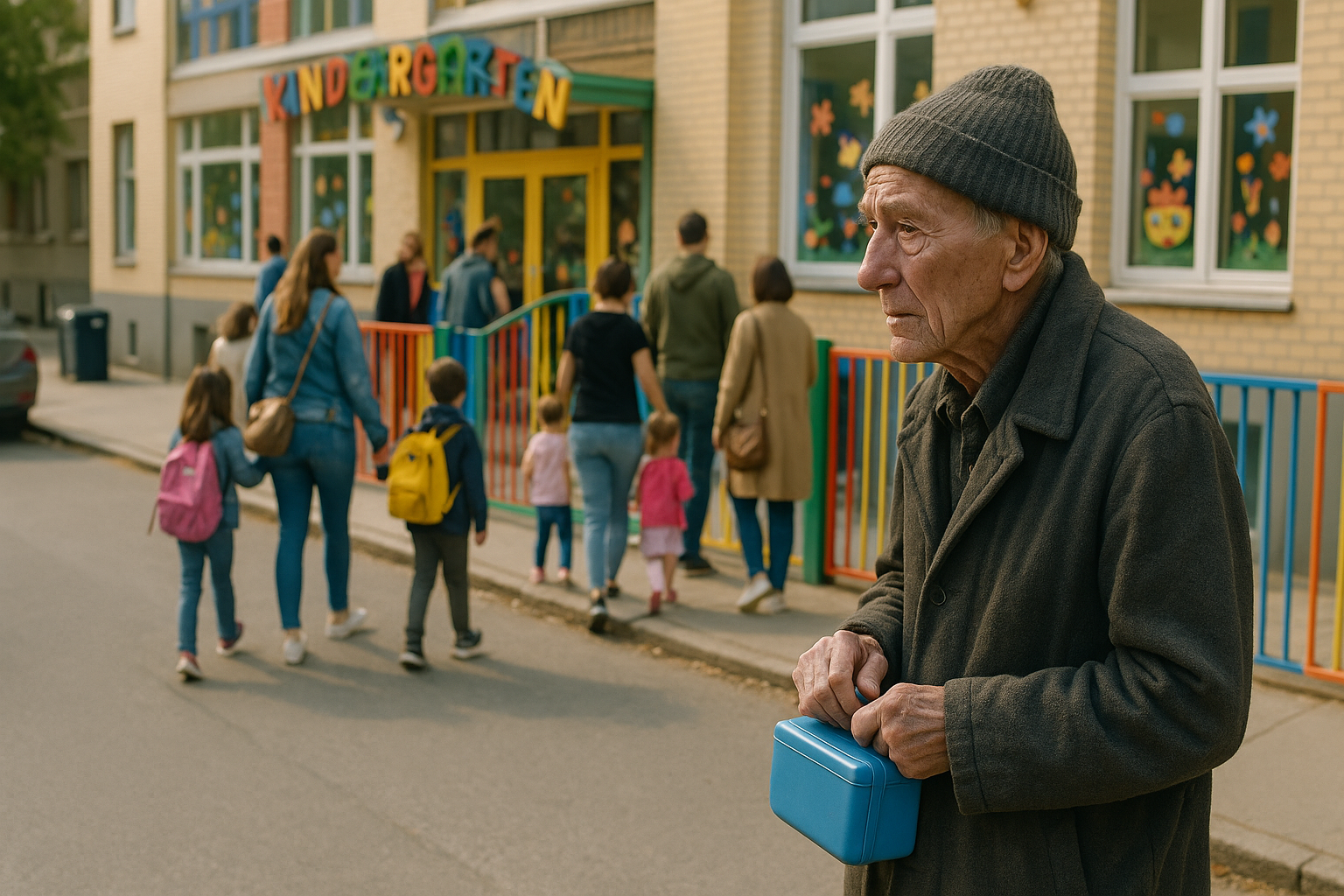
For weeks, maybe months, he was just part of the scenery. A thin, stooped man in a worn gray coat, a knitted hat pulled low, hands clasped behind his back. He stood across the street from Little Steps Kindergarten, always in the same spot, always at the same time: drop-off.
Parents rushed past him with sleepy children on their hips. Cars honked, doors slammed, someone was always late for work. And the old man just stood there, watching, as if he were afraid to blink.
At first, nobody cared. In a big city, you learn not to look too closely. But one rainy Tuesday, Emma, one of the teachers, noticed something she couldn’t unsee.
A small boy named Leo came in crying, clutching a broken toy car. While Emma was comforting him, she glanced through the window and saw the old man carefully pulling something from a plastic bag. A second second later, Leo’s exact toy car appeared in the old man’s hand—only this one was new, clean, bright red.
He didn’t cross the street. He didn’t call Leo’s name. He just stood there, fingers trembling, holding the toy in the air as if giving it, invisibly, to someone on the other side of the road.
Then he slowly lowered his hand, slipped the car back into the bag, and walked away with short, tired steps.
That night, Emma couldn’t sleep. She kept seeing his hand in the air, the way his shoulders drooped when he turned away. The next morning, she watched for him.
He was there. Rain or sun, always there.
Sometimes he lifted an invisible backpack.
Sometimes he mimed tying invisible shoelaces.
Sometimes he just raised his hand in a shy wave toward the gate, as parents hurried past, not looking up.
Emma began asking around.
“Do any of you know that old man outside?” she asked the parents.
They shrugged.
“He’s always there, but I thought he was waiting for someone else,” one mother said.
“I just assumed he was with the building across the street,” another father mumbled, already half on a work call.
No one knew his name.
One morning, Leo ran to the window mid-class.
“Teacher Emma! The grandpa is here again!”
The children had noticed him too. They called him “the quiet grandpa”. They waved sometimes. He never waved back directly, only in that strange, hesitant way—as if he were afraid to be seen.
The twist came on a cold, bright Thursday.
The old man didn’t just stand and watch. He took something from his bag—a small blue lunchbox—and opened it. Steam rose into the chilly air. He looked at the kindergarten door with such hunger and tenderness that Emma felt a knot in her throat.
He raised the lunchbox a little, like an offering.
Emma couldn’t take it anymore.
During her break, she slipped on her coat, told her colleague she’d be right back, and crossed the street.
“Good morning,” she said softly when she was close enough.
The old man flinched, almost dropping the lunchbox. Up close, he seemed even smaller. His eyes were pale, watery, framed by deep lines. He looked at Emma as if he’d been caught doing something shameful.
“I’m Emma. I work at the kindergarten.” She pointed back at the colorful building.
He swallowed. “I know,” he whispered, his accent light but noticeable. “You are the one who braids the little girl’s hair… and you carry the red backpack for the boy who always runs.”
He had been watching everything.
Emma’s voice gentled. “People have been… wondering. Are you waiting for someone?”
He stared at the gate. For a long moment, Emma thought he wouldn’t answer.
Then he said, “I am waiting for my grandson.”
Emma’s heart squeezed. “Which one is your grandson?”
He gave a tiny, broken smile. “He is not here.”
The words hung between them, colder than the air.
“You mean… he goes to another kindergarten?” Emma asked carefully.
The old man shook his head.
“My name is Daniel,” he said, as if that might explain everything. “My grandson’s name was Michael. He would be five now.”
“Would be.”
Emma felt her eyes sting.
“He died?” she asked, barely audible.
Daniel nodded once, quickly, like it hurt. “Three years. Car accident. My son and his wife moved away after that. Different country. Too many memories, they said.” His fingers tightened around the lunchbox until it shook. “They said I must forget. That it is not healthy to live in the past.”
He looked at the kindergarten, at the tiny jackets hanging by the door, the small shoes lined up.
“But I cannot forget,” he whispered. “Every morning I wake up at six. I cook. I pack his lunch. It is… habit. My body does it before my mind can stop. And when I stand in my empty kitchen, I feel like I am killing him a second time if I throw it away.”
Emma’s tears spilled over.

“So I come here,” Daniel went on. “This is the closest kindergarten to my home. I stand, and I imagine he is one of them. That he is running late, that any minute the door will open and he will shout, ‘Grandpa, you forgot my orange!’” His lips trembled. “I know he will not. But for one hour every morning, I can pretend.”
He opened the lunchbox with shaking hands. Inside was simple food: small sandwiches, a peeled orange, a cookie broken in half.
“You bring this every day?” Emma asked.
“Yes.” He gave a helpless laugh. “When I go home, I eat it at the table. I put a second plate. I talk to him. Neighbors think I am crazy old man. Maybe they are right.”
Emma thought of her own father, alone in another city, insisting he was fine. She imagined him cooking for a child who would never come.
“Daniel,” she said quietly, “would you… would you like to come inside?”
He jerked his head up, alarmed. “Inside? No, no, I don’t want to bother. The children, they have their lives. I am just—”
“You’re not bothering,” Emma interrupted softly. “Come. Just for a moment.”
He hesitated so long she almost gave up. Then, very slowly, he nodded.
Inside, the children were finishing their snack. When Emma entered with Daniel behind her, the room fell silent for a second. Twenty pairs of curious eyes turned to the old man.
“Children,” Emma said, voice trembling but steady, “this is Daniel. He misses his grandson very much. Today, I thought we could share snack time with him.”
Daniel tried to protest, but a small hand shot up.
Leo.
“Is he the quiet grandpa from the window?” Leo asked.
“Yes,” Emma said.
Leo slid off his chair, walked up to Daniel, and looked him straight in the eye.
“My grandpa lives far away,” Leo said seriously. “Maybe… you can be a little bit my grandpa when you stand outside.”
Something inside Daniel broke—Emma saw it happen, like a dam giving way. His shoulders shook, his mouth twisted, and for a terrible second she thought he would collapse.
But he didn’t. He knelt, very slowly, to be at Leo’s height.
“I would like that,” he said hoarsely.
Leo glanced at the lunchbox. “What’s that?”
“Lunch I made for my grandson,” Daniel answered.
Leo frowned. “But he’s in heaven, right? My mom says people in heaven don’t need lunch.”
A few kids giggled. The raw honesty of children.
Emma stepped in. “Maybe we can help,” she said. “Maybe, if Michael doesn’t need it, we can share it, so it doesn’t go to waste.”
Daniel blinked rapidly.
“You want to eat his lunch?” he asked, voice breaking.
Leo nodded eagerly. “Can we, Teacher Emma?”
In that small, brightly colored room, with tiny chairs and finger paintings on the walls, an old man opened his grandson’s lunchbox and placed the food on the table. The children gathered around, offering pieces of their own snacks in return.
“Here, you can have my apple,” a little girl said.
“I’ll give you my cookie,” another boy added.
Soon, the table was full of mismatched food, tiny hands passing pieces back and forth, crumbs everywhere. Daniel sat in a too-small chair, his knees almost up to his chest, tears running silently down his face as he chewed a sandwich that tasted of three years of grief.
No one teased him. No one asked him to stop crying.
When snack time ended, Emma walked him to the door.
“You can come again,” she said. “Not just to stand outside. If you want, you can read them a story once a week. We… we don’t have many grandpas around.”
Daniel looked at her as if she’d handed him something priceless.
“Are you sure?” he whispered.
“I’m sure.”
From that day on, the old man still came to the kindergarten every morning.
But now, sometimes, he didn’t just stand at the gate.
Sometimes he came inside, sat in the circle, and read picture books in his careful, accented voice while twenty children leaned in, hanging on every word.
He still packed a lunch every day. Only now, it was never eaten alone at a silent table. It was opened in a noisy room, surrounded by small hands and crumbs and laughter.
He never stopped missing Michael. The empty chair at his own kitchen table remained, a quiet ache he carried with him.
But when parents hurried past the gate in the mornings, they no longer saw a strange old man staring at their children.
They saw Daniel, the story grandpa, the one who always had a spare orange in his bag and who waved—properly now—when little Leo shouted his name.
And somehow, in the middle of a loud kindergarten full of children who weren’t his, an old man who had been ordered to forget found a gentler way to remember.