The day Ethan packed his suitcase and left our house, he forgot only one thing: his 8-year-old son on the front steps, clutching a broken toy car and waiting for a promise that was never going to be kept.

Liam sat there in his faded blue jacket, shoes untied, staring at the end of the street long after the car had disappeared. The toy car in his hand had a missing wheel; Ethan had promised to fix it “next weekend”. There would be no next weekend. Not from him.
I watched from the window, fingers pressed so hard to the glass it hurt. Part of me wanted to run out, scoop Liam up and tell him the truth: his father hadn’t just forgotten the wheel. He had forgotten them both.
Instead, I opened the door quietly and sat beside my son on the cold step.
“Mom, he’ll come back, right?” Liam asked, not looking at me. His voice was a brave whisper, like if he said it too loudly it might break.
“He said he would,” I replied carefully. “He said he needed some time.”
Liam nodded, as if that settled it. Children believe in words the way adults believe in signatures. He lined the broken toy car up with a crack in the pavement like a track.
“When he comes back, can you remind him about the wheel? He always forgets things,” he said, and finally looked at me with those wide, tired eyes that had seen too much shouting, too many slammed doors.
I swallowed the lump in my throat. “I’ll remind him,” I lied.
For the first week, Liam waited on that step every evening. He would finish his homework, put on his jacket no matter the weather, and sit there with the car on his knee.
“He said Friday is his favorite day,” Liam explained. “So he’ll come on a Friday. People go to their favorite things, don’t they?”
I wanted to tell him that sometimes people run away from their favorite things when those things demand responsibility, patience, love. But how do you tell that to a child without breaking something inside him that will never fully heal?
One night, after Liam had finally fallen asleep on the couch, still in his jacket, I found Ethan’s last message on my phone.
“I can’t do this anymore, Anna. I’m tired of being the bad guy. Tell him I love him, okay?”
Tell him I love him. Five seconds to type, a lifetime to repair.
I stared at those words until they blurred. Then, with hands shaking from a mix of anger and exhaustion, I typed back.
“He’s waiting on the steps every day with your broken promise in his hands. I hope your freedom is worth that picture in your head.”
I didn’t send it. Cowardice or mercy, I still don’t know. I deleted it and turned off the phone.
The twist came on a rainy Thursday, two weeks after Ethan left. I was in the kitchen, stretching spaghetti and cheap tomato sauce into something like dinner, when there was a knock at the door.
Liam ran faster than I could stop him.
“Dad!” he shouted, voice cracking with joy.
My heart slammed against my ribs. Ethan? Here?
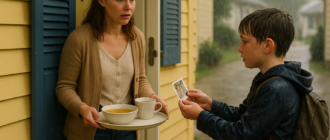
But when I reached the hallway, it wasn’t Ethan standing on the porch. It was a thin, gray-haired woman in a worn brown coat, holding an umbrella that dripped onto our doormat. Her eyes were the same deep hazel as Ethan’s.
“You must be Liam,” she said softly. “I’m Margaret. Your grandmother.”
Liam froze, confusion washing over his face. “Grandma? From the picture?” He pointed to the faded photograph on the wall—Ethan as a teenager, arm slung around this same woman, both laughing at some long-forgotten joke.
I hadn’t seen Margaret in years. Ethan always muttered something about her being “too much drama” and changed the subject.
“Anna,” she said, turning to me with a trembling smile. “May I come in? I… I’m so sorry to show up like this. I only found out yesterday.”
“Found out what?” I asked, coldness creeping into my voice.
She looked at Liam, then back at me. “That Ethan left. He called me from another country. Said he needed a new start. Said he would send money when he could. And then… he hung up.”
Liam’s face crumpled. “He called you?” His voice was very small. “But… but he didn’t call me. I was right here. I was waiting.”

I watched the realization hit him like a wave. This wasn’t a misunderstanding. This wasn’t traffic or a broken phone. His father had chosen to dial a different number.
Margaret knelt slowly, her old knees protesting. “Liam, listen to me,” she whispered. “Your father… he’s sick inside. Not the kind doctors fix easily. He runs from things that scare him. And you, sweetheart, you scared him because he loves you more than he knows how to handle. That’s not your fault. That’s his weakness. Not yours.”
He stared at her, tears gathering but not falling yet. “Did he ask about me?” he whispered.
She hesitated just a moment too long. Liam noticed. Children always do.
“He said…” Her voice cracked. “He said, ‘Tell him I’m sorry I wasn’t better.’”
It wasn’t enough. It would never be enough. But it was more than the silent phone, more than the empty driveway.
Liam sat down on the floor, cross-legged, the broken car still clutched in his hand. This time, when the tears came, they were quiet, steady, adult tears leaking from a child’s eyes.
“I waited,” he said. “Every day. I counted the cars. I thought maybe he got lost. How do you get lost from your own house?”
No one had an answer.
I sat beside him, not touching, just being there. Margaret slowly lowered herself to the other side of him, her hands shaking.
“You know,” she said, voice barely above a whisper, “when Ethan was your age, his father left too. Packed a bag and walked out the door. I told myself I would make sure my son never felt abandoned again. I held him so tight I think I squeezed the air out of him. Maybe I loved him in the wrong ways. Maybe that’s why he doesn’t know how to stay.” She wiped at her eyes angrily. “But you, Liam—you can choose different. You can grow from this, not into it.”
He looked at the toy car, turning it over in his hands.
“No one fixed it,” he murmured.
I reached for the small toolbox on the shelf by the stairs, the one Ethan always meant to organize but never did.
“Maybe,” I said, my voice steadier than I felt, “some things we can fix ourselves. Not because it’s our fault they broke. But because we deserve them whole.”
We spent that evening at the kitchen table: me, my son, and the woman who had raised the man who broke us. Liam held the flashlight; I bent over the tiny car with a spare wheel Margaret had found at the bottom of the toolbox. The rain outside turned to a soft drizzle.
When I finally snapped the new wheel into place, it rolled smoothly across the table. Liam watched it, then gave a small, tired smile.
“He won’t come back, will he?” he asked quietly.
I met his eyes. This time, I didn’t lie.
“I don’t think so,” I said. “But you still have a family sitting right here. We’re not going anywhere.”
Liam looked at the car, then at me, then at Margaret.
“Then… maybe,” he said slowly, “we don’t have to wait on the steps anymore. Maybe we can just… play in the yard.”
Something in my chest broke and healed at the same time.
The next day, when the sun came out, the front steps were empty for the first time in weeks. From the kitchen window, I watched Liam in the yard, racing his little car through the grass, Margaret clapping and cheering each lap.
He still glanced at the street from time to time. Habits like that don’t disappear overnight. But each time, he turned back a little faster.
Ethan had left us with a broken toy and a bigger hole. We couldn’t make him come back, couldn’t rewrite his choices. But at that worn kitchen table, with a spare wheel and shaking hands, we learned something quietly heroic: abandoned hearts can still learn how to roll forward.
Not perfectly. Not without scars.
But forward.