The boy who rang our doorbell every Sunday for a year and asked the same question changed our family the day he didn’t come.

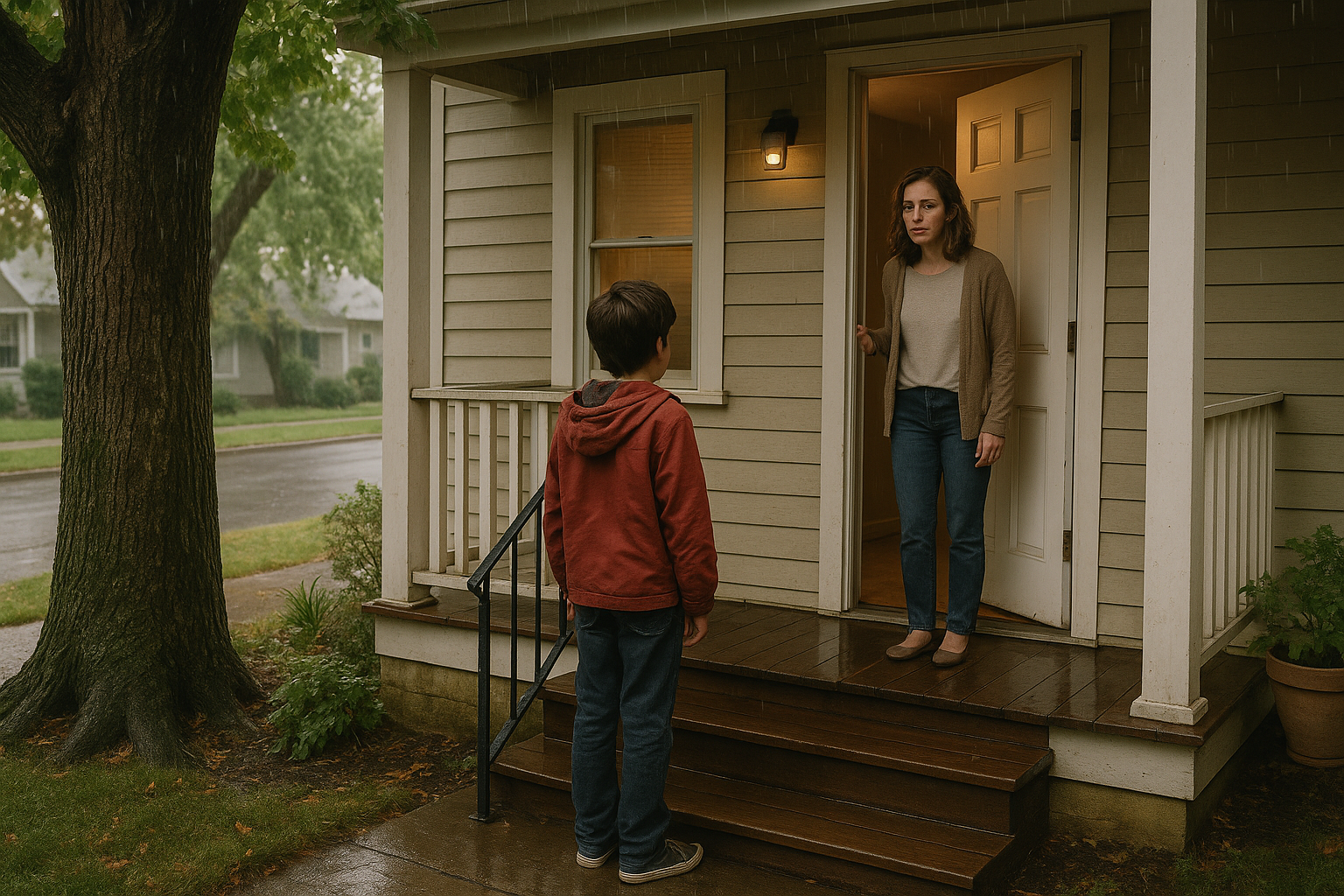
The first time, it was raining. A slow, stubborn rain that made our old house smell like wet wood and medicine. Daniel and I were arguing in the kitchen about the care home brochure we’d hidden from Mom. She sat in the living room, small and fragile in her armchair, staring at the muted TV like it was a window to a world she no longer remembered.
The doorbell rang — a clear, bright sound that somehow didn’t fit our tired house. Daniel sighed.
“I’ll get it,” I said, grateful for the excuse to step away.
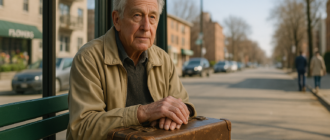
On the porch stood a thin boy, maybe ten, with dark hair plastered to his forehead. He clutched a wrinkled backpack and looked straight into my eyes, not shy, not bold — just… determined.
“Hi,” he said. “Does Mr. Michael live here?”
My father’s name.
For a second, I forgot how to breathe. Behind me, the hallway still smelled like his aftershave. It had been six months since we’d buried him.
“No,” I managed. “He… he doesn’t live here anymore.”
The boy’s shoulders fell, but his face didn’t crumple into the usual child’s disappointment. It was quieter than that, like he’d expected this answer.
“Okay,” he said. “Thank you.”
He turned and walked away in the rain, without asking another house, without looking around as if he might be lost. Just straight down the street.
I watched him until he vanished behind the maple tree.
Inside, Mom asked from her chair, “Who was it, Anna?”
“A boy,” I said. “Wrong house.”
That night, I dreamt of Dad knocking on our own door, soaked in rain, asking if he could come in.
The second Sunday, the doorbell rang again.
Daniel opened it this time. I heard his flat, tired voice: “Can I help you?”
“Does Mr. Michael live here?” the boy asked, the exact same way.
Silence stretched. Then Daniel: “No, kid. He doesn’t.”
Again, the quiet “Okay.” The retreating footsteps.
After the third Sunday, I stopped saying it was strange. It had become something else — an ache that arrived like clockwork.
“Maybe he’s mixed up the address,” I suggested.
“Maybe his parents should pay attention to where he goes,” Daniel muttered, rubbing his eyes. Night shifts at the hospital had carved dark circles under them. “You know how many confused kids I see?”
Mom had started calling him by Dad’s name on bad days. “Michael, could you make some tea?” she’d ask, and Daniel would say nothing, just fill the kettle.
The fourth Sunday, I waited by the window.
He came right on time, in a faded red jacket with a missing button. Same backpack. Same hesitant pause before the bell.
This time, I opened the door before he could press it.
“Hi,” I said softly.
He startled, then recovered. “Hi. Does Mr. Michael live here?”
“Did someone tell you to look for him?” I asked.
He blinked. “I have to find him.”
“Why?”
He hesitated, fingers tightening on the backpack strap. “I just have to.”
“Do you know his last name?” I tried.
He shook his head.
“What’s your name?”
“Eli.”
I swallowed. “Eli, our Mr. Michael… he died.” The words still felt heavy in my mouth. “He was my dad.”
Eli’s eyes flicked past me, into the dim hallway, as if expecting my father to step out and tell me I was wrong.
“Oh,” he said finally. Not I’m sorry. Just oh, like a fact had clicked into place. “Okay. Thank you.”
He turned again.
“Wait,” I said impulsively. “Do your parents know you’re going around asking for him?”
He shrugged. “It’s just me and my grandma. She knows I’m looking.”
“Looking for a stranger named Michael?” Daniel’s voice came from behind me. He leaned on the doorway, jaw tight.
Eli’s gaze dropped. “He’s not a stranger.”
He left before we could ask more.
Weeks turned into a pattern. Every Sunday at three, Eli appeared, always with the same question. Sometimes it was hot and he was sweating. Sometimes the wind cut through his thin clothes. Once, snow clung to his eyelashes.
“Does Mr. Michael live here?”
We tried different answers. “No, he passed away.” “No, he doesn’t live anywhere anymore.” “No, he lived here, but he’s gone.”
It didn’t matter. Eli always nodded, always said okay, always turned away.
Mom began to wait for him.
“Has the little boy come?” she’d ask, craning her neck toward the window. On clearer days, she’d remember Dad was gone and press her cardigan to her chest like armor. On worse days, she’d ask me to make coffee for “our guest” and set out a third cup.
One Sunday, while Mom dozed, I stepped outside before Eli could ring.
“Eli,” I said. “You don’t have to keep coming. There’s no Mr. Michael here anymore.”
He shifted from foot to foot. “I know.”
“Then why?”
He looked up at me with an expression too old for his face.
“Because he saved my grandma,” he said. “She says his name every day. She says, if you ever meet a Michael who’s kind, you say thank you for me. I asked her what he looks like, but she just cries and says, ‘He looked tired and kind.’ So I’m looking. She’s sick now. I’m running out of time.”
My throat burned. Behind me, Daniel had gone very still.
“Do you know where he’s from? Anything?” Daniel asked quietly.
“Just that he was a doctor,” Eli said. “He was in the big hospital when my grandma got the virus. Everyone said she wouldn’t make it. But she did. She says a doctor named Michael stayed all night, talked to her when she couldn’t breathe. She says people like him don’t stay long on this earth. So when I see flowers outside a house, or a name that sounds kind…” He shrugged. “I check.”
Dad had been an ICU doctor. During the worst weeks, he’d come home hollow-eyed and shaking, hands still smelling of antiseptic. Two years later, he collapsed in our kitchen.
I grabbed the doorframe.
“Eli,” I said, voice unsteady, “my dad worked at that hospital.”
He blinked. “Lots of doctors are named Michael.”

“Not lots with that exact story,” Daniel whispered.
We brought Eli inside.
Mom was awake, fingers worrying the edge of a cushion. When she saw Eli, her face brightened in that scattered way it sometimes did.
“Oh,” she breathed. “You came back.”
Eli perched on the edge of a chair, backpack clutched.
“Grandma says thank you,” he blurted. “For not giving up on her.”
Mom’s hands stilled. Her cloudy eyes sharpened with a sudden, painful clarity.
“Your grandma…” she said slowly. “A small woman. Gray hair in a braid. She knitted a blue scarf for Michael and made him promise to wear it when it was cold.”
Eli’s mouth fell open. “You know her?”
Mom pressed her hand over her heart. “I washed that scarf by mistake. It shrank. Michael laughed and said that was a sign he had to go back and check on her. He… he came home so tired that night.” Her voice broke.
Daniel sat down hard.
“Mom,” he said, “it’s the same woman, isn’t it?”
Her eyes filled. “Of course it is. He said there was a boy in a photo by her bed. A boy with a serious face. That must be you.”
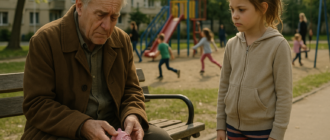
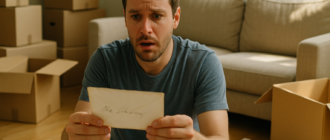
Eli reached shakily into his backpack and pulled out a folded photograph. A younger version of himself, front teeth missing, stood beside an old woman in a hospital gown, grinning.
Mom’s fingers trembled as she took it. “He was so proud of this,” she whispered. “He said, ‘Look, Laura, this is why we do it.’”
The room went very quiet. I realized I was crying only when a tear slid onto the photo.
“I’m sorry I didn’t find him sooner,” Eli said in a rush. “Grandma kept saying, ‘Thank him if you can. Tell him I’m still here because he cared.’ I thought maybe if I found the right Michael, everything would make sense.”
“You did,” I said. “You found him. Just a little late.”
Eli’s face crumpled. “Is it too late to say thank you?”
Mom reached forward, fingers brushing the air near his hand, unsure if she was allowed to touch.
“No,” she said, voice firm. “No, it’s not.”
We made tea. Eli told us about his grandma — Irene, who baked bread that never rose properly, who called every bird “sweetheart,” who now struggled to get out of bed. We told him about Dad — Michael, who fell asleep sitting up, who sang off-key in the car, who stayed too long at the hospital and never long enough at home.
When Eli left, it was already dark, even though it was barely evening. Winter does that — steals the light before you’re ready.
“I’ll come next Sunday,” he said at the door. “If that’s okay. Grandma would like to know where he lived.”
Mom nodded, tears shining. “Tell her he lived in a house full of love,” she said. “And that her boy is very brave.”
Eli smiled — a small, lopsided thing — and went down the steps, hugging his backpack.
He came the next Sunday. And the next. Sometimes he brought a note from his grandma, shaky handwriting spilling over the edges of the paper: Thank you for giving me more sunsets. Thank you for sitting beside me when I was afraid to sleep.
Mom kept the notes in Dad’s old watch box.
Then, one Sunday, the doorbell did not ring.
At first, it felt like any other quiet afternoon. Daniel napped on the couch, exhausted. Mom dozed, her breaths shallow but steady. I made tea for three out of habit, the third cup cooling untouched.
By four, I was pacing.
“Maybe his grandma’s having a good day,” Daniel said. “Maybe they went somewhere.”
But the next Sunday, and the one after that, our porch stayed empty.
I found the photograph of Eli and his grandmother, pinned by a magnet on our fridge. His serious eyes seemed to accuse me.
“Something’s wrong,” I said.
We didn’t know their last name. Didn’t know their exact address. Just a few details Eli had dropped without thinking: a brick building near the bus depot, a grocery store with a broken sign, the way his grandma complained about the third-floor stairs.
It was enough.
We found the building on our second try. The stairwell smelled of dust and old cooking oil. On the third floor, an older woman opened the door, thinner than in the photo but unmistakable.
“Are you Irene?” I asked.
Her hand flew to her mouth. “You must be his family,” she whispered. “Michael’s family.”
Inside, the apartment was small but tidy. On the nightstand by the bed lay a neatly folded blue scarf, frayed and shrunken.
“Where’s Eli?” I asked.
Her eyes filled. “He’s at the hospital,” she said. “He caught a bad infection. They said it’s serious. He kept saying, ‘I have to go on Sunday. They’re waiting. I still haven’t said thank you right.’ I told him to rest. He said… he said you looked like you needed him too.”
The air left my lungs.
Daniel was already pulling out his phone. “Which hospital?”
An hour later, we stood at the same entrance where Dad had once staggered out after twenty-hour shifts.
Eli lay in a pediatric ward, pale but awake, an oxygen tube under his nose. When he saw us, his face lit up — the first real, unguarded smile I’d seen on him.
“You came,” he said.
“You didn’t,” I answered, trying to make it sound like a joke. It came out as a sob.
Daniel, in his worn nurse’s badge, spoke to the attending physician in low, urgent tones. Mom, surprisingly steady, sat by Eli’s bed.
“I brought you something,” she said, pulling the watch box from her bag. Inside, under Dad’s old notes and Irene’s letters, was a small, worn ID badge: Dr. Michael Harris, ICU.
Eli traced the name with one finger.
“That’s him,” he whispered.
“That’s him,” Mom echoed.
He swallowed. “Thank you, Mr. Michael,” he said, voice trembling. “For my grandma. For Sundays. For… for giving me more time.”
Mom closed her eyes. For a moment, her face was younger, the lines of grief softened.
“I think he heard you,” she said.
Eli’s infection responded to treatment faster than expected. Daniel would later say it was good medicine, good timing, good luck. Mom would say quietly, to no one in particular, “He stayed a little longer for the boy.”
Now, every Sunday, our doorbell still rings.
Sometimes it’s Eli, healthier and louder, asking Mom about Dad’s “hero stories.” Sometimes it’s Irene, leaning on her cane, insisting on bringing over lopsided bread. Sometimes it’s a neighbor returning a dish, or a delivery man with the wrong address.
But every time it rings, Mom sits up a little straighter. Daniel’s jaw unclenches. The house smells less like medicine and more like something alive.
We never sent Dad a proper thank you. There were always more shifts, more crises, more reasons to wait.
In the end, it came from a boy who rang our doorbell every Sunday, asking the same impossible question, until the day he didn’t come and we finally understood that grief doesn’t end a story.
Sometimes, it hands it to someone else to finish.