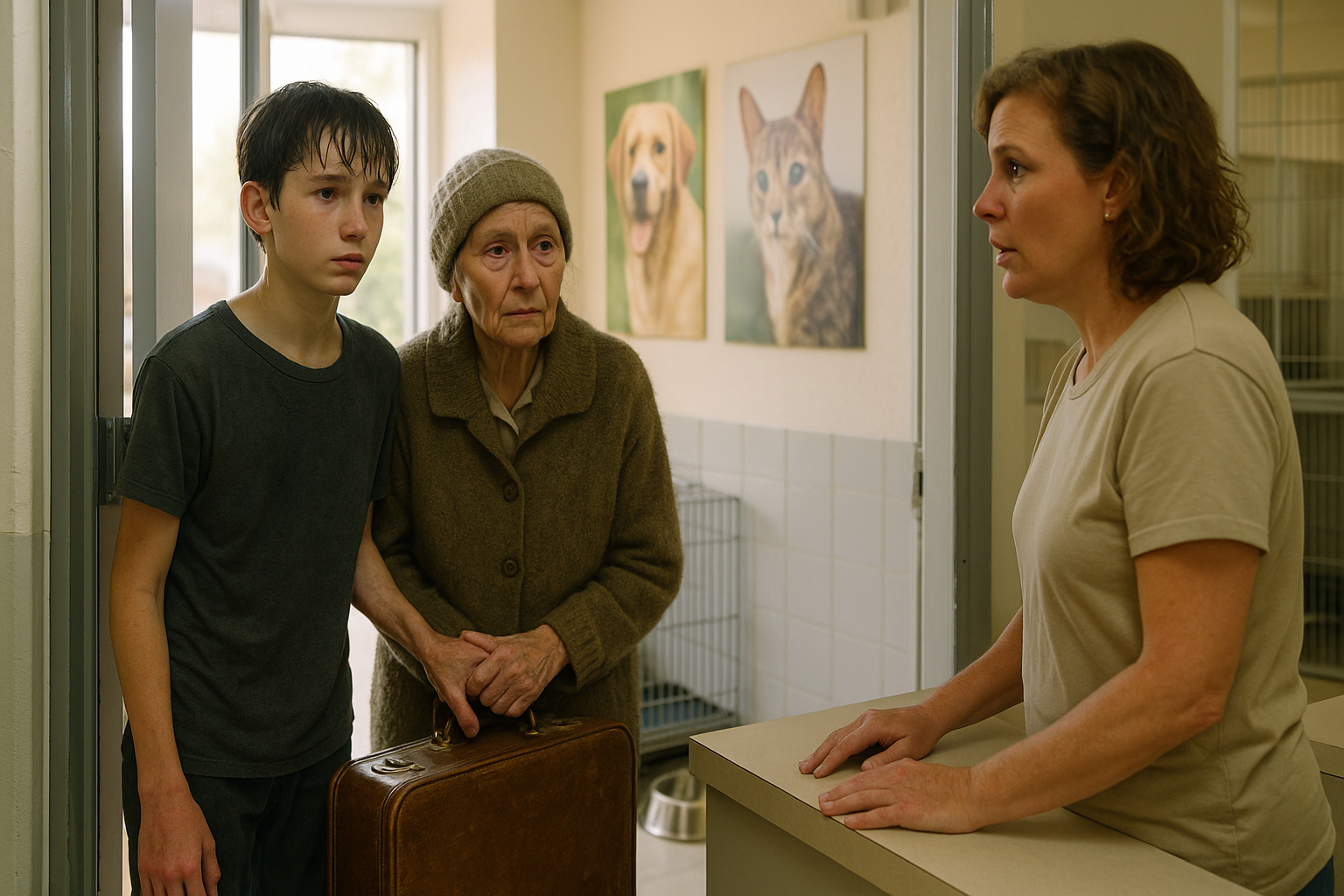
The day Daniel walked into the shelter with a suitcase and asked if someone could adopt his grandmother, the whole room went silent.

He was twelve, thin as a reed, his hair damp from the rain. Behind him, holding onto the handle of an old brown suitcase with both hands, stood an elderly woman in a faded blue coat. Her gray hair was tucked under a knitted hat, and her eyes kept searching Daniel’s face like she was afraid he might disappear.
The shelter was meant for abandoned animals. Posters of dogs and cats covered the walls, bowls clinked somewhere in the back, and a volunteer was filling out adoption forms at the front desk. No one had ever come here with a human being and a suitcase.
“Excuse me,” Daniel said, his voice hoarse. “Do you take people?”
The volunteer, a woman named Karen in her forties, blinked. “Honey, this is an animal shelter. Are you lost?”
He swallowed. “We’re not lost. I… I need someone to adopt my grandma. I can help take care of the dogs in return.”
The old woman tugged lightly at his sleeve. “Daniel, please,” she whispered. “We’ll find another place.” The words trembled as much as her fingers.
Karen stood up slowly. Something in Daniel’s face — the desperate tightness around his mouth, the way he tried to stand a little taller — cut through the routine of paperwork and barking.
“Come here, both of you,” she said softly. “Sit down. Tell me what happened.”
They sat on a bench near the door. Wet footprints formed a small, sad trail on the linoleum.
“Our landlord said we have to leave today,” Daniel began, staring at his shoes. “Mom left a year ago. Grandma says she went to ‘chase her dreams,’ but she never came back. Grandpa died when I was six. Grandma cleans houses, but she got sick and lost her job.”
He glanced at his grandmother, who was silently folding and unfolding a handkerchief.
“The landlord said we’re three months behind on rent. He changed the lock this morning. We… we don’t have anywhere to go now.”
Karen’s throat tightened. “Do you have any other family?”
“We called Uncle David,” Daniel said. “He said he can take me ‘for a while’ but not Grandma. He said he can’t ‘handle an old lady with problems.’” His voice broke on the last word.
“I’m not a problem,” the grandmother murmured, almost apologetically. “I just… forget some things.”
Daniel nodded quickly, as if defending her in court. “Sometimes she forgets what day it is, or where the salt is. But she remembers me. She always remembers me.”
He dug into his backpack and pulled out a crumpled sheet of paper. On it, in a child’s careful handwriting, was a list:
1. Kind
2. Has a warm house
3. Doesn’t shout
4. Likes stories
5. Lets me visit Grandma
“I made a list,” he said, pushing the paper toward Karen. “For the person who could adopt her. I can help clean or walk dogs. I’m good with animals. But Grandma needs a bed and medicine.”
Karen pressed her lips together to keep them from trembling. Behind the desk, a young volunteer pretended to sort flyers, wiping his eyes with the back of his hand.
“Sweetheart,” Karen said gently, “you can’t just give away your grandmother like a pet.”
“I’m not giving her away,” Daniel protested. “I’m trying to save her. Uncle David will only take me if Grandma goes to some… place. A ‘facility.’ He says they won’t let kids visit all the time. So if someone adopted her, I could visit. I’d know she’s safe.”
That was the moment the shelter went from a noisy building full of animals to a room where everyone was listening to the shattering of one little boy’s idea of childhood.
Karen knelt in front of him. “Where is Uncle David now?”
“In his car. Around the corner.” Daniel’s shoulders slumped. “He said I have ten minutes to ‘do something with Grandma’ or he’ll call the police and they’ll take her wherever they take old people no one wants.”
The words hung in the air like a bad smell.
Karen’s chest burned. She stood up, grabbed her phone, and muttered, “Stay here.” She walked a few steps away and dialed a number she hadn’t used in months — her older sister, Emily, a social worker.
“Em, I need you at the shelter. Now,” she said. “It’s… urgent.”
Within fifteen minutes, Emily arrived, her coat unbuttoned, hair still messy from rushing out of the house. She listened quietly as Karen retold the story, watching Daniel and his grandmother from across the room.
Then she walked over and sat beside the elderly woman.
“My name is Emily,” she said gently. “What’s your name?”
“Maria,” the grandmother replied. “This is my boy, Daniel. He thinks he has to be the adult.”
Emily smiled sadly. “Sometimes children grow up too fast because adults around them forget how.”

She turned to Daniel. “Can you introduce me to your uncle?”
The twist came in the parking lot.
Uncle David was leaning against an aging sedan, scrolling through his phone. He looked up with irritation when he saw the two women and Daniel.
“Did they take her?” he asked, as if talking about a broken TV.
Emily showed her badge. “I’m with social services. We need to talk.”
His face changed color. “Oh, come on. I’m the good guy here. I’m taking the kid. I can’t afford some old woman who doesn’t even know what day it is. I have my own life.”
“And you thought leaving her at an animal shelter was a reasonable solution?” Emily’s voice remained calm, but her eyes were cold.
“It was the boy’s idea,” David snapped. “He’s dramatic. He’ll forget in a week. Kids adapt.”
Behind them, Daniel stood frozen, every word carving into him.
Emily took a breath. “Here’s what’s going to happen. You’re not taking Daniel anywhere today. We’ll place them both in temporary care together while we look for a better long-term solution. Separating them right now would be harmful.”
David threw up his hands. “Fine. Take them. I tried. Don’t call me when things go wrong.” He got into his car and drove away without saying goodbye to his nephew.
Daniel watched the car turn the corner. He didn’t cry. His face just seemed to fold in on itself, as if he’d become smaller.
Back inside, Karen led them to the small staff kitchen. She made tea for Maria and hot chocolate for Daniel.
“So… they’re taking us to a facility?” Daniel asked quietly.
Emily sat down opposite him. “Not exactly. There’s a program for emergency family placements. People who open their homes for situations like this. Just for a while, until we figure out something stable.”
“And Grandma stays with me?”
“Yes,” Emily said. “That’s non-negotiable.”
His shoulders lowered, just a little.
Karen hesitated, then spoke. “Em… what about me? I have a spare room. My son is at college most of the year. It’s not a palace, but it’s warm. And I like stories.” She glanced at Daniel with a half-smile. “And I never shout.”
Emily raised her eyebrows. “You sure?”
Maria looked up, eyes wet. “We don’t want to be trouble.”
“You’re not trouble,” Karen replied. “You’re just… people. People who need a place to land.”
That night, instead of sleeping on a shelter bench or in separate, faceless buildings, Daniel helped carry the old brown suitcase into Karen’s small house. There was a spare bed with a handmade quilt for Maria, and a mattress in the corner of Karen’s son’s room for Daniel.
As he unpacked, Daniel placed the crumpled list on the bedside table next to Maria’s bed.
“Why did you bring that?” Maria asked softly.
He smiled for the first time that day. “To check if we chose the right place.”
He read it out loud:
“Kind.” He glanced through the open door, where Karen was fussing in the kitchen, adding extra marshmallows to his cocoa.
“Has a warm house.” The heater hummed, and the room smelled faintly of laundry and cinnamon.
“Doesn’t shout.” The only voices were quiet, careful, like they were afraid to break something fragile.
“Likes stories.” On the shelf above the bed, there were books with worn covers and bookmarks made from bus tickets.
“Lets me visit Grandma.” He looked at Maria, reached for her hand, and squeezed.
“I think,” he said slowly, “we might have found someone who adopted both of us, without even reading the list.”
Maria closed her eyes, and for the first time in a long while, her forgetfulness felt less like a curse and more like a mercy: maybe she would forget the landlord’s cold voice, the slammed door, the car driving away. But she knew she would remember this — the boy who tried to give her away to save her, and the strangers who refused to let either of them be unwanted.
In the quiet of that small, warm house, with a dog from the shelter snoring softly at their feet — a dog Karen had “forgotten” to return after a foster stay — Daniel finally allowed himself to be what he had almost forgotten how to be.
A child, with his grandmother beside him, and a tomorrow that didn’t look like a locked door.