The old man kept standing every afternoon at the school gate, until one day a teacher followed him home and found out who he was.

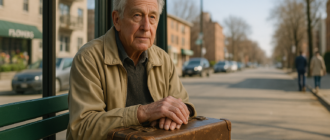
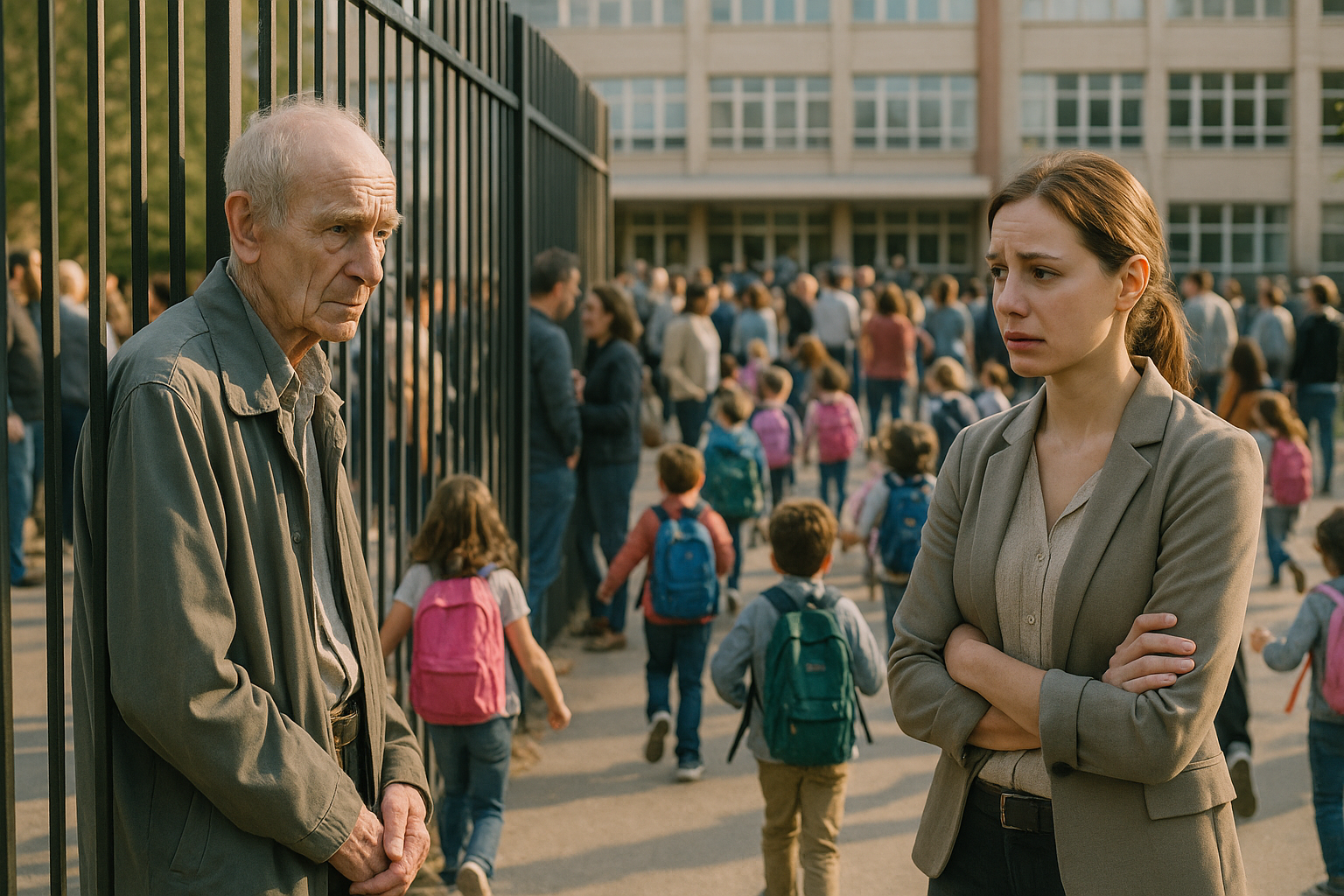
For three weeks, Emma had watched him from the staffroom window. Always the same: a thin man in a worn gray coat, maybe in his late seventies, hands clasped behind his back, eyes searching the stream of children spilling out of the building. He never spoke to anyone, never called out a name. He just watched, his gaze moving over every small face with a desperate, almost painful hope.
At first the other teachers joked. “Our new security guard,” Mark from math said. “Maybe he just likes the noise,” someone else shrugged. But Emma, who taught the youngest class and noticed the smallest things, didn’t laugh. She saw how his shoulders tensed each time the doors opened, how his lips moved silently as if he was whispering names only he could hear.
One rainy Thursday she stepped outside, holding an umbrella over her head. The man was there, of course, his thin jacket already damp.
“Sir?” she said carefully. “Are you waiting for someone?”
He flinched, as if pulled back from somewhere far away, then gave a polite, almost embarrassed smile.
“I’m sorry,” he murmured. His English carried a faint Eastern accent. “I am not… disturbing? I stay on the sidewalk. I do not talk to the children.”
“No, you’re not disturbing.” Emma hesitated. “It’s just… we noticed you come every day. Do you have a grandchild here?”
He looked past her to the children running through puddles, his eyes suddenly glassy.
“Maybe,” he said softly. “Maybe I do. I just don’t know which one.”
Before she could ask, a parent called her name, and by the time she turned back, the old man had already walked away, his steps slow but determined.
That night, his words wouldn’t leave her alone. Maybe I do. Maybe I don’t know which one.
The next afternoon she waited by the gate on purpose. When he appeared, she walked up again.
“I’m Emma,” she said. “I teach here. Would you… like to come inside and talk for a moment?”
He shook his head quickly. “No, no inside. I am fine here. Fresh air.” He gave a short, apologetic laugh. “I am Daniel.”
They stood in silence as the bell rang and children flooded out. Daniel’s eyes scanned them, faster now, almost panicked, then slowed, then dimmed.
“Not today either,” he whispered.
“Who are you looking for?” The question slipped out, gentle but firm.
He swallowed. “My granddaughter. Maybe.”
Emma’s heart clenched. “Maybe?”
“My son,” he began, then stopped, as if the words were too heavy. “My son Michael. We had big argument seven years ago. He moved away, changed number, email, everything. My wife died the year after. I am alone now.” He rubbed his hands together, nervous. “Last month, in the market, I met an old neighbor. She said, ‘Daniel, I saw your son on social media. He lives near the big school on Hill Street. He has a little girl now.'”
His voice broke on the last words.
“Hill Street,” he repeated. “There are three schools. I walk. I look. Maybe she comes out one day and… I will know.”
Emma felt something twist inside her. “Do you know her name?”
“No.” His eyes filled with shame. “He does not speak to me. I only know she is six. Or seven. She has his eyes, neighbor said.” He shrugged helplessly. “How many little girls with brown eyes, teacher?”
She stared at the river of children. Hundreds of them. “Why don’t you ring his doorbell?” she asked quietly.
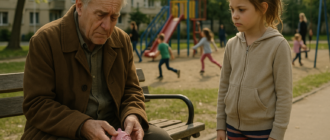
Daniel’s jaw tightened. “I don’t know exact building. Only this street. And… he said last time we speak that I am ‘dead’ to him. If I go, maybe he calls police. But if I stand here… maybe she will see me. Children are kinder.” He gave a fragile smile. “Maybe she will wave.”
A sharp wind cut between them. Emma realized his shoes were cracked, his fingers red with cold.
“Would you let me try to help?” she asked. “Maybe we can find him in the system, or—”
“No, no trouble,” he interrupted quickly. “I don’t want him to be angry more. I just want to see her once. From far. That is all.”
The bell echoed in her ears long after the yard emptied. When she turned back, Daniel was already at the corner, a small, bent shadow against the gray sky.
For a few days he didn’t come. Each afternoon Emma found herself glancing at the gate, feeling an unreasonable disappointment. On the fourth day, she saw him again—slower, paler, one hand pressed to his chest as if it hurt to breathe.
She made up her mind.
When the last student left, she quietly followed him. He walked two bus stops, then three, refusing to sit, as if his bones were made of stubbornness instead of calcium. Finally he turned into a crumbling building with a broken intercom. Emma waited a minute, then entered behind a neighbor carrying groceries.
She found his door on the fourth floor by the piece of cardboard taped to it: “D. Kovac” written in shaky letters.
Her knock echoed in the dim corridor. After a long pause, the door opened a crack.
“Emma?” he asked, surprised, almost frightened.

“I’m sorry,” she said, suddenly aware of how this looked. “I followed you. I was worried. Can I come in for a minute?”
His apartment was almost empty. A narrow bed, a small table, one chair. On the wall, a faded photograph of a young man holding a baby, both faces turned away from the camera as if hiding from her.
“This is him?” she asked softly.
Daniel nodded, sitting on the edge of the bed because there was nowhere else.
“He was angry because I worked too much,” he said. “Because I pushed him to study, to be better than me. I said stupid things. ‘You are ungrateful, you will understand when you have your own child.'” His eyes filled with tears. “He understood. But too late for me.”
Emma took a breath. “Do you know his last name now? Where he works? Anything?”
He shook his head. “Only that he lives near your school. That is enough. Every day I stand there, I think… what if she has his little nose? His way of walking? I will know. A grandfather always knows, yes?” He tried to smile, but his lips trembled.
Emma looked at the photograph, at the bare room, at his trembling hands. In that moment she realized the terrible truth: he could stand at that gate for years and never recognize the right child. Hundreds of girls with brown eyes, with small noses, with nervous steps. He was searching for a ghost.
“Daniel,” she said carefully, “what if he moved last year? What if she goes to a different school now?”
The possibility seemed to physically hit him. His shoulders slumped. For a long time he said nothing.
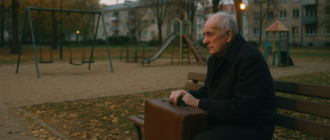
“Then I was late again,” he whispered finally. “First I was late saying ‘I’m sorry’ to my son. Now I am late saying ‘hello’ to my granddaughter. I always come after.” He rubbed his face with both hands. “Maybe it is better if I stop. I don’t want to scare the children.”
The next day he didn’t appear at the gate.
Emma told herself she had done her part. She had listened. She had offered help. He had said no. Life moved on. Homework piles, parents’ meetings, broken crayons, lost gloves. Still, every afternoon, when the bell rang, she found her eyes drawn to that one empty spot by the fence.
A week later the principal entered the staffroom with a letter in his hand.
“Emma, this came for you,” he said. “From a man named Daniel. He asked the caretaker to give it to ‘the young teacher with sad eyes’.” He smiled faintly. “I assume that’s you.”
Her fingers shook as she opened the envelope.
Inside was a single page, written in careful, uneven handwriting.
“Dear Teacher Emma,
Thank you for talking to an old fool at the gate. Tomorrow I go to the hospital for my heart. Maybe I will come back, maybe not. I am not afraid. I am only afraid that my granddaughter will pass by the gate and nobody will look at her like I did.
If you ever see a little girl with my son’s eyes (you don’t know them, but your heart will), please tell her that somewhere in this city there was a grandfather who waited for her every day and was sorry.
Thank you for following me home. It is nice when someone follows you not to hurt you, but to see if you arrive.
Your friend,
Daniel”
There was no address for a reply. No surname of the son. Only, pressed between the pages, a tiny photograph so worn it was almost white: a young man sitting on a park bench, a baby on his lap. Both faces turned away.
Daniel never came back to the school gate.
Months passed. Spring painted the yard with dandelions, then summer emptied it, then autumn filled it again with taller children and new backpacks. Sometimes, when the light hit just right, Emma imagined she saw his outline by the fence, hands behind his back, searching.
One afternoon, as the leaves turned orange and gold, a little girl from her new class stayed behind after everyone left. She had big brown eyes and a serious, thoughtful face.
“Miss Emma?” she asked. “Can I ask something weird?”
“Of course.”
The girl twisted the strap of her backpack. “Do grandpas wait for you even if you don’t know them? My mom says her dad was stubborn and they don’t talk, but sometimes I feel like… someone is watching me from far away and being sad. Is that crazy?”
Emma’s throat closed.
She knelt to be at the girl’s eye level. In those eyes she saw nothing of Daniel for certain—and everything of him at once. His hope. His regret. His impossible, stubborn love.
“It’s not crazy,” Emma said, her voice barely steady. “Sometimes people wait for us even when we never see them. And even if we never meet them, the waiting still means something.”
“So… he loves me?” the girl whispered.
Emma didn’t ask for the mother’s name. She didn’t ask where they lived. She didn’t compare faces or search for proof. She simply placed a hand over her own heart, where a letter in uneven handwriting seemed suddenly very heavy.
“Yes,” she said. “He loves you very much.”
The girl smiled—a small, shy thing that lit up her entire face—then ran off to her mother waiting at the corner.
Emma watched them go, then turned to the empty gate.
“She knows, Daniel,” she whispered silently. “Somehow, she knows.”
And for the first time since the old man had disappeared, the place by the fence didn’t look empty anymore. It looked like a promise that had finally, quietly, reached the child it was meant for.