My father’s second family lived 20 minutes from our house.
I found out because of a wrong delivery.
A pizza, of all things.
It was a Sunday.
My mom, Anna, had a migraine, so she went to bed early.
My dad, Mark, was “working late again”.
I was alone in the living room, watching some show with the volume low.
The doorbell rang.
A delivery guy stood there with two big pizza boxes.
“Order for Mark,” he said.
I shook my head. “You’ve got the wrong house.”
He showed me the screen with our exact address.
Under the notes it said: “Call when outside, kids asleep. Don’t ring.”
There was also a phone number.
My father’s number.
I froze.
The guy scratched his head and said, “He orders every Sunday. Maybe it’s just saved wrong?”
He called the number.
I heard my father’s ringtone from the kitchen.
His phone was charging on the counter.
The delivery guy canceled the order and left.
I stood in the hallway with my dad’s phone in my hand.
On the screen: 8 missed calls from a number saved as “Emma (work)”, plus three unread texts.
The last one: “Kids want to see you before bed. Don’t be late again.”
We don’t have little kids at home.
I’m 22.
My parents always said they “didn’t manage” to have more.
My mom came out of the bedroom, holding her head.
“Was someone at the door?” she asked.
I said it was a wrong address.
My voice sounded strange, even to me.
She didn’t notice.
She never notices when she has a migraine.
When she went back to bed, I opened my father’s phone.
I’d never done that before.
He always preached about trust.
The first thing I saw was a separate messaging app.
Not the one we all use.
The icon was hidden in a folder called “Tools”.
His account name inside was just “M”.
The top chat was “Emma”.
No surname.
Just a small photo of a woman holding a baby.
The last messages were from that day:
“Don’t forget milk and the dinosaur pajamas for Noah.”
“Lily made you a drawing, she’s waiting.”
“I’m tired of explaining why daddy doesn’t sleep here.”
There were photos.
A boy about four.
A girl maybe six.
My father with them in a park, on a sofa, in a small kitchen with yellow tiles.
He looked younger there.
Softer.
Like someone I didn’t know.
I scrolled back.
Years.
The first message from Emma was almost seven years ago.
“Hi, it’s Emma from the training. Let me know you got home safe.”
Then coffee.
Then “I’m late.”
Then “Positive.”
Then a picture of a pregnancy test.
I read in silence until I heard the gate.
My father’s car.
I put the phone back on the charger.
My hands were shaking so much I had to use both.
He came in, kissed my forehead, asked about mom.
He smelled like fried food and some perfume that wasn’t my mother’s.
“Did anyone call?” he asked.
“Just spam,” I said.
He nodded, checked his phone, and for a moment his face tightened.
Then he smiled again.
That night I didn’t sleep.
I kept thinking about the kids in the photos.
My brother and sister, technically.
Growing up thinking their father was just “busy with work”.
Like I did.
The next day, when my father left for work, I followed him.
I told my mom I was meeting a friend.
I walked to the bus stop, waited, then took the first bus going in his direction.
I tracked his location through the family app he’d installed himself.
“Safety,” he called it.
He didn’t go to the office.
He drove to a residential area I’d never been to.
Quiet streets.
Small houses with tiny gardens.
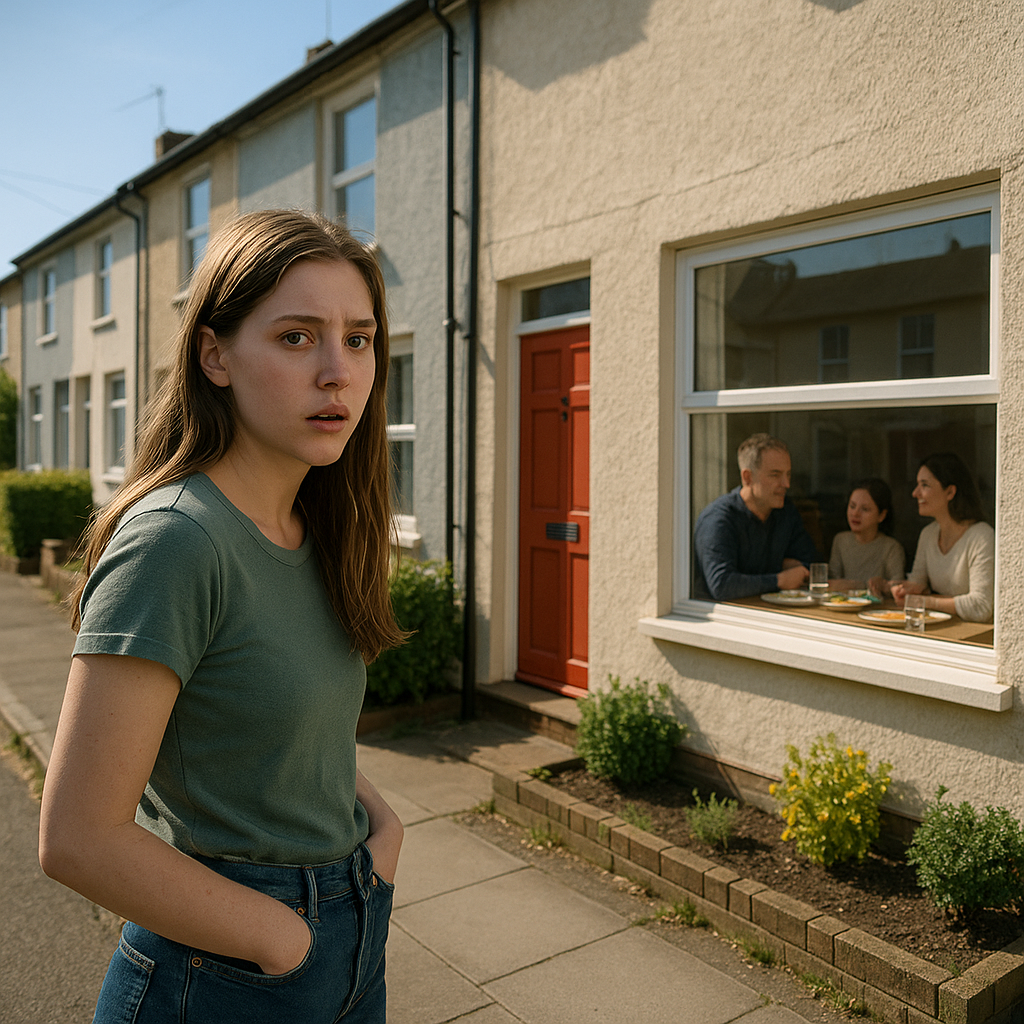
He parked in front of a beige house with a red door.
He took a bag from the trunk — milk, cereal, a toy dinosaur sticking out.
He rang once.
The door opened almost immediately.
Emma.
I recognized her from the photo.
Loose hair, oversized T-shirt, tired eyes.
She smiled when she saw him.
The two kids ran to the hallway, socks sliding on the floor.
“Daddy!” they shouted.
He dropped to his knees and hugged them.
He looked happy.
Not like at home, where he was always tired, always busy.
He went inside.
The door closed.
I stood across the street.
My hands were in my pockets, but my nails were cutting into my palms.
I waited.
Ten minutes.
Twenty.
Forty.
I walked closer and looked through the front window.
No curtains.
Inside, a small table.
Four plates.
My father pouring juice.
The boy sitting on his lap.
The girl showing him a drawing.
Emma putting bread on the table.
It looked like a picture from a catalog.
Except it was my father.
My phone buzzed.
A message from my mother.
“Can you bring bread when you come home? We’re out.”
She added a smiley she rarely uses.
I stared at the screen, then at the table inside.
My father, at another table, with another family, already eating bread.

I didn’t ring the bell.
I didn’t knock on the window.
I just walked away.
I bought bread at the corner store.
White, cheapest brand.
At home, my mom was making soup.
She looked pale but better.
She thanked me for the bread.
She asked if I’d eaten.
I said yes.
It wasn’t a lie.
I’d swallowed something that wouldn’t go down.
In the evening, my father came home “late from work”.
He hugged my mom from behind while she washed the dishes.
She flinched, then relaxed.
He looked at me over her shoulder.
For a second, our eyes met.
I thought he saw everything.
Or maybe I just wanted him to.
At night, I opened his messaging app again.
There was a new photo.
The boy in dinosaur pajamas, smiling at the camera.
Text from my father:
“Goodnight, champ. Daddy loves you.”
I stared at that sentence.
He’d never written that to me.
Not once.
In the morning, I printed three photos from his secret gallery at a self-service kiosk.
One of him with the kids.
One of the house.
One of Emma holding the baby.
I put them in a plain envelope.
No note.
No explanations.
I left the envelope on the kitchen table before leaving for university.
Right under the salt shaker.
Somewhere he couldn’t miss, and she couldn’t ignore.
By noon, the family app showed both of them at home.
Their two dots, close together, not moving for a long time.
My father’s phone was offline after 2 p.m.
My mother’s dot stayed at home.
Didn’t move all day.
No one called me.
No one wrote.
I went to a café, ordered coffee I barely touched, stared at the street.
People walked by, carrying groceries, talking on the phone, laughing.
Nobody looked like their whole family had just been quietly replaced.
When I came home in the evening, the envelope was gone.
The photos were gone.
The salt shaker stood exactly where it had always been.
The house looked the same.
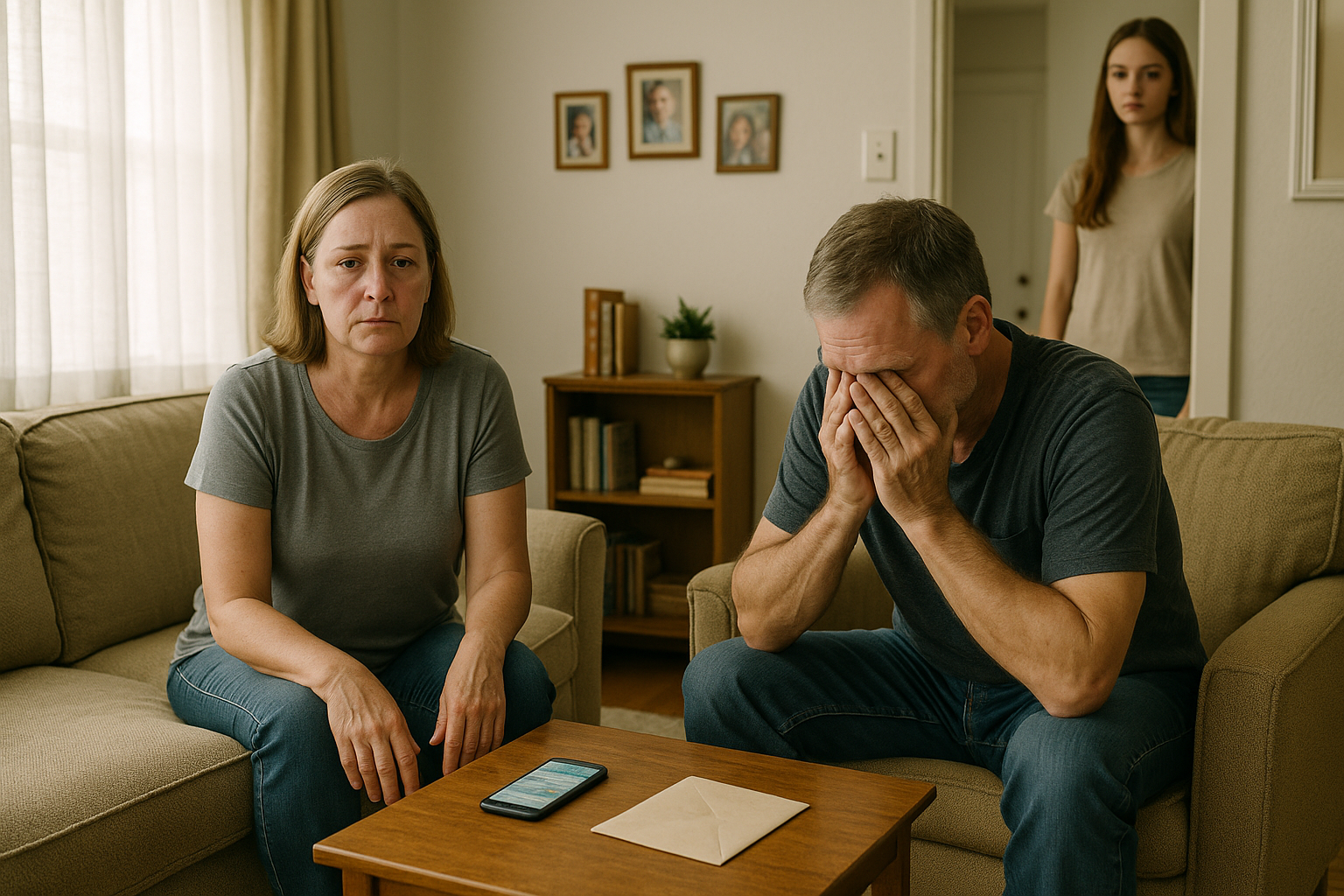
My mother was in the living room, sitting very straight, hands on her knees.
My father was in the armchair, elbows on his thighs, face in his hands.
Between them on the table lay my father’s phone.
The secret app was open.
My mother’s eyes were red but dry.
She looked at me and asked, very calmly:
“How long have you known?”
I said, “Since yesterday.”
She nodded.
My father still didn’t look up.
Nobody shouted.
Nobody threw anything.
No one begged.
We just sat there in that small room, in that small house, that turned out to be only half of his life.
Later that night, he packed a bag.
Not all his things.
Just enough.
He took his documents, a few shirts, his laptop.
He didn’t touch the photo albums.
He didn’t take any pictures from the walls.
At the door, he finally looked me in the eyes.
He opened his mouth like he wanted to say something.
Then closed it again.
He left without a word.
The house is quieter now.
My mom sleeps with the lights on.
I do the shopping.
I answer her texts right away.
On Sundays, when I hear a scooter outside, I still think of that pizza order.
Somewhere, twenty minutes away, he sits at another table.
Two kids ask him when he’s staying for the night.
I don’t hate them.
They didn’t lie to anyone.
They were just born.
Like me.
We don’t talk about him at home.
We talk about bills, about work, about what to cook.
The big things happened in silence.
Now we only handle the small ones.
It’s not a dramatic ending.
Just a different kind of Sunday.
With one less plate on our table.