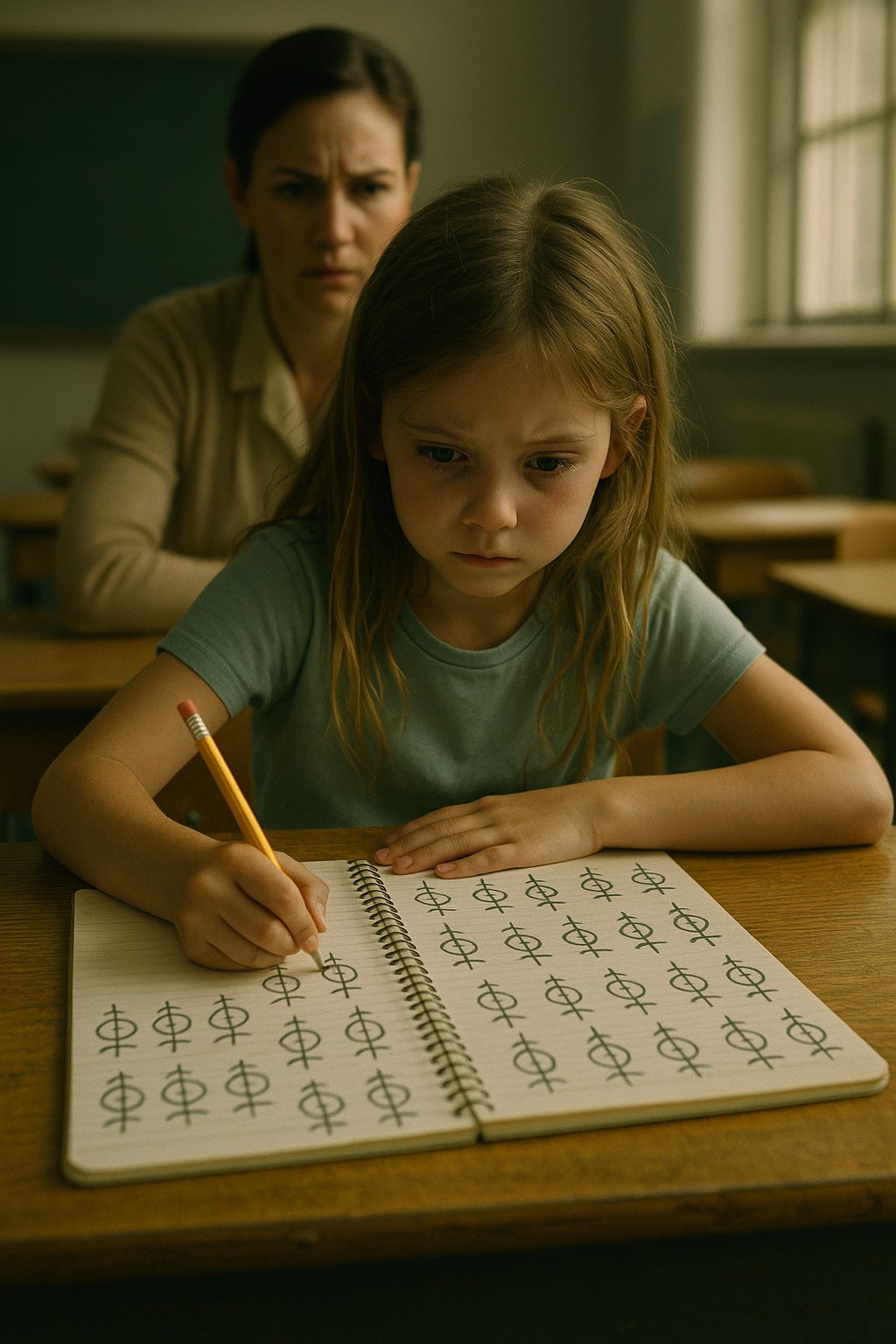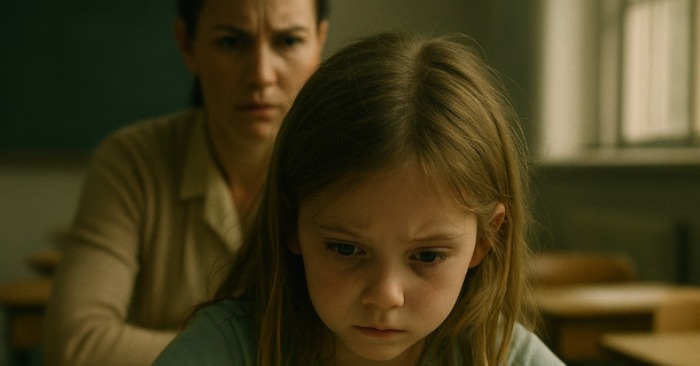
Six-year-old Emily was a bright, happy child. She loved coloring books, fairy tales, and doodling animals in the margins of her homework. But one afternoon, her teacher noticed something strange.
Instead of the usual flowers and suns, Emily had filled her entire page with the same symbol. Over and over.
It wasn’t a heart, or a star, or even letters. It was a circle with jagged lines through it, almost like a sun — but uneven, broken, sharp. She drew it carefully, deliberately, as if she’d practiced it a hundred times before.
When the teacher asked what it was, Emily just shrugged. “I don’t know. It just comes into my head.”
At first, her parents thought nothing of it. Kids draw weird things all the time. But the symbol didn’t go away. Emily drew it on her math worksheets, her notebooks, even her bedroom wall.
One evening, her father found her sleepily sketching it onto the fogged bathroom mirror after a shower. “Emily,” he said gently, “why do you keep drawing that?”
Her answer made him shiver.
“Because he tells me to.”
Alarmed, the parents took the drawings to a child psychologist. The doctor asked Emily to explain the “he” she mentioned. Emily tilted her head, thinking.
“He’s old,” she said. “He stands in the corner of my room at night. He wants people to remember him. The symbol is his name.”
The psychologist frowned but didn’t press further, chalking it up to imagination.
But when the doctor casually showed the symbol to a colleague — an anthropologist — everything changed.
The man’s face drained of color. “Where did you get this?”
He explained that the symbol wasn’t random. It was nearly identical to a marking found in an ancient burial site in Eastern Europe, associated with a pre-Christian cult. The symbol, known in academic circles as “The Sun Fractured,” was linked to rituals meant to preserve memory of the dead.
“It hasn’t been seen in centuries,” the anthropologist whispered. “And certainly not here.”
Emily’s parents were stunned. How could their six-year-old daughter, who had never left their small town, know something tied to an obscure ancient culture?
As the weeks went by, Emily’s behavior grew stranger. She began waking in the night, muttering words in a language her parents didn’t recognize. Sometimes she would sit at the kitchen table at dawn, tracing the symbol into salt spilled from the shaker.
One night, her mother woke to find Emily standing at the foot of the bed, whispering: “He says you mustn’t forget him. He’s still waiting.”
Terrified, they contacted the anthropologist again. This time, he visited their home. When Emily calmly drew the symbol for him on a napkin, he trembled.
“That’s not just similar,” he said. “That’s exact. The same number of lines, the same fractures. This girl is reproducing something she could not possibly know.”
He suggested the family search their property records. To their shock, they discovered that their home had been built over farmland once owned by an immigrant family in the late 1800s. That family traced their roots directly back to the same Eastern European region where the burial site had been discovered.
And one of their sons — a child who died young — had been buried somewhere on the land, his grave marker long since lost.
The anthropologist believed Emily had tapped into something — not possession, but memory. A child’s mind replaying a story buried deep in the ground beneath her feet.
Still, the family couldn’t shake their fear.
One night, desperate, Emily’s mother asked her, “Who is he, sweetheart? Who’s asking you to draw this?”
Emily put down her pencil, her eyes glassy.
“He says his name was forgotten. But if I keep drawing it, people will remember. Then he can rest.”
The next morning, her parents placed flowers in the backyard, near the spot where old maps suggested the burial had once been. They told the unseen child they remembered him, that his name — though lost — wasn’t gone forever.
That night, Emily slept through without waking.
And for the first time in months, she didn’t draw the symbol again.