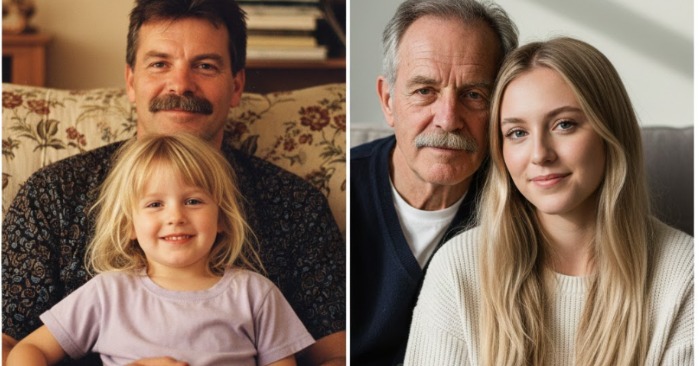
They say time heals, but some truths stay buried until they are ready to be found. Twenty years after a devastating blizzard took my family, my granddaughter gave me a note that revealed everything I thought I knew.
I am 70 years old.
I have buried two wives and outlived almost everyone I called friends. You might think that nothing could shake me anymore.
But grief has a strange way of staying, of changing form. I thought I had learned to live with it. It turns out that it was just waiting for the truth to find me.
I thought I had learned to live with it.
THAT TRUTH BEGAN ONE EVENING WHEN THE SNOW FELL AS IF IT HATED ME.
That truth began one evening when the snow fell as if it hated me.
It was a few days before Christmas, 20 years ago.
My son Michael, his wife Rachel, and their two children came to my house for dinner. I lived in a small town where everyone said hello whether they liked it or not, and blizzards were as common as morning coffee.
The forecaster said there would be a light snowfall, maybe an inch or two.
He was wrong.
THE TRUTH BEGAN ONE EVENING WHEN THE SNOW FELL…
The truth began one evening when the snow fell…
They left around seven in the evening. I remember this because Michael was standing in the doorway with his little daughter Emily, half asleep in her jacket.
He smiled at me the way children smile when they think they have everything under control.
“We’re going to be okay, Dad,” he said. “I want to get the kids home before it’s too late.”
The wind howled as I closed the door after they left, and something inside me twisted. I remember that part so clearly, like some alarm in my bones had gone off too late.
WE’RE GOING TO BE OK, DAD.”
“We’re going to be okay, Dad.”
Three hours later, I heard a knock on the door. One you’ll never forget. It was sharp and urgent.
I opened the door and saw Officer Reynolds, snow melting on his jacket, sadness already spreading across his face, as if he’d rehearsed it in front of a mirror.
There had been an accident.
The country road Michael was driving on had become icy. His car had gone off the road and crashed into trees.
MY SON DIED. RACHEL AND MY OLDEST GRANDSON, SAM, WHO WAS ONLY EIGHT, DID NOT SURVIVE.
My son died. Rachel and my oldest grandson, Sam, who was only eight, did not survive either.
Only Emily survived.
She was five years old.
My son died.
I remember sitting in the waiting room hallway.
EMILY HAD A CONCUSION, BROKEN RIBS, AND BRUISE FROM THE SEATBELT SO DEEP THEY LOOKED BLACK UNDER THE FLUORESCENT LIGHTS.
EMILY HAD A CONCUSION, BROKEN RIBS, AND BRUISE FROM THE SEATBELT SO DEEP THEY LOOKED BLACK UNDER THE FLUORESCENT LIGHTS. She didn’t say much.
The doctors said the trauma had clouded her memory. Just “confusion” and “fragments.” It’s better not to push anything. You have to let her come back naturally or not at all.
So I didn’t push.
I became her caregiver overnight. I went from grieving father to full-time father at 50, with no preparation.
She didn’t say much.
DOCTORS CALLED EMILIE’S SURVIVAL A MIRACLE.
Doctors called Emily’s survival a miracle. So did the police and the pastor at the funeral, standing in front of three closed coffins.
I learned to cook meals I hadn’t cooked in 20 years.
I learned to do my little girl’s hair without making her cry and to sit in the school gym holding back tears as she played Snow White Number Three.
Emily didn’t ask for much.
She never complained or made a scene. Sometimes she would just look at me, as if she expected someone other than me to walk through the door.
DOCTORS CALLED EMILIE’S SURVIVAL A MIRACLE.
The doctors called Emily’s survival a miracle.
We never talked about the accident. Not really.
She asked me where her parents were and why they weren’t coming back. I gave her an answer I had rehearsed a hundred times.
“It was an accident, dear. A big storm. It wasn’t anyone’s fault.”
She nodded and didn’t ask any more.
THE YEARS WENT BY, AND EMILIE Grew Up Calm, Observant, and Intelligent.
The years went by, and Emily grew up calm, observant, and intelligent. She did well in school, and she liked puzzles and detective books. She never caused trouble or broke any house rules. Amy was a serious girl, as if she were carrying something heavier than a child should be carrying.
She nodded and didn’t ask any more.
When she left for college, I cried more than I did at her parents’ funeral. That’s not an exaggeration. You don’t realize how much life someone brings into a home until they leave.
Four years after graduating, she came home. She said she wanted to save up for a place of her own.
She got a job as a paralegal at a small local legal research firm downtown and was already talking about becoming a secretary one day.
MY GIRL WAS 25, SHE WAS SMART AND INDEPENDENT, BUT SOMEHOW SHE STILL WAS THAT LITTLE GIRL WHO FELL Asleep ON MY SHOULDER.