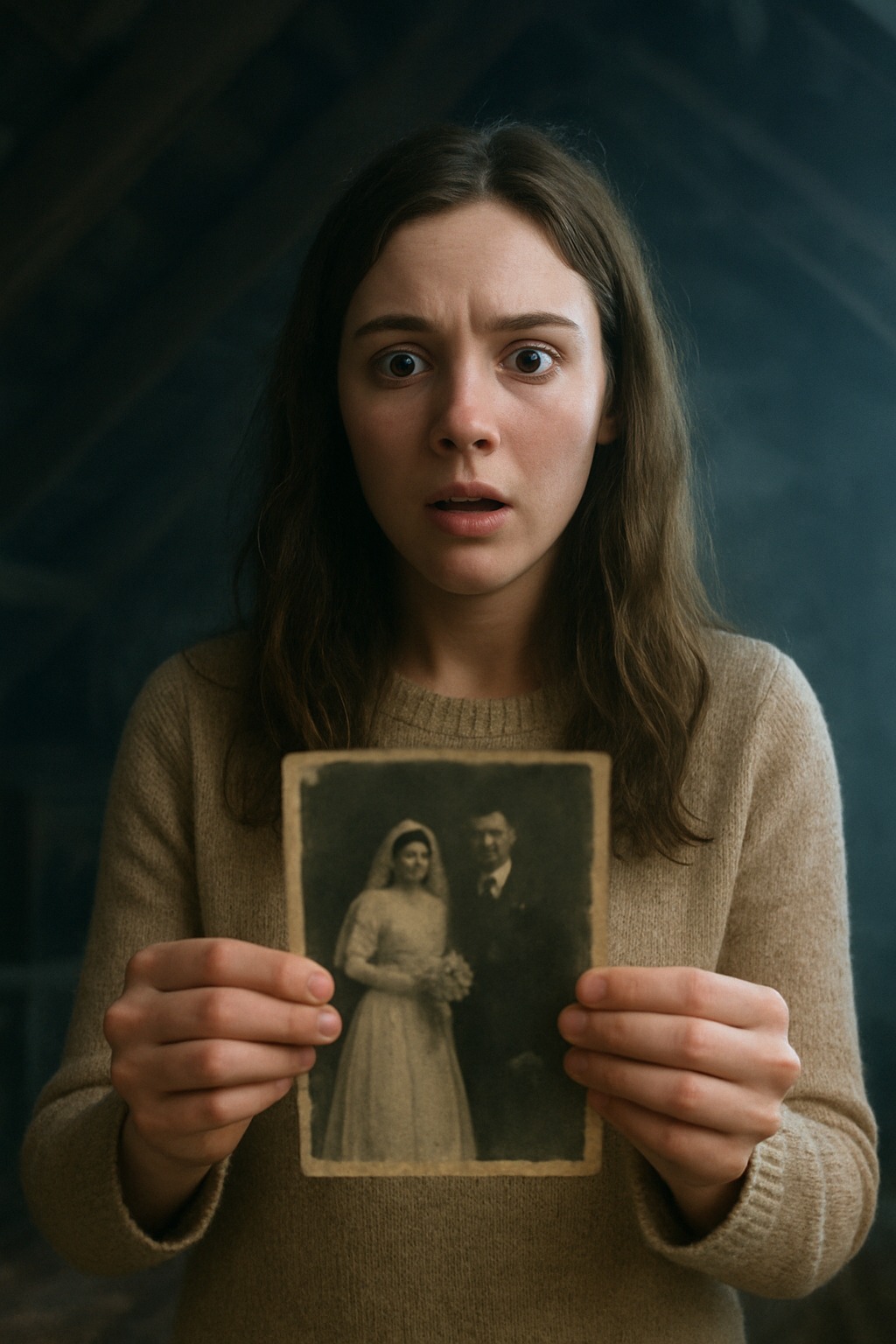
Anna loved family history. She spent hours going through dusty boxes in her parents’ attic, piecing together the past from faded photographs, postcards, and brittle letters.
One rainy afternoon, while sorting through an old album, she stopped cold.
The black-and-white photograph showed her grandmother as a child, no more than eight years old, standing in front of the family farmhouse. She looked shy, holding a doll, her hair tied with a ribbon.
But Anna’s eyes were drawn to the figure beside her.
A tall man in a dark suit. His posture stiff, his expression grim. And his eyes — cold, piercing, staring directly into the camera as though he knew she’d be looking decades later.
The problem? Anna recognized him immediately. It was her great-great-uncle Thomas.
And according to every record, Thomas had died twenty years before that photograph was taken.
Confused, Anna took the photo to her parents. They frowned, exchanged uneasy glances, and dismissed it as a mistake. “Maybe it’s just someone who looked like him,” her father said quickly, closing the album.
But Anna wasn’t convinced. She had seen portraits of Thomas. The strong jawline, the shape of his nose, even the way he stood with one hand in his pocket — it was him.
She began digging.
In the town archives, Anna uncovered old reports about Thomas. He had vanished mysteriously in 1911. No body was ever found, but a death certificate was issued years later, declaring him dead “in absentia.” The whispers, however, told a different story.
Some said Thomas had been involved in secret societies. Others claimed he knew something he shouldn’t — about the government, about the town’s wealthiest families, about a murder that had never been solved.
The trail grew stranger when Anna found a newspaper article from 1931, nearly twenty years after his disappearance.
It described townsfolk who swore they had seen Thomas walking the streets at night. Always in the same dark suit. Always silent.
The authorities dismissed it as hysteria. But now Anna had a photograph that proved it wasn’t.
Desperate for answers, Anna showed the picture to a local historian. When he saw it, his face went pale.
“This man,” he whispered, pointing at Thomas, “is connected to one of the region’s strangest cases. In 1911, a judge was assassinated. Witnesses described a tall man in dark clothing leaving the scene. Rumors linked it to Thomas. But before he could be questioned… he disappeared.”
Anna felt her blood run cold.
“So you’re saying my great-great-uncle was a killer?”
The historian shook his head slowly. “Or a scapegoat. But either way… if this photo is real, it means he came back. And no one ever explained why.”
That night, Anna stared at the photograph again. Her grandmother was smiling faintly, unaware of the man beside her. The farmhouse loomed behind them, its windows dark.
And Thomas — if it really was him — looked not like a man caught by accident, but like someone who wanted to be remembered.
The more she stared, the more it felt like his eyes weren’t just looking into the camera. They were looking at her.
Weeks later, Anna went back to the farmhouse, now abandoned. She walked through the creaking halls, the floorboards groaning under her steps. In her grandmother’s old bedroom, she found another photograph tucked into a dresser drawer.
It was the same picture. But in this version, Thomas wasn’t standing still.
He was turned slightly, as if he had moved closer to the child. His hand almost resting on her shoulder.
Anna dropped the photo, her breath catching.
Because now she understood.
It wasn’t that Thomas shouldn’t have existed in the photograph. It was that he still existed — and for reasons no one could explain, he had chosen not to leave.