Clara hated long commutes. Every morning, she boarded the 7:45 train to the city, and every evening, she returned on the 6:10. Same carriage, same seat if she was lucky, same blur of faces she never really looked at.
That Tuesday started no differently. She found an empty window seat, pulled out her book, and let the rhythm of the train settle her into routine.
Until he sat down beside her.
The man was tall, neatly dressed, and carried no bag. He offered a polite nod and a faint smile, the kind of gesture that suggested old-fashioned manners. His voice, when he spoke, was low and deliberate.
“Do you take this train often?”
Clara hesitated. Normally, she brushed off small talk. But something about him felt… familiar, though she couldn’t place why.
“Yes. Every day.”
He nodded thoughtfully. “It’s strange, isn’t it? How we pass the same places, the same people, without noticing. And yet, sometimes, you’re meant to notice.”
Clara smiled politely, unsure how to respond. The man continued, speaking of odd little details — the trees that bent just so near mile marker 14, the graffiti under the old bridge, the way the light always seemed different on Tuesdays.
It was eerie. He noticed things most commuters ignored. Things Clara herself had never paid attention to, even after years of traveling the same route.
Still, the conversation wasn’t unpleasant. In fact, she found herself oddly comforted by his calm presence.
When the train slowed at her stop, he stood, tipped his head, and said: “Take care, Clara.”
She froze.
She had never told him her name.
Shaken, she hurried off the train. She tried to dismiss it — maybe she’d said her name earlier without realizing, or maybe he’d overheard someone else say it. But the unease lingered.
That night, as she scrolled through her phone, she opened the camera app. She had absentmindedly taken a few photos on the train earlier — shots of the countryside, blurred through the window.
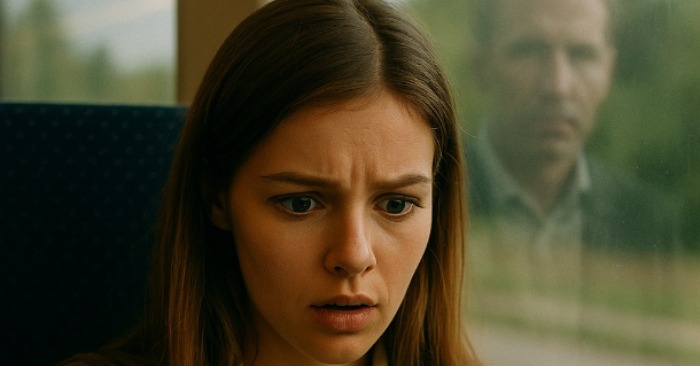
And in one photo, the man was sitting beside her, his face half-turned toward the glass.
But when she swiped to the next photo — taken seconds later — the seat was empty.
Clara stared at it for a long time.
Over the next week, she tried to spot him again. Every morning, every evening, she scanned the carriage. But he was never there.
One evening, she showed the photo to her friend Anna. “He was sitting right next to me. I talked to him. But look at this — he’s gone.”
Anna frowned. “Maybe he moved seats?”
Clara shook her head. “The train hadn’t even stopped. He just… vanished.”
Anna laughed nervously. “You’ve been watching too many ghost shows.”
But later, when Anna zoomed in on the photo, her expression changed. “Clara… look.”
In the reflection of the window, the man’s face was clear. Too clear. His eyes seemed locked not on the countryside, but directly on Clara.
Determined to understand, Clara dug into the train line’s history. Buried in local archives, she found a story.
Decades earlier, in the 1970s, there had been an accident on that very route. A man in his thirties had died after stepping off the train too soon, near mile marker 14 — the very place the stranger had mentioned.
Clara found an old black-and-white photo in a newspaper clipping. Her stomach dropped.
The man. The same sharp features, the same deliberate gaze.
The next day, Clara boarded the train with her hands trembling. She sat in her usual seat, clutching the clipping in her bag.
When the train passed mile marker 14, the carriage jolted suddenly. Lights flickered. For a brief second, she caught the reflection in the window — not hers, but his.
He was there. Sitting beside her again.
Only this time, he whispered.
“Thank you for remembering.”
And just as quickly, he was gone.
Clara never saw him again. But she still keeps the two photographs — one with him, one without — side by side on her phone. Proof, at least to herself, that not all fellow travelers are of this world.
And sometimes, on quiet evenings, she wonders: did he choose her because she listened? Or because she sat where he once sat, on the train he never left?