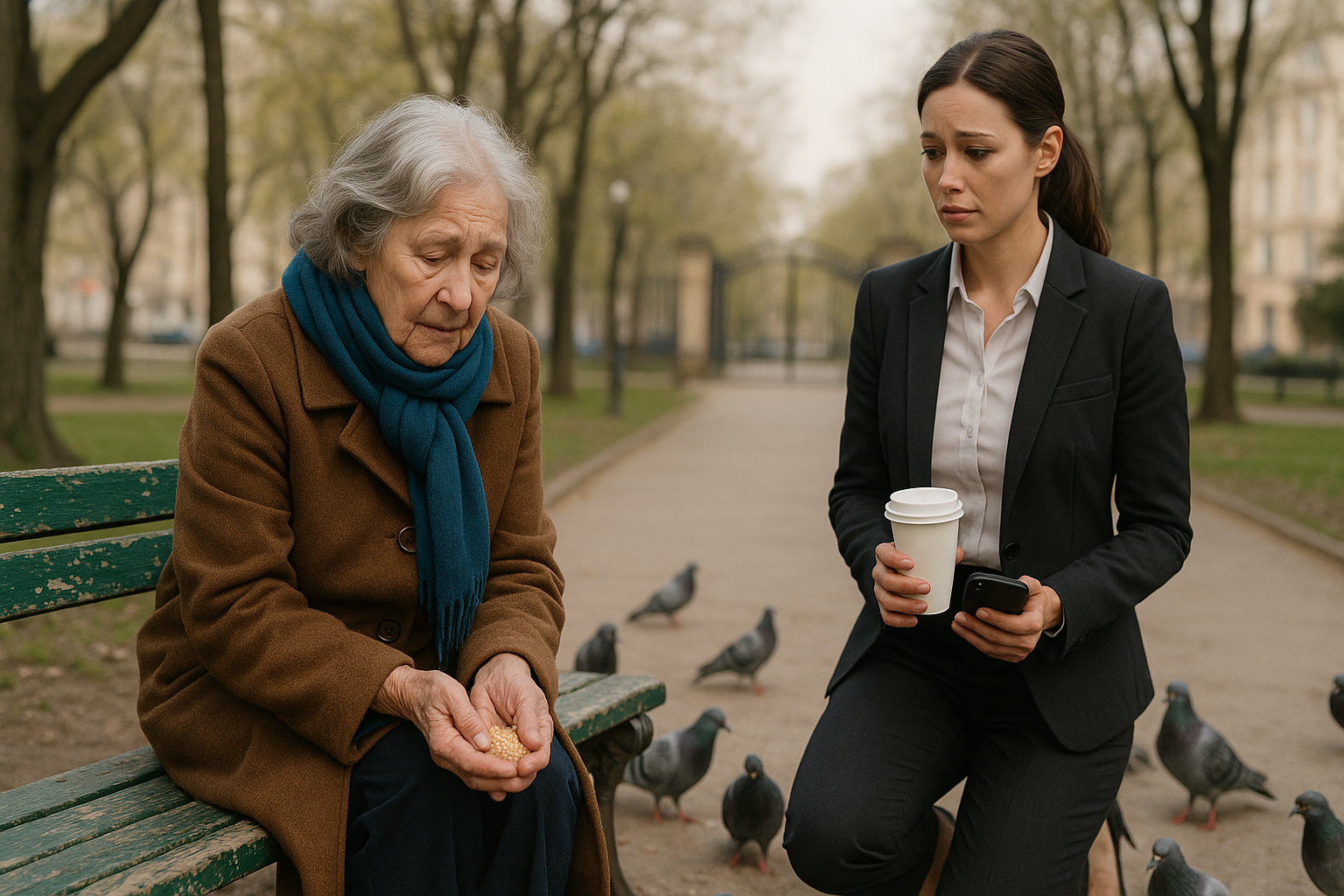
The woman on the park bench kept feeding the pigeons with trembling hands, until Emma realized the old lady was saving all the fresh bread for someone who never came.

Emma first noticed her on a Tuesday, rushing past the small city park with a coffee in one hand and her phone in the other. The old woman sat on the same peeling green bench, a neat brown coat buttoned up to her throat, a blue scarf carefully tied. A plastic bag of bread rested on her knees. She broke off tiny pieces, threw them to the pigeons, and every minute or so, lifted her head to look at the park gate with a strange, bright expectation.
On Wednesday, Emma saw her again. Same bench, same coat, same bag of bread. The pigeons clustered around her shoes. Once more, that hopeful glance toward the gate, as if someone important was running late.
By Friday, curiosity had started to gnaw at Emma more than her own problems. She had deadlines, a cranky boss named David, and an ex-husband who remembered their daughter’s birthday only when social media reminded him. Still, she slowed down, pretending to check her phone just a few steps from the bench.
The old woman unfolded a paper napkin. Inside lay a small, perfect sandwich wrapped in cling film. She didn’t eat it. She just placed it beside her on the bench, smoothing the napkin like it was something sacred, then stared again at the park gate.
The next week, Emma finally stopped.
“Hi,” she said, feeling ridiculous for talking to a stranger when she should have been in a meeting ten minutes ago. “The pigeons seem to like you.”
The woman looked up. Her eyes were pale, almost colorless, but incredibly clear.
“They’re always on time,” she replied softly, with a faint accent Emma couldn’t place. “Not like people.”
Emma gave a polite, awkward smile. “Do you mind if I sit for a minute?”
The woman patted the bench. Up close, Emma noticed the tremor in those thin fingers, the fraying cuffs of the coat, the shoes polished carefully despite their age.
“I see you here often,” Emma said. “Do you live nearby?”
“Just across the street,” the woman answered, nodding toward a shabby building beyond the trees. “I am Lara.”
“I’m Emma.”
Lara smiled at the sandwich on the napkin. “I wait for my son here. He used to work near this park. We always met on this bench after his shift. I bring him lunch. I still do.”
Emma felt something cold drop into her stomach. “That’s… sweet. Does he work late now?”
Lara’s smile did not falter, but her eyes drifted to the park gate again. “He said he would come when he can. Work is difficult. Life is expensive. Young people, they rush, rush, rush.” She chuckled faintly, as if reciting a line she’d rehearsed. “Sometimes he is very late.”
“How often does he… come?” Emma asked carefully.
“Oh, he is busy,” Lara said, smoothing her scarf. “But I come every day. So he knows where to find me. A mother must make it easy.”
Emma glanced at the untouched sandwich, at the careful way the edges had been cut off, the crusts removed. “Has he ever… missed lunch?”
“Once,” Lara replied. Her voice thinned, the way old paper does when you unfold it too often. “Then twice. Then… it has been some time. But he will come. He is my Alex. He used to run from the bus stop, so afraid I would wait alone.”
A gust of wind lifted the edges of the napkin. Emma swallowed. “How long has it been, Lara?”
Lara blinked slowly. “Four years. Maybe five. Time is… noisy. I do not hear it well anymore. But a mother knows. He will come when he can breathe again.”
The world seemed to tilt. Emma thought of her own mother, who called twice a week and always apologized before asking how she was. She thought of the unanswered messages she’d left on her ex-husband’s phone before their daughter’s last school play.
“Do you have his number?” Emma asked quietly.
Lara nodded and pulled out a tiny, worn notebook. On one page, carefully written, was a phone number and a name: Алекc. The last digits were smudged.
“I called,” Lara said. “It is… how do you say… disconnected. Maybe he changed it. Young people change everything, phones, jobs, countries. But this bench,” she patted the wood, “this stays.”
Emma stared at the number. The smudge, the faded ink. An idea rose in her mind, unwelcome and ugly.
“Lara… do you know where he works now?”
“He used to work at the construction site near the river,” Lara said. “Very dangerous. I told him: wear your helmet, eat your lunch. He laughed. He said, ‘Mama, nothing will happen to me.’”
The past tense sat between them like a stone.
Emma felt her throat tighten. She remembered a news story from years ago: a scaffold collapse by the river, several workers injured, one killed. She hadn’t paid attention then. She had been too busy arguing with David about a client brief.
“What was his last name?” Emma asked, her voice barely more than a whisper.

Lara answered, and it landed exactly where Emma feared it would. The name was familiar; she’d heard it on the news, a fleeting mention among many. A tragedy that had filled thirty seconds of air time and then vanished.
Emma suddenly realized the awful twist of it: Lara wasn’t waiting for a careless son who had moved on and forgotten his mother. She was waiting for someone who could never come, because no one had ever told her he was gone.
“Lara,” Emma began, her eyes stinging, “about the accident at the river… do you remember hearing about it?”
Lara frowned slightly, as if searching a dark shelf in her mind. “There are many accidents on television. I do not like to watch. Too much sadness. I prefer to come here. Here, I remember my son young.” She smiled, a fragile, almost childlike expression. “If I do not hear bad news, maybe it did not happen to him. You understand?”
Emma did understand. Too well. Her job was data and facts, metrics and results. But sitting beside this woman, facts felt like knives.
She looked at the sandwich again. Perfect, untouched, already starting to dry at the edges. The pigeons pecked at the scattered crumbs of older bread near Lara’s shoes.
“Why do you always feed them old bread and save the fresh one?” Emma asked softly.
Lara’s eyes brightened. “The fresh one is for Alex. He does not like dry bread. When he was little, he would make a face and say, ‘Mama, it hurts my teeth.’ So I bring soft bread. Every day.”
Emma’s phone vibrated in her pocket. David, probably, demanding to know where she was. For once, she didn’t care.
“Lara… if… if Alex couldn’t come,” Emma said slowly, “would you want to know? Or would you rather keep waiting?”
Lara looked at her with a strange, sharp clarity. The pigeons rustled at their feet.
“A mother always knows,” she said. “Even when no one tells her. Here,” she touched her chest, “I know something happened. But here,” she tapped the bench gently, “I still like to wait. Because when I wait, he is only late. Not gone.”
Emma’s vision blurred. She thought of all the times she’d rushed past this park without seeing anyone. How many Laras had she missed? How many benches like this existed, holding up the weight of invisible grief?
“May I sit with you sometimes?” Emma asked. “So you’re not alone while you wait?”
Lara’s face lit up in a way the weak winter sun never could. “I would like that very much. You can tell me about your work, your life. I like stories. Alex used to tell me everything. I was his best audience.”
Emma laughed, a broken, wet sound. “Okay. I’ll be your new audience.”
She picked up the sandwich, unwrapped it, and took a small bite.
“You’re eating his lunch,” Lara said in surprise.
“Only so it doesn’t go to waste,” Emma replied, forcing a smile. “If he comes, we’ll buy him a fresh one together. Deal?”
For a second, something in Lara’s face crumpled, some thin wall of denial bending under the weight of years. Then she nodded.
“Deal.”
Days turned into weeks. Emma began arranging her schedule around the park. She brought her daughter, Nina, on weekends. Nina would sit beside Lara and show her school drawings, while Lara listened as if they were masterpieces.
Emma never told Lara directly that Alex was gone. Instead, she wove gentle truths between stories and silences: how sometimes love had to accept empty chairs, how memories could be a kind of presence. Lara, in turn, started bringing only half a sandwich.
“One for you,” she told Emma one Tuesday, “and one for the birds. Alex, he eats now in my memories. There, the bread is always fresh.”
The pigeons fluttered around their feet. The park gate stood open, as always. The bench held them both, a tired piece of wood carrying two women and a boy who would never grow older than his mother remembered.
Emma glanced at Lara’s hands, still trembling, still breaking bread with care.
She pulled out her phone and, for the first time in years, dialed her own mother before work.
“Hi, Mom,” she said when the familiar voice answered. “I just wanted to hear you. And to tell you… I’m glad you’re there.”
Beside her, Lara smiled at the gate, at the pigeons, at the half-empty napkin.
“See?” Lara whispered, more to herself than to Emma. “Sometimes, when you wait long enough, someone’s child does come back to a bench.”
Emma reached down and scattered the last crumbs. The pigeons came running, right on time.