I left my father in a nursing home for three days to “rest”. When I came back with flowers, his room was empty, his bed was made, and his name was no longer on the door.

For a whole year I had been telling myself I was doing my best. My name is Daniel, I am 37, and I work two jobs. My father, Mark, is 74, after a stroke he barely walks, often forgets words and sometimes even who I am. Our tiny apartment smelled of medicine and boiled potatoes, and the nights were full of his coughing and my silent crying in the kitchen.
Every time I thought about a nursing home, guilt burned in my chest. My mother used to say: “We are not the kind of family that leaves their own.” But she died five years ago, and there was no one left to share this promise with me.
That Monday I simply broke. Dad spilled hot soup on himself, almost fell, and then stared at me with empty, angry eyes and shouted, “Who are you? Get out of my house!” I locked myself in the bathroom and slid down the door, shaking. Ten minutes later I opened the browser and searched: “short-term care for elderly”.
The place looked clean in the photos. White curtains, flowers on the windowsills, smiling nurses. The administrator, a woman named Linda, assured me:
“It’s just respite care, Daniel. Three days. He’ll be safe, you’ll get some sleep, and then you’ll bring him home. We do this all the time.”
Dad sat in the wheelchair, his hands trembling. When we signed the papers, he suddenly grabbed my sleeve.
“Danny… you’re coming back, right?” His voice was small, like when I was a child and he checked under my bed for monsters.
“Of course,” I said too quickly. “It’s just for a few days. I’ll bring you your favorite cookies tomorrow.”
I kissed his forehead and pretended not to notice the tear running down his cheek. As I left, I heard him call my name, but I didn’t turn around. If I had, I might have taken him back home that very second.
The first night I slept twelve hours straight for the first time in months. The second day I cleaned the apartment, threw away boxes of expired pills, opened the window wide and breathed in the cold air with a strange feeling of freedom and betrayal.
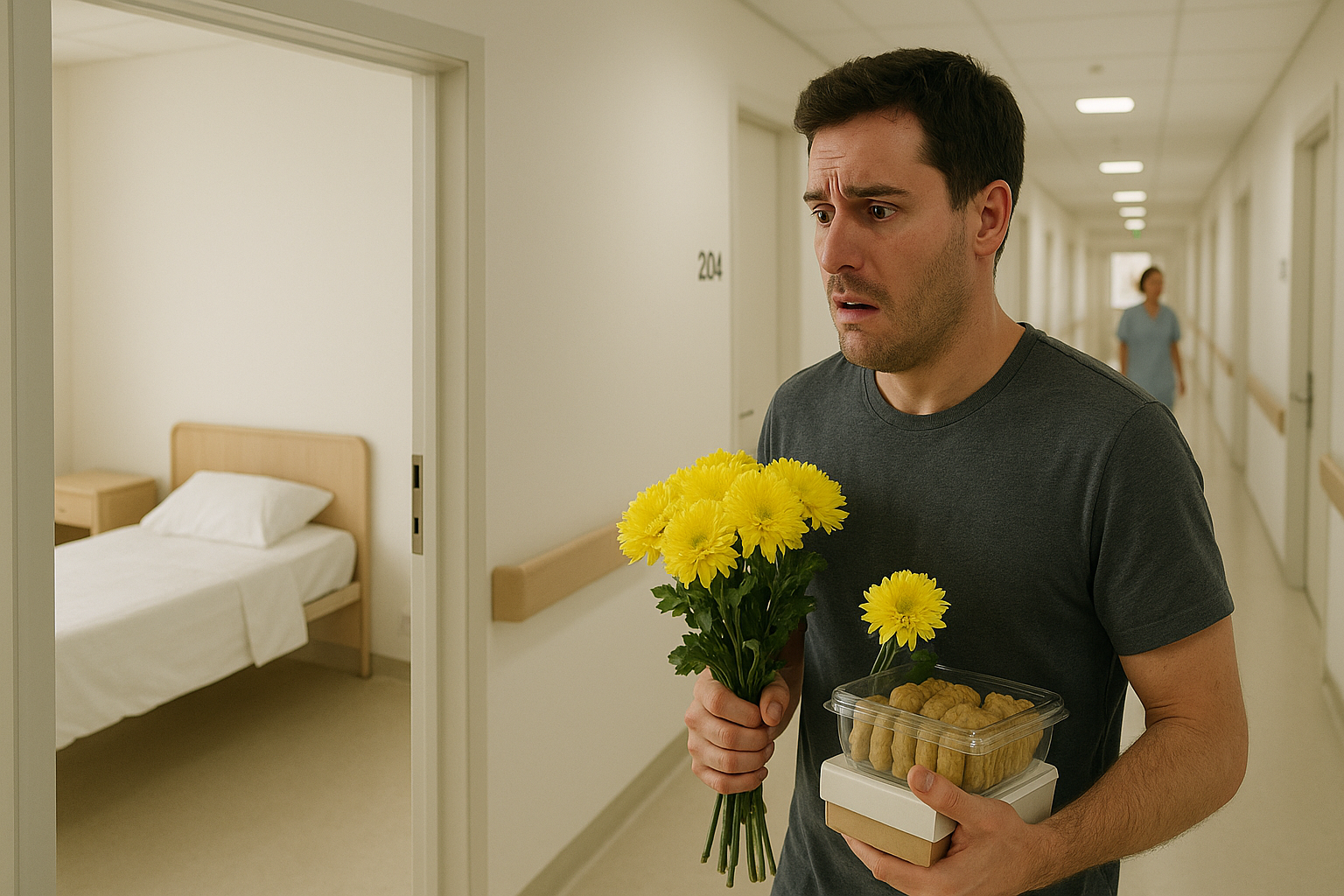
On the third day, I bought his favorite chocolate cookies and a bunch of yellow chrysanthemums. I even felt a little proud: I had finally done something right. He rested, I rested, and now everything would be easier.
I walked into the nursing home, nodding politely at the receptionist. The corridor smelled of disinfectant and overcooked cabbage. Dad’s room was at the end of the hall on the left. I remember counting the doors: 12… 13… 14…
His door was closed. There was no nameplate.
I froze. When I left, there had been a white plastic plate: “Mark Harris”. Now there was only a small rectangle of cleaner paint where it had been. My heart started beating in my throat.
I knocked and opened the door.
The bed was perfectly made, with a fresh, flat sheet. The bedside table was empty. No sweater on the chair, no slippers under the bed. The room looked like a hotel room waiting for a new guest.
“Excuse me?” I grabbed a passing nurse. “My father, Mark Harris, he was in this room. Where is he?”
The nurse blinked, looked at her tablet and frowned.
“Harris… it says here he was transferred yesterday.”
“Transferred where?” The flowers in my hand began to shake.
“To long-term care,” she said, as if it were nothing. “Another facility, across town. Paperwork says ‘permanent placement’.”
My ears rang. “No, no, that’s a mistake. He’s here for three days. Just respite. I’m taking him home today.”
She shrugged. “You’ll need to talk to administration.”
Linda met me in her glass office with that same professional smile, which vanished when she saw my face.
“Daniel, please, sit down.”
“Where is my father?” I didn’t sit. My voice sounded strange, as if it belonged to someone else.
She folded her hands. “Yesterday we received signed authorization for transfer to our partner facility for long-term care. They picked him up in the afternoon.”
“Signed by who?” My palms were sweating.
She slid a copy of the document across the desk. At the bottom, in shaky letters, was my father’s name.
“He agreed,” she said gently. “He told the social worker he didn’t want to be a burden to you any longer. That you ‘finally had a chance at a normal life’. He insisted we process it immediately.”
I stared at the paper. The signature was his, but crooked, like all his writing after the stroke. Above it, in printed text, my own name appeared: ‘Next of kin notified by phone, verbal consent obtained.’
“No one called me,” I whispered.
“We tried the number on file several times,” Linda said. “No answer. The social worker wrote that your father became very anxious and kept asking if you would change your mind and leave him here anyway. He said moving faster would be kinder to you.”
The worst part was that a small, ugly part of me felt… relief. Someone had done the cruel choice for me.

“Give me the address,” I said. “I’m taking him home.”
The second facility was farther away, almost by the outskirts of the city. From the outside it looked newer, friendlier. Inside everything was too bright, too clean, too quiet.
“Room 208,” the receptionist said.
I almost ran up the stairs. My chest hurt. I pushed the door open without knocking.
Dad was sitting by the window in a thin gray sweater, his hands folded in his lap. A plastic bracelet with his name clung to his wrist. He was looking at the parking lot below, at the cars coming and going.
“Dad,” I said.
He turned slowly. For a second his eyes were empty. Then they filled with something I will never forget: shame and hope fighting in one look.
“Danny,” he said quietly. “You found me fast. I thought… maybe you wouldn’t.”
I dropped the flowers on the chair and knelt in front of him.
“They moved you without telling me. They said you signed—”
“I did,” he interrupted. His voice was firm for the first time in months. “I told them I wanted it. I didn’t want to go back and watch you die next to me while still alive.”
I stared at him. “What are you talking about?”
He touched my cheek with a trembling hand.
“You think I didn’t hear you crying in the kitchen every night?” he whispered. “You think I didn’t see you fall asleep in that chair at 3 a.m., then rush to work at 7? I watched my son turn into an old man faster than me. I’d rather forget my own name than watch that.”
His words cut deeper than any accusation.
“Dad, I’m supposed to take care of you. I promised Mom.”
He smiled sadly. “Your mother also promised not to leave me, and life decided otherwise. Promises are not chains, Danny. They are directions. Sometimes we take a different road and still love each other.”
I felt hot tears on my face.
“I came to take you home,” I said stubbornly. “I cleaned your room, I bought your cookies, I—”
“And where will you put your own life?” he asked softly. “On the balcony next to the empty flower pots? You think I don’t see how lonely you are? How you say no to every invitation because ‘Dad might need something’?”
He looked around the room, at the clean bed, the TV on the wall, the nurse passing in the hallway.
“It’s not a prison here,” he said. “People talk to me. They have therapy. A doctor, a chapel, a garden. Yesterday a volunteer came with a guitar. I… liked it. I felt like a person again, not a burden counting your hours of sleep.”
The twist of it all hit me: I had brought him here to rest from him, and he had stayed to save me from myself.
“So you want to stay?” I asked finally.
He nodded. “I want you to visit me because you want to, not because you’re afraid I’ll fall in the bathroom. I want you to call me and tell me about your day, not your exhaustion. I want to be your father again, not your patient.”
The chrysanthemums lay crushed on the chair, petals already falling. I suddenly hated them. They were flowers for funerals, not for this new, strange life we were negotiating.
“What if I can’t forgive myself?” I whispered.
Dad sighed, his fingers tightening on my shoulder.
“Then come every Sunday until you can,” he said. “Bring bad coffee, boring stories, and those awful chocolate cookies. We’ll sit in the garden and pretend the world is normal. And one day you’ll realize you didn’t abandon me. You just stopped doing it all alone.”
I sat with him until evening. We talked about nothing and everything: about the neighbor’s dog, about the football team he still supported, about the nurse who reminded him of my mother when she was young. When I left, he walked me to the door with his walker, every step slow but determined.
“Go, Danny,” he said. “Go live a little. I’ll be here. I’m not disappearing, I’m just… changing address.”
On the way home I cried so hard I had to pull over. The empty apartment no longer felt like betrayal. It felt like a pause. On the kitchen table I put his cookies in a tin box and wrote on a sticky note: “For Sunday. Don’t forget.”
Every week now I visit him. We argue about the news, complain about the food, laugh at the other residents’ stories. He still forgets words, sometimes even my name, but he never forgets to ask, “Are you sleeping better? Are you eating? Are you living, son?”
I thought the worst thing I could do was leave my father in a nursing home. It turned out the worst thing would have been to keep him at home while both of us slowly disappeared. Sometimes love is not holding on until your fingers bleed. Sometimes love is learning how to let go without turning your back.