I am 39, and if you had asked me last month whether the past can suddenly grab you by the throat, I would have laughed. I was convinced I had closed those chapters. Neatly packed away. Filed somewhere deep in the back of my mind, where they could no longer hurt me.
I was wrong.
Fifteen years ago, I divorced my husband Caleb.
We were young – that kind of young that makes you both confident and foolish at the same time. We shared a bank account with twenty dollars in it and argued over groceries as if they were matters of state.
Then I caught him cheating.
It wasn’t just one woman. It was several. Again and again.
It wasn’t a slip, not a one-time mistake. It was a pattern. And that pattern was unforgivable.
When I added up all the lies, half-truths, and convenient omissions, it felt less like betrayal and more like humiliation. As if I had been the joke everyone else had already been laughing at.
WHEN I TOLD HIM I WANTED A DIVORCE, HE JUST SHRUGGED.
When I told him I wanted a divorce, he just shrugged.
“If that’s what you want. Fine.”
The fact that it was so easy for him to let me go hurt almost more than the cheating itself. As if our marriage had never meant anything to him.
Everyone expected drama.
Friends braced for screaming, slammed doors, and public scenes. My parents warned me to prepare for pleading, threats, or desperate attempts to win me back.
What no one expected was Dorothy.
I went to her because I didn’t know where else to go. She had always been good to me. Even when Caleb was difficult or we argued, she had remained consistently kind and reliable. I felt she had the right to hear it from me – not through back channels or awkward phone calls.
She opened the door with a smile, wearing an apron, the scent of something warm and familiar drifting from the kitchen.
MY DEAR, YOU LOOK PALE.
“My dear, you look pale. Come in, I’ll make us tea.”
I couldn’t even step over the threshold.
“I’m leaving Caleb. I caught him cheating.”
Her face changed instantly.
“Cheating?” she repeated, as if the word didn’t belong in her mouth.
“With more than one woman,” I said.
She sank heavily into a kitchen chair, as if her legs had suddenly given out. And then she cried. Not quietly or reservedly, but hard, her chest shaking and her hand over her mouth because she couldn’t control it.
“Oh God,” she kept saying. “Oh God, no.”
SHE GRABBED MY HANDS AS IF SHE WAS AFRAID I MIGHT DISAPPEAR.
She grabbed my hands as if she was afraid I might disappear.
“I did not raise him to be that kind of man,” she said desperately. “I swear to you.”
I tried to comfort her, which felt wrong and twisted. I was the one who had been hurt, whose life was falling apart – and yet I was stroking her back and telling her it wasn’t her fault.
In the courtroom, she stood by my side. Not by her son’s. By mine.
When the papers were signed and everything was officially over, Dorothy hugged me outside on the steps.
“You deserved better,” she said.
Then she disappeared from my life.
Until three weeks ago.
I WORK AT A LOGISTICS COMPANY DOWNTOWN.
I work at a logistics company downtown. Nothing special. Processing orders, managing inventory, solving problems.
That Tuesday was terrible. The kind of day that makes you wonder why you even got out of bed. First the system crashed, then one of our best employees quit without warning. I spilled coffee over reports I had been working on for days.
I went outside just to breathe cold air and remind myself that there was a world beyond fluorescent lights and screens.
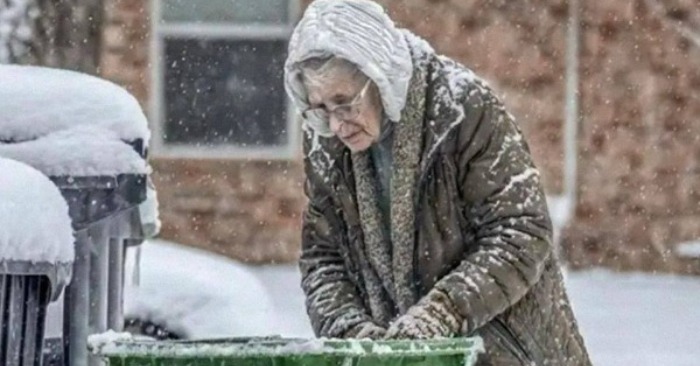
That’s when I saw an older woman crouching behind the building by the dumpster.
She wore a thin gray coat, far too big for her narrow body. Her hands trembled as she pulled a crushed sandwich from the trash.
At first, I didn’t recognize her. Why would I? Fifteen years had passed.
But then she looked up. Her face was gaunt, her hair gray, her eyes empty in a way I had never seen before.
And I knew.
MY STOMACH DROPPED.
My stomach dropped.
“Dorothy?” I whispered.
She froze, flushed, and nearly stumbled as she hurriedly stood up.
“Oh. Oh my God. I’m sorry. I didn’t know anyone was here. I’ll go.”
“Wait,” I said louder than I meant to. “Please. Don’t go.”
She looked at me as if she had no right to be seen.
“What are you doing here?” I asked softly. “Why… are you here?”
She avoided my gaze and stared at the ground between us.
YOU SHOULDN’T HAVE SEEN ME LIKE THIS,” SHE SAID.
“You shouldn’t have seen me like this,” she said.
Then her story came – in pieces.
After the divorce, she had told Caleb he needed to change, or she wanted no contact with him.
He accused her of being a bad mother and said she had always taken my side.
Then he didn’t contact her for years.
One evening he suddenly stood at her door – with a little boy. Two years old. He said the mother had disappeared, and he didn’t know what to do.
Dorothy let him in because of the child.
A week later, Caleb was gone. The boy was still sleeping in the next room.
He never came back.
She worked two jobs to take care of the child. Sold furniture, jewelry, everything. Eventually she lost the house. Everything – except the boy.
“We sleep in the car now,” she said quietly. “I park near the school so he can walk in the morning.”
My throat tightened.
I asked her to bring the boy.
When she returned, he stood close to her, backpack over one shoulder, eyes watchful as if ready to flee at any moment.
I introduced myself and asked if he was hungry.
He nodded cautiously.
That was enough.
I took both of them home with me.
They slept in beds. For the first time in a long time.
The next morning, I learned that Dorothy wasn’t even officially his guardian.
We made it official.
Weeks passed. The boy went to school. Dorothy began sleeping again. She cooked, helped around the house, slowly regained trust.
One evening she broke down in tears and asked me where she had failed with Caleb.
I held her and let her cry.
WHEN THE GUARDIANSHIP WAS CONFIRMED, SHE CRIED QUIETLY.
When the guardianship was confirmed, she cried quietly.
“I don’t know what comes next,” she said.
I looked around my kitchen, at the shoes by the door, the backpack, the drawings on the refrigerator.
“We don’t have to know that yet,” I said. “Right now, we’re okay.”
And we were.
The past had caught up with me – but not to hurt me.
To let something new grow instead.