I am Margaret. I never thought my life would take such a turn.
I was a simple woman. I worked as a school librarian, loved silence and order. On Fridays, I baked blueberry muffins, and at church, I knitted a blanket for every newborn. When I lost my husband to cancer at the age of 42, my daughter, Anna, became the only reason I got up in the mornings.
Anna was the center of my life. At 27, she already had her own marketing position, a small house nearby, and a curly-haired, brown-eyed little boy – Ethan. My grandson.
Then came the phone call on a rainy afternoon.
Plane crash. Technical failure. No survivors.
One moment, we were laughing on the phone about something Ethan had said at kindergarten. The next, he was no more.
I was kneeling on the kitchen floor, the shards of the broken cup cutting into my palm, but I didn’t feel the pain. I just whispered Anna’s name over and over again.
Ethan was three.
HE DIDN’T UNDERSTAND DEATH, BUT HE KNEW SOMETHING HAD CHANGED.
He didn’t understand death, but he knew something had changed. He clung to me as if I were the only sure thing in the world.
I thought we would heal together.
But a few weeks after Anna’s funeral, another blow came.
There was a knock on the door on a Saturday morning.
Mark was standing at the door – my son-in-law – with Ethan’s small suitcase at his feet.
“I can’t do this, Margaret,” he said in a dry voice. “I’m still young. I want to live. Take Ethan. You’ll figure it out.”
“Mark… he’s three.”
He shrugged.
I MET SOMEONE.
“I met someone. I’m moving. This isn’t the life I want.”
And he simply walked away.
He didn’t hug his son. He didn’t say goodbye.
Ethan dragged his stuffed bunny behind him on the porch, unaware.
“From now on, it’s just you and me, kiddo,” I whispered, kissing his forehead.
And so it was.
We stayed in Anna’s small house. It was cramped, the paint began to peel, and the garden was always overgrown. In the evenings, I cleaned medical offices, on weekends, I worked in the bakery early in the morning. I was tired, but Ethan’s laughter made everything worth it.
He never asked why his dad didn’t call. By the time he was six, he didn’t even mention it.
YEARS LATER, ETHAN GREW INTO A MAN – SMART, CARING, STRONG.
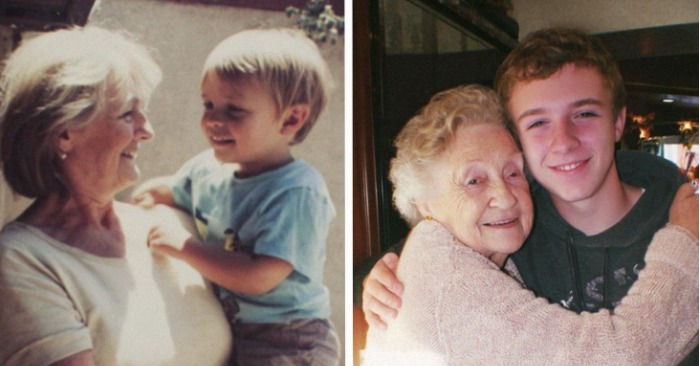
Years later, Ethan grew into a man – smart, caring, strong. At 25, he sat down with me at the kitchen table, a folder in his hands.
“Grandma, we’re moving. I don’t want you living alone. Now I’ll take care of you.”
The new house was huge – white stone walls, massive windows, a sparkling kitchen. There was also staff, which made me feel uneasy at first.
But Ethan asked every night, “Did you eat? Do you need anything?”
For the first time in decades, I allowed myself to breathe.
The old house still had our name on it. Over time, it became run-down. The paint peeled off, the sidewalk grew over with weeds.
One afternoon, Mrs. Palmer, the old neighbor, called.
“Margaret… Mark is back.”
MY STOMACH TIGHTENED.
My stomach tightened.
Ethan took the phone.
“If he shows up again, give him our address. Look him in the eye.”
Two days later, a rickety car rolled up in front of our house.
Mark was barely recognizable. Thinner, with graying hair, wearing worn clothes. But it wasn’t his appearance that surprised me.
It was his gaze.
There was no guilt in it.
But greed.
“WELL, SON” – HE SAID, LOOKING AROUND.
“Well, son,” he said, looking around. “You’ve built a nice life. I’m proud.”
Ethan stiffened at the word “son.”
Then an envelope slid out of Mark’s pocket. Ethan picked it up. His name was on it.
He opened it.
His face changed.
“What’s this?”
Mark rubbed his hands together.
“A rightful share of the old house. When we bought it, Anna and I were still married. That means I’m entitled too. Sign it, and I’ll be a co-owner again. The run-down house is mine, this palace stays yours. Fair, right?”
BLOOD BOILED INSIDE ME.
Blood boiled inside me.
Ethan calmly raised his gaze.
“That house isn’t a ruin. That’s where I learned to ride my bike. That’s where you read me stories, Grandma. That was my home. And it’s not yours.”
He took a step closer.
“You gave up on it the day you walked away. I’ll restore it. Because it’s my mother’s legacy. Not your bargaining chip.”
Mark’s face paled.
“You owe me. Without me, you wouldn’t even exist.”
Ethan’s voice turned steel-hard.
MAYBE YOU GAVE LIFE.
“Maybe you gave life. But Grandma gave everything that came after. You left. She stayed.”
He extended the envelope back.
“You have no place in my life.”
We closed the door.
There was silence. There was no anger left in me, only peace.
The old house wasn’t Mark’s. Anna bought it with her own teaching salary. Mark didn’t put a penny into it.
A few weeks later, Mrs. Palmer called again.
“Mark came again. He slowly drove past the house… but didn’t stop.”
THERE WAS NOTHING LEFT FOR HIM.
There was nothing left for him.
No forgiveness.
No second chance.
Ethan and I later went to the old house. It was worn down, but full of memories.
“You lined up your toy cars here,” I said.
“Your sewing machine hummed here,” he replied.
We’ll restore it.
Because family isn’t defined by who leaves.
It’s defined by who stays.
And in the end, it was always just us.
The two of us.