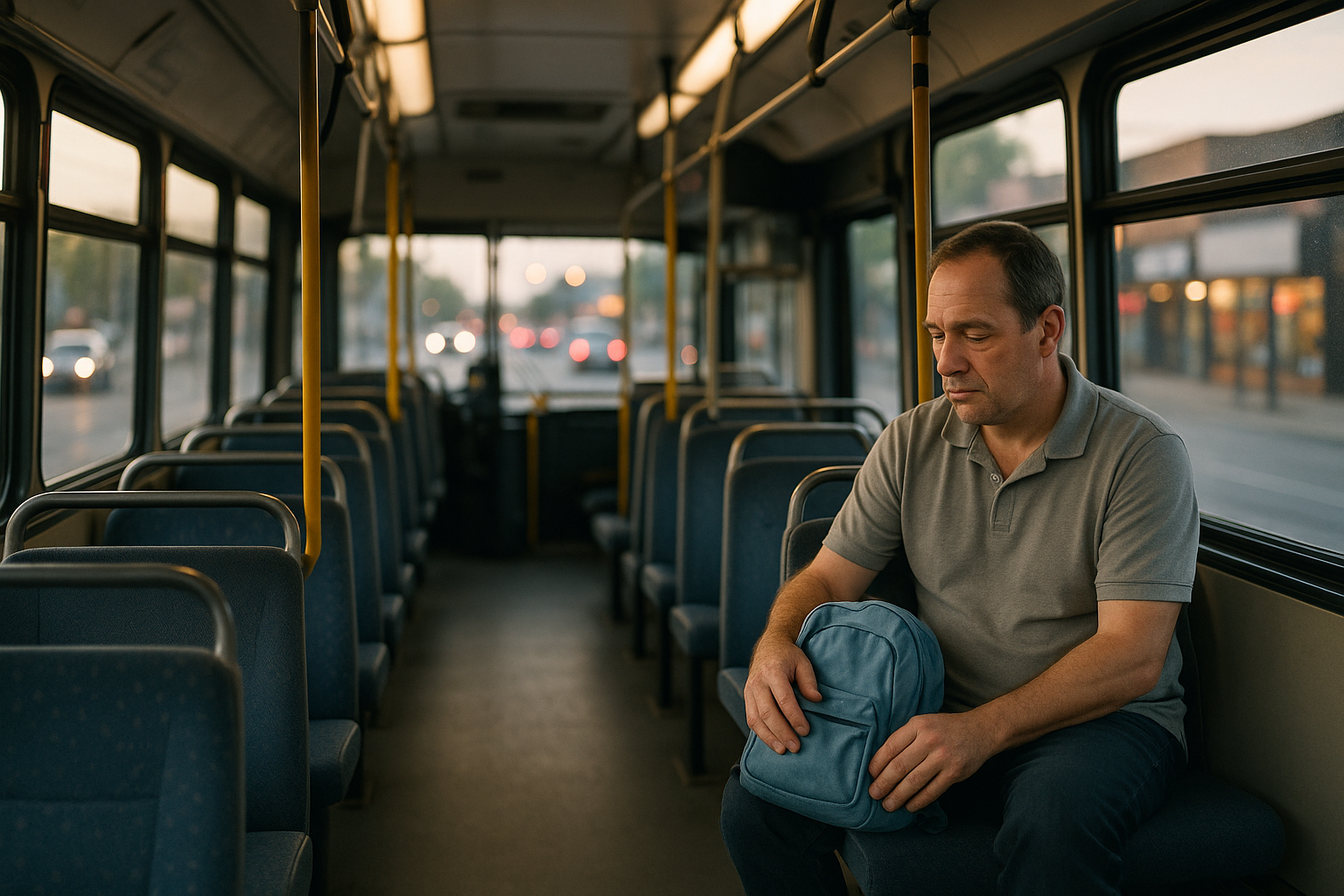
The boy who left his backpack on my bus every Friday and made me lie to my own daughter. I noticed him first because of the shoes – too small, the soles peeling, stuffed with newspaper that showed when he walked. He always sat in the very front seat, clutching a faded blue backpack like it was something alive. Every Friday, without fail, he would “forget” it on the seat when he got off.

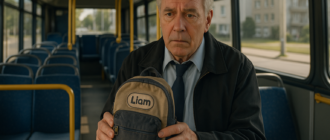
My name is Daniel. I have driven the same city bus line for eleven years. I know my passengers by faces, by habits, by the way they hold onto the rail when we hit the corner near the hospital. Friday evenings are always the same: tired nurses, men who smell like factories, students with headphones. And, for the last three months, the boy with the backpack.
He got on at the third stop. Thin, dark-haired, maybe ten or eleven. Always alone. He never asked for a ticket; he showed a crumpled school card and the inspector never came that late anyway. The first Friday he left the backpack, I shouted after him, but the doors had already closed and the light changed. I cursed under my breath, thinking I’d have to hand it to lost and found.
At the last stop, when the bus was empty, I opened it, just to check for a name. Inside was a neatly folded T-shirt, a pair of cheap plastic sandals, a toothbrush wrapped in paper, and a small plush dog with one eye missing. No notebook, no pencil case. No name. Nothing.
I handed it in at the depot. On Monday, the boy got on the bus holding the same backpack.
“Hey, you forgot that on Friday,” I said.
He flinched, then forced a tiny smile. “Yes, sir. They gave it back to me. Thank you.”
His English had that slow, careful sound of someone still learning. I nodded and let it go.
The second Friday, he did it again. Same ritual: front seat, silent ride, quick exit, backpack left behind like a shed skin. This time I ran out of the bus, shouting, but he had already disappeared into the crowd near the supermarket.
The same contents, the same neat folding. I stared at the toothbrush for a long time. I didn’t take it to lost and found immediately. I waited.
Twenty minutes later, I saw him at the edge of the parking lot, standing under a streetlamp, pretending to check his pockets, looking in the direction of the bus stop, then away, like he was afraid to come closer.
I took the backpack and walked toward him. When he saw me, his shoulders sagged.
“You forgot it again,” I said.
He swallowed. “I am sorry, sir.”
“You do this every Friday?”
He stared at the ground. “Sometimes.” Then, in a smaller voice: “Only when it is cold.”
I looked at the backpack, at his too-thin jacket, the way his fingers were red from the wind.
“Where do you live?” I asked.
He hesitated. “Near… there.” He pointed vaguely behind the supermarket.
“With your parents?”
He shook his head once. “With my mother. She cleans.”
“Your name?”
“Adam.”
I wanted to ask a hundred questions, but the radio on my shoulder crackled; dispatch was calling. I handed him the backpack.
“Don’t forget it next time, Adam.”
He nodded, clutching it tight. “Yes, sir. Thank you.”
The third Friday I decided to test a suspicion I didn’t want to name. I watched him in the mirror. He sat stiffly, eyes on the door. When we reached his usual stop, he rose, took three steps… and left the backpack on the seat, carefully, like placing a sleeping baby. At the door he hesitated, his hand hovering over the handle of the bag, then pulled away and jumped off.
I didn’t shout this time. I just closed the doors and drove on.
At the final stop, instead of opening the backpack, I carried it with me and walked back along the line. It took ten minutes to reach the supermarket. The wind cut through my uniform. Behind the building was a small, hidden loading area, two dumpsters, and a strip of concrete sheltered by the overhanging roof.
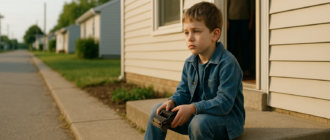
There, on a piece of cardboard, sat Adam, hugging his knees. Next to him was a plastic bag with something that might have been bread.
He saw the backpack and went pale.
“Please,” he whispered. “Don’t take it.”
“I’m not taking it,” I said, suddenly ashamed. “I just… wanted to see.”
He pressed his lips together, fighting tears that made him look much younger.
“We cannot stay in the room on Fridays,” he muttered. “The man wants money for weekend. We don’t have. My mother works late. I wait here. Only Friday.”
The toothbrush. The T-shirt. The sandals.
“So the backpack…?” I couldn’t finish.
“Sometimes,” he said, eyes glued to the ground, “if I leave it on the bus, I can sit on the bus at the last stop. It is warm. They think I forget. They let me sit until cleaning. Then I go here.”
He said it like a confession, like a crime.
Something in my chest twisted so hard it hurt.
That night, at home, my daughter Lily asked why I was late. She is nine, all questions and missing front teeth.
“There was traffic,” I lied. I did not tell her about a boy almost her age who arranged his life around the heating schedule of a city bus.
My wife, Emma, noticed the way I picked at my food. “What happened?” she asked quietly when Lily went to brush her teeth.
I told her. All of it. The backpack, the toothbrush, the man who charged extra for weekends. Emma listened, her hands around her mug, knuckles white.
“We can’t,” she said at first, reflexively. “We barely manage as it is. Rent, Lily’s school…”

“I know,” I said. “I just… I had to tell someone.”
That night I didn’t sleep. I thought about my own childhood, the winters when my father drank most of the money and my mother pretended she wasn’t hungry. I thought about how I had sworn my child would never be cold.
The next Friday, Adam climbed onto the bus as usual. But when he reached the front seat, he found me sitting there, his backpack in my lap.
“Today,” I said, trying to sound casual while my heart hammered, “you really forgot something.”
He frowned. “What?”
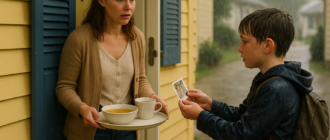
“Dinner,” I said, and held up a small brown bag Emma had packed.
His eyes widened. “I can’t pay.”
“You already did,” I lied, sensing a pattern in myself. “It’s… a prize. For always being on time.”
He didn’t believe me, not really, but hunger is stronger than pride. He took the bag slowly, like it might vanish.
That was the first lie.
The second lie was to my supervisor, when I asked if we could keep the bus doors open a little longer at the final stop “for cleaning” so a boy could sit in the front seat without being thrown out.
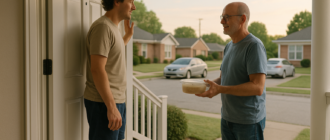
The third lie was to Lily, two weeks later, when she found a small blue toothbrush in our bathroom glass.
“Whose is this?” she asked.
I hesitated for a second that felt like a year. “It’s for a friend,” I said. “Someone who needs it.”
“Can I meet them?” Her eyes were bright, curious.
“Maybe later,” I said. “Not yet.”
The twist I didn’t expect came on a Tuesday, not a Friday. Adam didn’t get on the bus.
I waited all day for him to appear at some stop, maybe late, maybe running. He never came. On Wednesday, still nothing. On Thursday, my chest felt like a fist.
On Friday I drove the route with a stone in my stomach. When I reached the third stop, I slowed down more than usual, scanning the faces.
He wasn’t there.
At the supermarket, I saw the man who ran the cheap rooms – I recognized him from Adam’s description. I left the bus for a minute and walked up to him.
“The boy who lived here with his mother,” I said. “Adam. Where are they?”
He shrugged. “Gone. Police come. Social people. Take them.”
“Take them where?”
He spread his hands. “I don’t know. Not my problem.”
For him it wasn’t. For me, suddenly, it was everything.
That evening, I went home with the blue backpack. It felt heavier than it had any right to be. Lily met me at the door.
“You’re early,” she said, surprised.
“I needed to talk,” I managed.
Emma looked up from the table, saw my face, and went still.
I told them about Adam. The empty bus stop. The man’s shrug. The way the world can swallow a child whole without even a sound.
Lily listened with a seriousness I rarely saw in her. When I finished, she stood up, walked to her room, and came back with her favorite stuffed rabbit.
“He can have this,” she said firmly.
“Lily,” Emma whispered. “He might not… be back.”
“Then you keep it on the bus,” Lily said, looking at me. “So if he comes, he knows someone was waiting.”
I don’t know why those words broke me, but they did. I turned away so she wouldn’t see my eyes.
Now, every Friday, the front seat of my bus holds a faded blue backpack and a small gray rabbit with one ear bent. People ask sometimes. I tell them it’s for a child who forgot his things and will one day remember to come back.
That’s my fourth lie.
The truth is, I keep them there because I can’t stand the idea that a boy who slept between dumpsters might disappear without anyone reserving a place for him in the world.
Sometimes, when the bus is empty and the city lights smear the windows, I catch myself talking softly to the backpack, as if Adam could hear me wherever he is.
I tell him I’m sorry I didn’t do more. I tell him there is still a seat waiting for him. I tell him that my daughter, who has never met him, keeps a toothbrush on our sink for a boy who only wanted somewhere warm to wait for his mother.
And in those moments, I realize the cruelest part: he taught me to lie. Not to hurt, not to hide, but to make room in a house and in a heart that were already too full.
I lie to my daughter so she can believe the world is kinder than it is.
I only hope, if Adam ever does climb onto my bus again, I won’t have to lie to him when I say: “You’re safe now.”