The stranger who sat at my father’s hospital bed and called him “Dad” while I, his real daughter, was stuck in traffic with a dead phone. When I finally ran into the room, breathless and shaking, she was holding his hand, and he was smiling at her in a way I hadn’t seen in years.

My father, David, had been in the cardiac ward for three days. The doctors said it wasn’t yet the end, but every beep of the monitor sounded like a countdown. I, Emma, his only child, tried to be there as much as possible, juggling work, guilt, and the endless smell of antiseptic.
That morning my boss made me stay for “just one more call.” By the time I escaped the office, it was rush hour. My phone died while I was texting the nurse that I was on my way. I remember slamming the steering wheel at a red light, imagining the worst: that he would open his eyes, look around, and see no one.
By the time I charged my phone in the hospital lobby and rushed upstairs, I braced myself for an empty room or a flat line on the monitor. Instead, I stopped at the doorway.
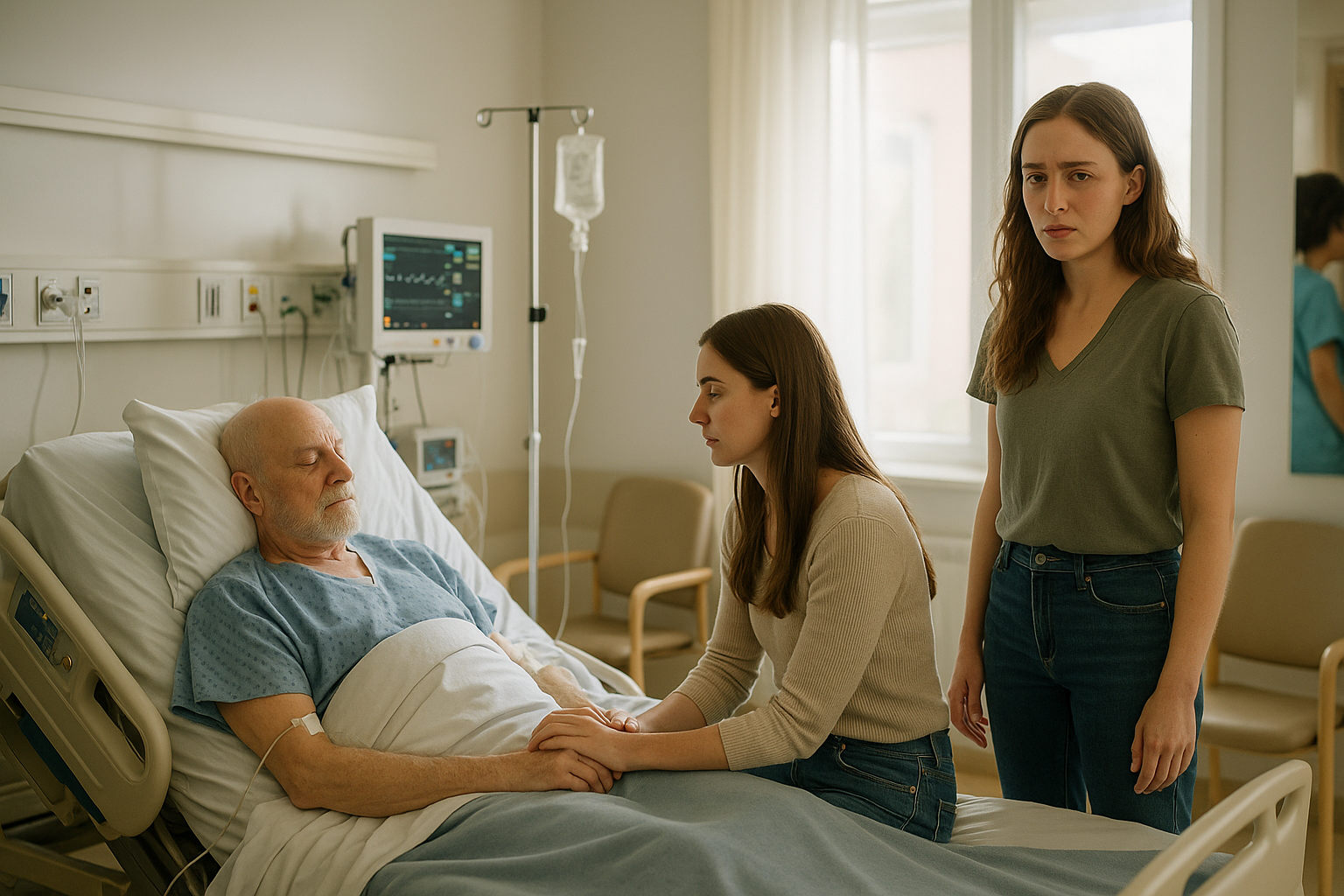
There was a young woman, maybe in her late twenties, sitting in the chair where I usually sat. She leaned toward my father, gently lifting a plastic cup to his lips. Her hair was pulled back in a simple ponytail, her coat tossed over the chair as if she had always belonged there. My father, who had barely spoken the day before, was talking quietly, his eyes alive.
“Dad, slow down,” she said with a little laugh. “You’re going to choke on the water.”
My heart went cold. Dad. She had called him Dad.
I stepped inside, my voice coming out too sharp. “Excuse me, what did you just call him?”
They both turned. My father’s smile faded, replaced by that familiar mix of confusion and fear that came with the medication and his frayed memory.
“Emma,” he murmured, reaching out a trembling hand.
The woman stood up quickly. “You must be Emma,” she said softly. “I’m Nina.”
I ignored her outstretched hand. “Why are you calling my father ‘Dad’?”
The nurse, Sarah, slipped into the room behind me as if she’d been waiting for this moment. “Emma, it’s okay,” she said carefully. “Nina has been here since this afternoon. Your father asked for her.”
I stared at all of them, my throat tight. “He asked for her? He doesn’t even remember what day it is.”
Nina flinched but didn’t look away. “He remembers some things,” she said. “He remembered my mother.”
“My mother is dead,” I snapped.
“I know,” Nina answered quietly. “So is mine.”
For a second, the room seemed to tilt. I heard my father’s labored breathing, the steady beep of the monitor, my own pulse pounding in my ears.
“Emma,” my father whispered, his fingers closing around mine with surprising strength. “Don’t be angry. I… I needed to tell you both.”
“Both?” The word scraped my throat. “Tell us what?”
He glanced at Nina, then at me, his eyes glossing with tears. “When I was young… before I met your mother… I made mistakes,” he said. “I left someone. I left a baby.”
Nina’s face crumpled just slightly. “My mother’s name was Lily,” she said. “She lived two streets away from your old house. She kept a photo of him by her bed until she died. She told me his name was David, and that he had another family now. I spent years wondering if I should look for him.”
I felt like someone had punched a hole in my chest. “You’re saying he’s your father too?”
Nina nodded. “DNA test confirmed it last year.” She looked down at her hands. “He tracked me down. He said he wanted to make things right before it was too late. I didn’t expect… this.” Her voice broke on the last word.
I looked at my father, searching his face for the man who taught me to ride a bike, who sat through every school play even when he had late shifts. “You never told me,” I whispered.
“I was ashamed,” he said. “I thought I had time. Then the heart attack… and I realized I might leave this world with a lie between us. I asked Nina to come today because…” He coughed, wincing. Sarah adjusted his pillows, eyes shiny. “Because you’re both my daughters. I wanted you to see each other. To know you’re not alone.”
The word daughters echoed in my head like a foreign language. All those childhood nights when I thought I wasn’t enough for him, when I wondered why he worked late so often. Had he been thinking of another child he’d abandoned?
Jealousy, betrayal, and a strange, piercing pity twisted together inside me. Nina stood maybe two steps away, shoulders slightly hunched, as if bracing for me to throw her out.
“How long have you known about me?” I asked her.
“A year,” Nina said. “I met him at a café. He sat there for ten minutes before he could look me in the eye. He told me about you immediately. He was… proud.” Her lips trembled into a small, sad smile. “He showed me pictures of you graduating, your first apartment. He said you were the best thing he ever did right.”
I turned back to my father. Tears were streaming down his cheeks. “I was a coward,” he whispered. “To both of you.”
The sharpness in my chest dulled, replaced by something heavier. I suddenly saw not a villain but an old man in a hospital gown, trapped by his own regrets and a failing heart.
Nina took a tentative breath. “If you want me to leave, I will,” she said. “I don’t want to take anything from you, Emma. I just… wanted to see him before I lose him again.”

The words “lose him again” hit me harder than I expected. I had a lifetime of memories: birthday candles, arguments about curfew, quiet Sunday breakfasts. She had one awkward meeting in a café and a mother who died with a picture of a man who never came back.
I sank into the chair opposite her and covered my face with my hands. For a moment, no one spoke. Only the monitors did.
“Dad,” I said finally, my voice hoarse. “You should have told me. I can’t say I’m okay with all of this. I’m not. But…” I glanced at Nina, who looked like she was trying not to breathe too loudly. “But I’m more angry at time than at you right now.”
His fingers tightened around mine again. “I don’t deserve that kindness,” he whispered.
“Probably not,” I said, a broken laugh escaping. “But you get it anyway.”
I looked at Nina. “Sit down,” I said. “He talks too much when he’s nervous. We might need two daughters to keep him quiet.”
For the first time, she smiled without fear. She sat, carefully, as if the chair might reject her. My father closed his eyes, a single tear sliding into the gray of his hair.
“Tell me about your mother,” I said to Nina, surprising myself. “About Lily.”
She blinked, then nodded. “She loved sunflowers,” she began. “She worked two jobs. She never said a bad word about him. Only that he was scared.” She glanced at my father. “I used to hate him for that. But when I saw him in that café, shaking so hard he spilled his coffee… I didn’t know what to do with all that hate anymore.”
We sat there for an hour, trading pieces of a man we both knew and didn’t know. His bad jokes, his taste in old songs, the way he pretended not to cry at sad movies. Sometimes he chimed in, sometimes he just listened, eyes drifting between us as if memorizing our faces.
When visiting hours were nearly over, Sarah came in with a gentle warning. I felt panic rise again.
“Will you come tomorrow?” Nina asked me quietly in the hallway.
“If he’s still here,” I said, the words cutting my throat.
She swallowed. “If he’s not… would it be too strange if I still called you?”
I looked at her, really looked: the tired eyes, the hope she was too scared to name. Another person who would stand at his funeral and pretend to be just a friend.
“Nothing about today isn’t strange,” I said. “But… yes. Call me.” I hesitated, then added, “Sister.”
The word tasted unfamiliar but not wrong.
That night, I sat by my father’s bed until the nurses made me leave. He woke up once, squeezed my hand, and whispered, “Thank you.”
“For what?” I asked.
“For letting her in,” he said. “For not leaving me alone with my mistakes.”
He slept again, and I watched his chest rise and fall, terrified of the moment it might stop.
He made it through the night. He didn’t make it through the week.
At the funeral, people whispered, trying to guess who Nina was. Some assumed she was a coworker, others a distant cousin. We let them think what they wanted. When it was our turn to say goodbye, we stood side by side at the casket.
“I should hate him,” I murmured.
“Me too,” Nina said. “But I don’t know how.”
We both laughed through tears.
Later, when everyone else had left, we stayed behind, two women bound by the same selfish, frightened, loving man. I placed a sunflower on the coffin. Nina placed a small photo of her mother.
“He left us both,” she said.
“And somehow also gave us each other,” I answered.
We walked out of the cemetery together, into the cold pale sunlight, both knowing that grief doesn’t erase betrayal, and forgiveness doesn’t rewrite the past. But in the space my father’s absence left behind, there was a fragile, unexpected thing growing.
Not closure. Not yet.
Just the beginning of a shared story neither of us had asked for—but both of us needed more than we were ready to admit.