When I paid 2 dollars for a stranger’s bus ticket on a completely ordinary Tuesday morning, I had no idea that I was about to become part of a miracle. What happened afterward reminded me that sometimes the smallest gestures of kindness can unlock the most astonishing moments – and that a single inconspicuous event can tilt your entire life in a direction you never would have foreseen.
My name is Isabel, and I have learned that most mornings blur together and become one single, unremarkable routine. Coffee. Toast. The same playlist on repeat while I hurry to catch the 7:42 bus downtown.
That Tuesday began no differently. My travel mug was burning through the sleeve against my fingers, my coat was only half buttoned, and in my head I was already sorting through the mountain of emails waiting for me at the office.
I work as a marketing analyst for a tech company in the middle of the city. People hear that and immediately imagine a glamorous life – corner office, company-paid business dinners, maybe even a company car.
The reality? I take the bus every single day because parking costs more than my grocery budget. And honestly, those 20 minutes of quiet before all the chaos begins are worth more than any leather seat. I can switch off, scroll through the news, and pretend I’m not about to spend eight hours in meetings that could have been handled with a simple email.
The morning air had that bite… the kind that makes you wish you had grabbed a scarf, but at the same time promises that spring might eventually show up after all. The sky was doing that gray thing where you can’t tell if it’s going to rain or if it’s just going to stay miserable and undecided all day.

And that’s when I noticed him.
An elderly man stood near the curb, slightly hunched, holding a small bouquet of daisies wrapped in transparent plastic. His coat was too large for his body. The fabric looked as if it had been washed too many times – faded from what had once been navy blue to a sad blue-gray.
But what truly caught my attention were his hands. They moved constantly, patting his pockets in a frantic, repetitive pattern. Front left, front right, back right, inside jacket pocket. Then again from the beginning. And again. And again.
With every unsuccessful search, his face tightened more, his eyebrows drawing together in confusion and rising panic.
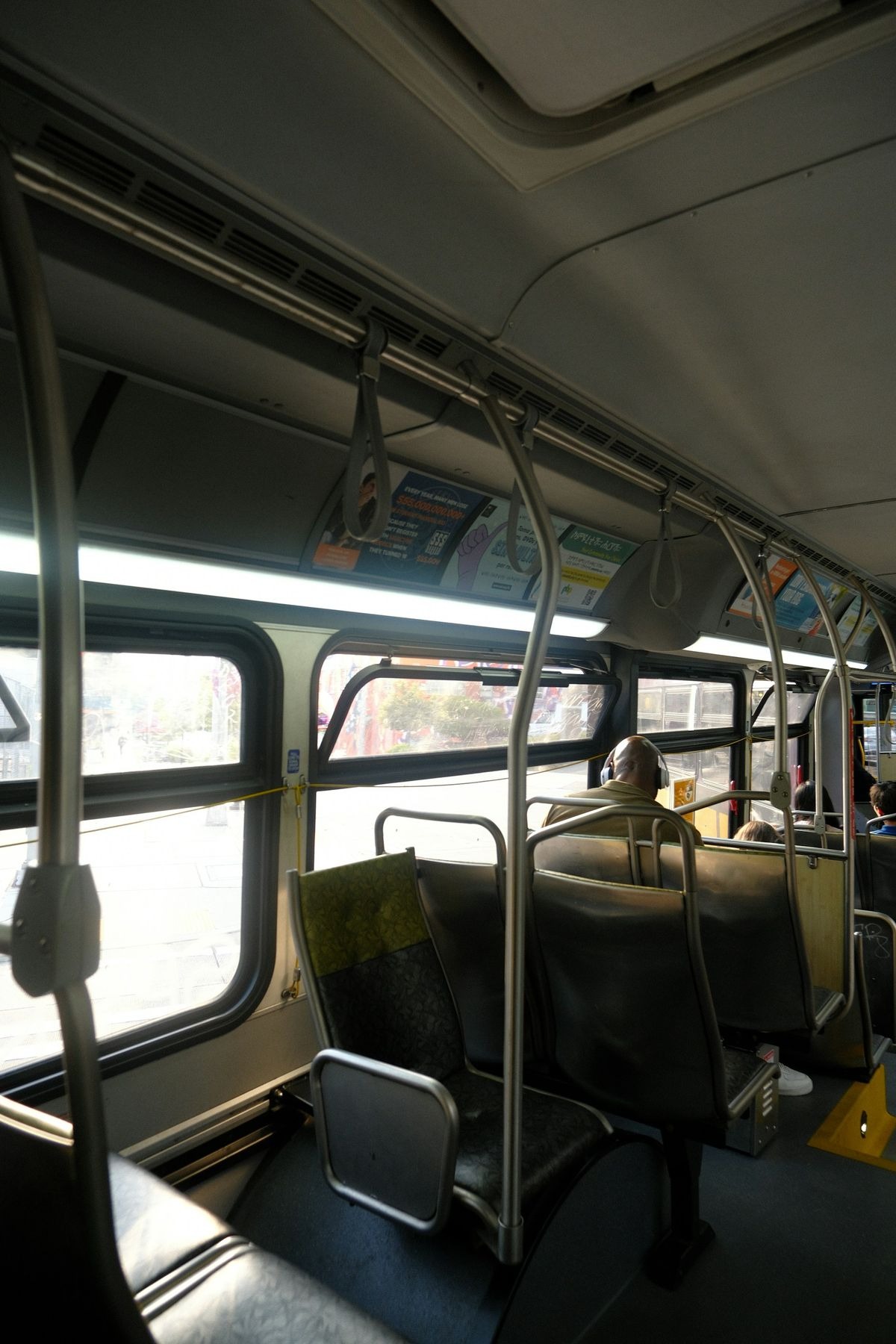
The bus hissed to a stop, and the usual morning crowd pushed forward. I let myself be carried along, tapped my card on the reader, and moved toward the back. I had just grabbed a pole when I heard the driver’s voice cut through the muffled murmur of the passengers.
“Sir, you need to pay or get off.”
The old man stood frozen at the front, still holding the daisies. His voice sounded thin and fragile. “I… I must have left my wallet at home. Please, I only need to go to the next stop. I’m meeting someone. It’s important.”
“I can’t take you without a ticket,” the driver said flatly. “Rules are rules.”
I saw the stranger’s shoulders sag. He looked down at the flowers as if they might whisper a solution to him.
Behind me, a woman in a business suit let out an annoyed sigh. “There’s some kind of drama every day!” she muttered.
Someone else groaned. “Please not this, we’re all going to be late.”

A guy from the middle shouted, “Just get off, man. Some of us have work.”
The old man’s face turned red with shame. “I’m sorry. I didn’t mean to…”
To this day, I don’t know exactly why I did it. Maybe it was the way he held those flowers so carefully, as if they were made of glass. Maybe it reminded me of the moments when I had frantically searched for my card while people behind me snorted in annoyance. Or maybe I was just tired of watching people become cruel for no reason.
I pushed my way to the front and tapped my card on the reader a second time.
“It’s fine,” I said, looking into the driver’s irritated eyes. “I’ll cover it.”
The driver looked at me as if I had just ruined his day, but he waved the old man through with a curt motion of his hand.
“Thank you,” the man breathed. The corners of his eyes glistened with moisture. “Thank you very much, young lady.”
“Don’t worry about it,” I replied.
He followed me to two empty seats and lowered himself slowly, as if his bones punished every movement that was too quick. He laid the bouquet across his knees and held it with both hands, adjusting it again and again so nothing would get crushed.
We sat in silence for a moment as the bus jerked back into traffic. I pulled out my phone, ready for the usual scrolling, but then he spoke.
“You didn’t have to do that.”
I glanced at him. “It’s really not a big deal. It’s two dollars.”
“For you maybe. But for me today… it was everything.”
“Are they for someone special?” I asked, nodding toward the flowers.
His whole face changed. The worry smoothed away, replaced by something tender, something that was both beautiful and painfully sad at the same time. “For my wife. Her name is Lila. She always loved daisies… she said they reminded her of summer picnics and lazy afternoons.” He looked down at the bouquet. “I bring her some every week.”
“That’s really beautiful,” I said softly.
He nodded slowly. “I couldn’t miss today. I… I just couldn’t.”
Before I could ask what he meant by that, he turned fully toward me. “Please give me your number. I’ll pay you back, I promise. It’s important to me.”
“You really don’t have to…”
“Please.” His eyes were serious, almost desperate. “It would mean a great deal to me.”
I hesitated. Giving my number to a stranger felt strange. But he looked so determined, and honestly – what could happen? I recited the digits while he pulled a tiny spiral notebook from his coat pocket.
“Isabel,” I said when he looked up expectantly.
He wrote it down and underlined the name. “John,” he said. “My name is John.”
The bus slowed; it was his stop. He tucked the notebook away, stood up, and gave me that grateful, fragile smile once more. “You are a blessing, Isabel. I hope you know that.”
Then he was gone – disappearing into the crowd, with his oversized coat and the bouquet he held as if his heart depended on it.
I watched him through the window as the bus pulled away.
The woman in the business suit slid into the now-empty seat beside me. “You do realize he probably won’t pay you back, right?” she said without looking up from her phone.

“I know,” I replied.
She snorted. “Then why do it at all?”
I didn’t have a good answer for her. Or maybe I did, but it was too personal to explain to a woman who had just spent five minutes complaining about someone else’s bad morning.
So I just shrugged and looked back at my phone.
By the time I got to the office, I had almost forgotten about John and his daisies.
The next morning I was standing in my bathrobe in the kitchen, waiting for the coffee machine to finish its gurgling ritual, when my phone vibrated on the counter.
Unknown number. I almost ignored it. Probably spam or someone trying to sell me a warranty for a car I didn’t even own. But something made me answer.
The message was long. Too long for a scam:
“Miss Isabel, the one who paid for me on the bus yesterday. You have no idea how much you helped me. I need you to know what you did.”
My stomach made a strange leap. I sat down at the kitchen table, still holding my empty cup.
Before I could respond, another message came through:
“My wife Lila has been in a coma for six months. The doctors keep saying she may never wake up, that I should prepare myself. But I can’t. I won’t. Every single morning I bring her daisies because those were the flowers I gave her on our first date. I was seventeen and far too nervous to speak. The daisies spoke for me.”
I stared at the screen. Another message:
“Yesterday, when I forgot my wallet, I thought I would miss visiting hours. The hospital is strict because of her condition. If you hadn’t helped me, I wouldn’t have made it. But I made it. I got there. I went into her room and put the daisies in the vase beside her bed, like always. And I told her about you… about the kind young woman who helped a forgetful old man.”
My hand was trembling now. I set the cup down before it slipped from my fingers.
“And then her fingers moved,” the message continued. “At first just her little finger. I thought I was imagining it. But then her whole hand twitched. The nurses came running. And Isabel… she opened her eyes. She looked at me. After six months of silence, my Lila came back.”
I could barely breathe. I was sitting in my kitchen, with cold coffee and morning light at the window, reading those lines over and over again.
Then the final message came:
“The doctors call it a miracle. I call it you. If I may, I would like to thank you in person. Just a few minutes. We are at City Hospital. Please… I know it is strange, but you are now part of our story. Would that be alright?”
I’ll be honest – my first impulse was to say no.
It felt too intimate. I had done something small, and now I was supposed to be pulled into a huge, life-changing moment that really had nothing to do with me. It made me uneasy.
But all day at the office I kept thinking about it. During my lunch break, I wrote back to John:
“I would love to come. When is a good time?”
He replied immediately. “Anytime after four. We are here. Thank you, Isabel. Thank you for everything.”
So that evening I didn’t get on the bus home as usual. I got off three stops early and walked to City Hospital.
The lobby smelled of disinfectant and that strange cafeteria scent that all hospitals seem to share. John was waiting near the main entrance, in the same coat, but with a face glowing with joy. Beside him stood a man about my age.
“Isabel,” John said, as if my name were something precious. He clasped my hand in both of his. “This is my son Daniel. We both wanted to thank you properly.”
Daniel extended his hand. His handshake was warm and firm. “Dad told me everything. What you did… somehow ‘thank you’ doesn’t feel like enough.”

“I only paid for a bus ticket,” I said, my face growing warm. “That’s not—”
“You gave him time,” Daniel interrupted gently. “And that is everything.”
We stood in the lobby for a while and talked. John told me about Lila – how they had met at a fair, how she had laughed at all his bad jokes, how they had built a life out of nothing but love and stubbornness.
Daniel told me about growing up with them, about family dinners, Sunday rituals, and how his mother managed to make every person in the room feel like the most important one.
Before I left, Daniel pressed something into my hands. A package, wrapped in brown paper and string.
“I paint,” his father said, almost shyly. “Not very well, but it helps me think. I made this for you.”
“John, you really didn’t have to—”
“Please,” he said. “Let an old man say thank you in the only way he knows how.”
At home, I carefully unwrapped it on the living room floor. Inside was a canvas: a forest, morning light falling between tall trees and casting patterns on the ground.
It was beautiful – in that understated way that comes when someone paints what they love instead of what is supposed to be loved.
That very evening, I hung it above my sofa.
A week later, another message came from John: “We are having a small birthday dinner for me this Saturday. Lila is coming home tomorrow. Please come. You are family now.”
I almost said no again. Almost.
But I went.
Their house was small and tidy, the kind of place where everything has been in the same spot for decades and no one sees a reason to change it. Photos stood on every surface – John and Lila over the years, their faces growing older but their hands intertwined the same way.
Lila was there, on the sofa, pillows around her like a small fortress. She looked fragile, her skin almost translucent, but her eyes were awake and clear. When I walked in, she smiled.
“You’re the girl from the bus,” she said, her voice soft but steady. “John told me about you. He said an angel paid for his ticket.”
“I am definitely not an angel!” I said, sitting down beside her as she patted the cushion.

“For us, you are.” She took my hand. Hers felt like paper, but her grip was surprisingly strong. “Thank you for giving me a second chance to annoy my husband.”
John laughed from the kitchen. “Too late for that! You already did a great job of annoying me in the hospital bed.”
The meal was simple: roast chicken, mashed potatoes, and canned green beans that someone had somehow dressed up with almonds to make them “special.” Nothing fancy. But it was warm, full of laughter and that familiar teasing that only people who have loved each other long enough to know exactly which buttons to push can manage.
Daniel sat across from me. During dinner, I caught him looking at me several times – with a look I couldn’t quite place. When dessert was over, he offered to walk me to my car.
In the end, we stood in the driveway for over an hour.
“I’m glad you came,” he finally said. The streetlight above us flickered, casting strange shadows. “I think… I think my parents needed this. They needed to see that there are still good people.”
“Your father is the good one,” I said. “He loves your mother more than anything in this world. That’s devotion.”
“He does!” Daniel grinned.
When I got home later, I had a message from him: “I know this is direct, but would you like to get coffee sometime? Not as a thank-you. Just… coffee.”
I stared at the screen for a long time before replying: “Yes. I’d like that.”
It has been four months now since that morning on the bus.
The painting John made still hangs in my living room. Every time I look at it, I think about how strange life is – and how a forgotten wallet and 2 dollars set off a wave I never saw coming.
Lila is doing better. She still has therapy twice a week and will probably need it for a while, but she is home. She is awake. And she can annoy John in person again – and according to Daniel, she is making up for every lost minute.
And Daniel?
Well… he is the reason I don’t ride the bus alone anymore.
His parents invite me to dinner constantly. Last Sunday, Lila shared her secret for the perfect pie crust with me while John painted at the kitchen table and Daniel did the dishes. It felt like family. Like home.
It’s crazy how the smallest gestures can open the biggest doors – and how the best things in life sometimes cost exactly 2 dollars.