When Emma Saw Her Father Sitting on the Bench Outside the Shelter, She Thought He Had Finally Come to Take Her Home, But the Paper in His Hands Said Something Else.

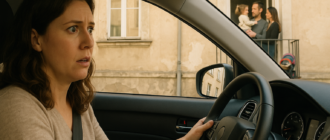
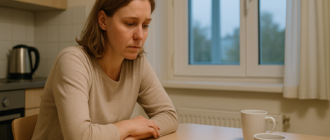
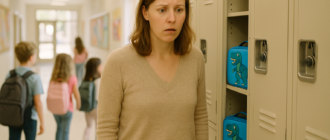
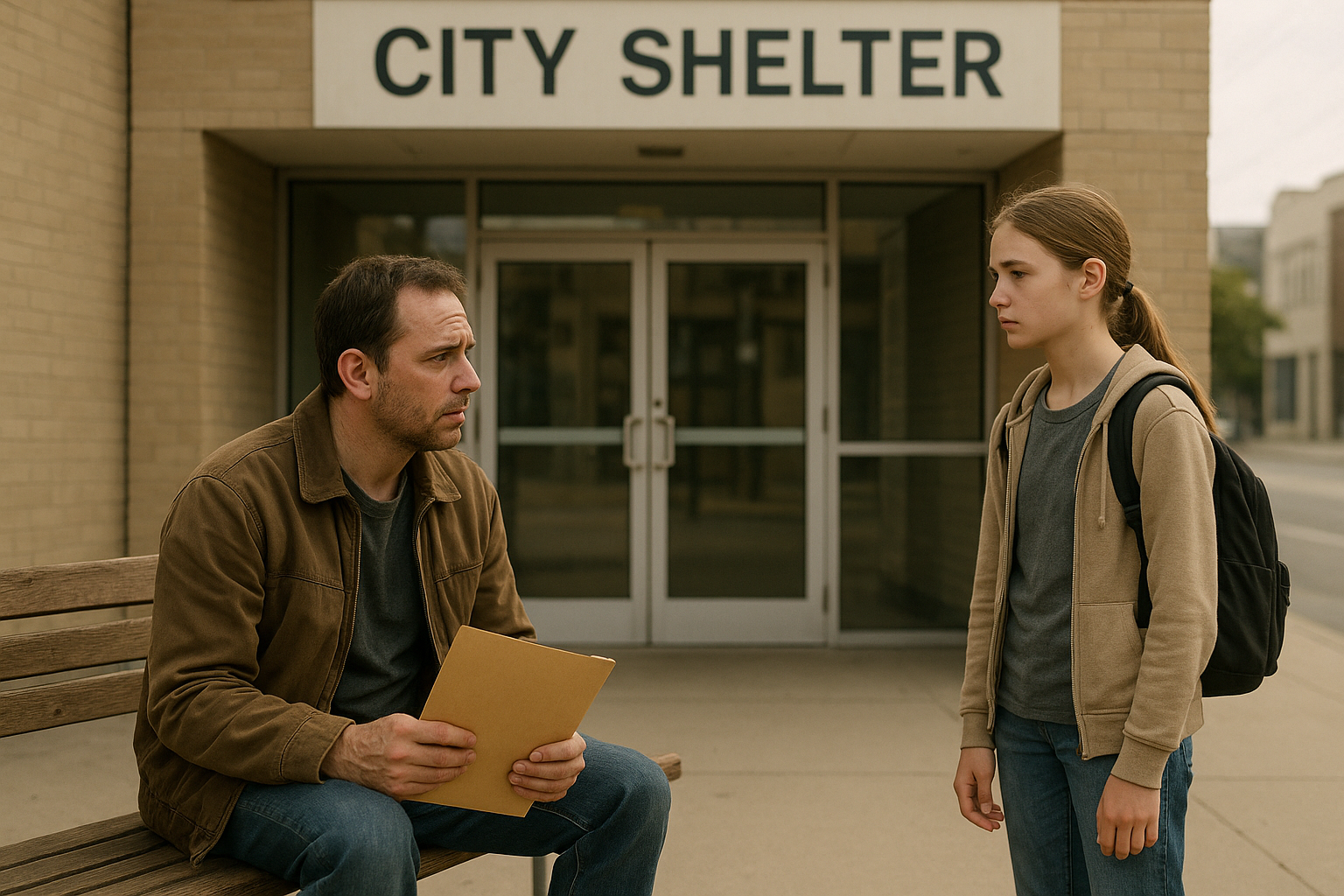
Emma pressed her forehead to the cold windowpane of the city shelter, her breath leaving small clouds on the glass. Outside, on the worn wooden bench by the entrance, sat Mark — the man she still forced herself to call Dad. A thin folder trembled in his hands. He kept checking his watch, then the door, then the folder again.
“He came,” Emma whispered, not sure if she was happy or terrified.
Next to her, social worker Laura followed her gaze. “He’s early,” Laura said softly. “That’s a good sign, Emma.”
Emma didn’t answer. She remembered other times he was early — early to leave, early to drink, early to shout. Her fingers tightened on the strap of her worn backpack. The staff had told her this meeting was important, that today they would finally have clarity.
“Come,” Laura said. “He’s been sober for six months now. Let’s just hear what he has to say.”
Six months. Emma had been counting too. Six months since the last time he had shown up at the shelter with glassy eyes, smelling like old bottles and cheap cigarettes. Six months since she’d watched him sign yet another paper and walk out without turning back.
Today, though, he wore a clean blue shirt, buttoned wrong at the collar, and held that folder like it might explode. As Emma and Laura stepped outside, the bright afternoon light wrapped them in warmth that Emma didn’t feel.
Mark stood up too quickly, almost dropping the folder. “Emma,” he said, voice cracking on the first syllable.
She stopped a meter away. “Hi,” she replied, her English suddenly feeling too big and heavy in her mouth.
Laura gave them both a gentle nod. “I’ll be right inside if you need me.” She stepped back but stayed where she could see them through the glass door.
Mark swallowed, eyes flickering over his daughter’s face — the same hazel eyes as his, the same stubborn chin. “You’ve grown,” he said. “Of course you’ve grown. It’s been… too long.”
Emma lifted her shoulders. “You could have come,” she said quietly.
He flinched. “I know.” He looked down at the folder. “That’s why I’m here. To… to fix what I can.”
Her heart stumbled. The way he said it — fix — sounded almost like home, like finally packing her things and leaving the gray walls of the shelter behind. “Are you… are you taking me back?” she blurted.
For a second, hope rose in his eyes, shining, raw. Then it dimmed. “Emma, I—” He broke off, sat back down on the bench, and patted the space beside him. “Please. Just sit. Let me explain.”
She remained standing, arms crossed. “You can talk. I hear you fine from here.”
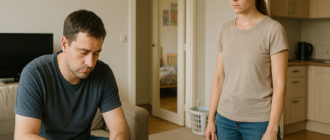
He gave a sad, understanding nod. “Fair enough.” He opened the folder with shaking hands. Inside were several documents with official stamps. One page had her name on it, typed in bold letters. Emma tried to read it upside down, catching only words like ‘placement’ and ‘permanent.’
“I started the process,” Mark said. “I went to the meetings, the counseling. They told me if I stayed sober, if I found steady work, we could start reunification.”
“You told me that last year,” she said, feeling anger warming her cheeks. “Then you disappeared.”
“I relapsed,” he admitted without excuse. “I lost my job. I lost myself again.” His eyes shone. “But this time… this time I didn’t just lose myself. I realized I was losing you for good.”
She looked away, focusing on a crack in the pavement. “So why are you here now?”
There was a long pause. Even the distant traffic seemed to hush.
“Because I don’t want you to stay here waiting for a man who may never be the father you deserve,” he said finally.
Her head snapped up. “What does that mean?”
He pulled out the top document and turned it toward her. “It means I signed consent for you to be adopted by the family that applied for you.”
For a heartbeat, the world went silent. Emma stared at the paper as if it were written in another language.
“You… what?” Her voice broke on the last sound.
“There’s a couple,” Mark said quickly, desperate. “Anna and David. They’ve been visiting, talking with your caseworker. They have a small house, a dog, a garden. They want you, Emma. They want to be your parents.”
Her vision blurred. “I already have a father,” she whispered, not sure if she believed it.
“Yes,” he said, tears spilling freely now. “You do. You have a father who loves you so much he finally understands he might be the worst place for you to grow.”
She shook her head, backing away. “No. No, you’re just… you’re giving up. Again. Like always.”
“I’m not giving up on you,” he insisted. “I’m giving up on the lie that I can fix everything fast enough to give you a real childhood. You’re thirteen, Emma. How many more years should you spend watching that door, wondering if I’ll come back drunk or not at all?”
The words struck deep, because they were true. Nights staring at the shelter ceiling, listening to other children cry. Birthdays with donated cakes and plastic candles. The way she still jolted at every male voice in the hallway, thinking it might be him.
“You could keep trying,” she said, almost pleading. “Why can’t you just keep trying with me?”
Mark covered his face with his hands for a moment, shoulders shaking. When he looked up, there was something new in his eyes — a tired honesty Emma had never seen before.
“I am going to keep trying,” he said. “For me. To stay sober, to work, to be someone you can be proud of from a distance, if that’s all I can be. But you… you deserve more than a promise that keeps breaking. This family, they are ready now. Not ‘maybe someday,’ not ‘if I don’t drink again.’ Now.”

A soft sob tore from her chest. “So you’re signing me away like… like a dog at the shelter?”
His face twisted in pain. “No. I’m signing a paper that says you are more important than my pride. That your chance at a real home matters more than my fear of losing you.”
She hugged herself, nails digging into her arms. “How is that not losing me?”
He hesitated, then reached into his pocket and pulled out a small, folded photo. He held it out, not stepping closer. “Do you remember this?”
Reluctantly, she took it. It was creased and worn, colors faded. A much younger Emma sat on his shoulders in a park, both of them laughing, ice cream smeared on their faces. Behind them, her mother — gone now too soon — smiled at the camera.
“I carried this to every meeting,” Mark said hoarsely. “Every time I wanted to drink, I took it out instead. I would tell myself, ‘You do not ruin her again.’ But I’m still learning. I’m still weak. And you are running out of time to be just a kid.
“Anna and David showed me their photo album,” he continued. “They have a room ready for you. Light green walls, a bookshelf, a desk by the window. They even argued over which posters you might like, because they didn’t want to get it wrong.” A faint, broken smile touched his lips. “They already argue about you like parents do.”
The image hit Emma harder than she expected — a room with walls she could decorate, a desk that was hers, not shared. People who argued about posters, not about bottles.
“What if I hate them?” she asked, voice small.
“Then you tell your caseworker,” he said steadily. “You have a voice in this. But from everything I’ve heard, they’re kind. Patient. They don’t drink. They want family.” He drew a shaky breath. “I want you to have what I never gave you: safety that doesn’t depend on whether I had a bad day.”
She sat down slowly on the bench, leaving a careful distance between them. For the first time since she’d come outside, she looked straight at him. The wrinkles at the corners of his eyes, the gray at his temples, the way his hands shook even now.
“Did it hurt to sign?” she asked.
He laughed once, bitterly. “It felt like I was cutting off my own arm. But when I finished… for the first time in years, I felt like I did something right for you.”
Tears slid down her cheeks, hot and unstoppable. “I waited for you,” she said. “Every weekend. I told the kids here, ‘My dad is getting better. He’s coming back.’ I defended you.”
“I don’t deserve that,” he whispered.
“But I did it anyway,” she choked. “Because I thought one day you’d walk in and say, ‘Pack your things, Emma, we’re going home.’”
He swallowed, his own tears falling freely. “I am saying it,” he answered softly. “Just not the home I dreamed of. The home you need.”
For a long time they sat in silence, the sounds of the city drifting around them. Emma traced the edge of the old photo with her thumb.
“Will I still see you?” she asked suddenly.
“If you want,” he replied at once. “If your new parents agree, if the court allows it. I will write, I will call, I will show up sober. Always sober. I can’t promise perfection, but I can promise I will never again disappear without a word.”
She considered this, weighing the tired man beside her against the empty bed in the dormitory, the rotating faces of children who came and went. She thought of a green room, a garden, people arguing over posters instead of shouting over broken plates.
Very slowly, she slid the photo back into his hand and closed his fingers over it.
“You keep it,” she said. “So you remember what you’re trying to fix.”
He inhaled sharply. “Emma—”
She stood up, shoulders trembling. “I’m not forgiving you. Not yet. Maybe not for a long time.” She took a breath that felt like jumping off a cliff. “But I don’t want to wait here anymore either.”
His eyes searched hers. “Then…?”
“Then I’ll meet them,” she said. “Anna and David. I’ll see the room. I’ll… I’ll try.”
Something like relief and grief tangled across his face. He rose to his feet but didn’t reach for her. “Thank you,” he whispered. “For even considering it.”
Emma turned toward the shelter door, then paused. Without looking back, she said, “If I go… and if they’re good… don’t come drunk to any of my birthdays. Ever again. Not even once.”
“I won’t,” he said, voice firm in a way that surprised even him. “If I ever drink again, I don’t deserve to see you at all.”
She nodded, wiped her face with the sleeve of her sweater, and walked back inside. Laura met her in the hallway, eyes gentle but curious.
“Well?” she asked.
Emma’s throat ached. “Can we call Anna and David?” she said. “I think… I think I’m ready to see the room.”
Through the glass, she caught one last glimpse of Mark on the bench. He sat hunched over, the photo pressed to his chest, shoulders shaking. For the first time, she realized that letting go was breaking him too.
It didn’t make it hurt less. But as she followed Laura down the bright corridor, for the first time in years, the word ‘home’ didn’t feel like a cruel joke. It felt like a door, half-open, waiting.
And behind her, on that worn wooden bench, a father finally chose his child’s future over his own broken heart.