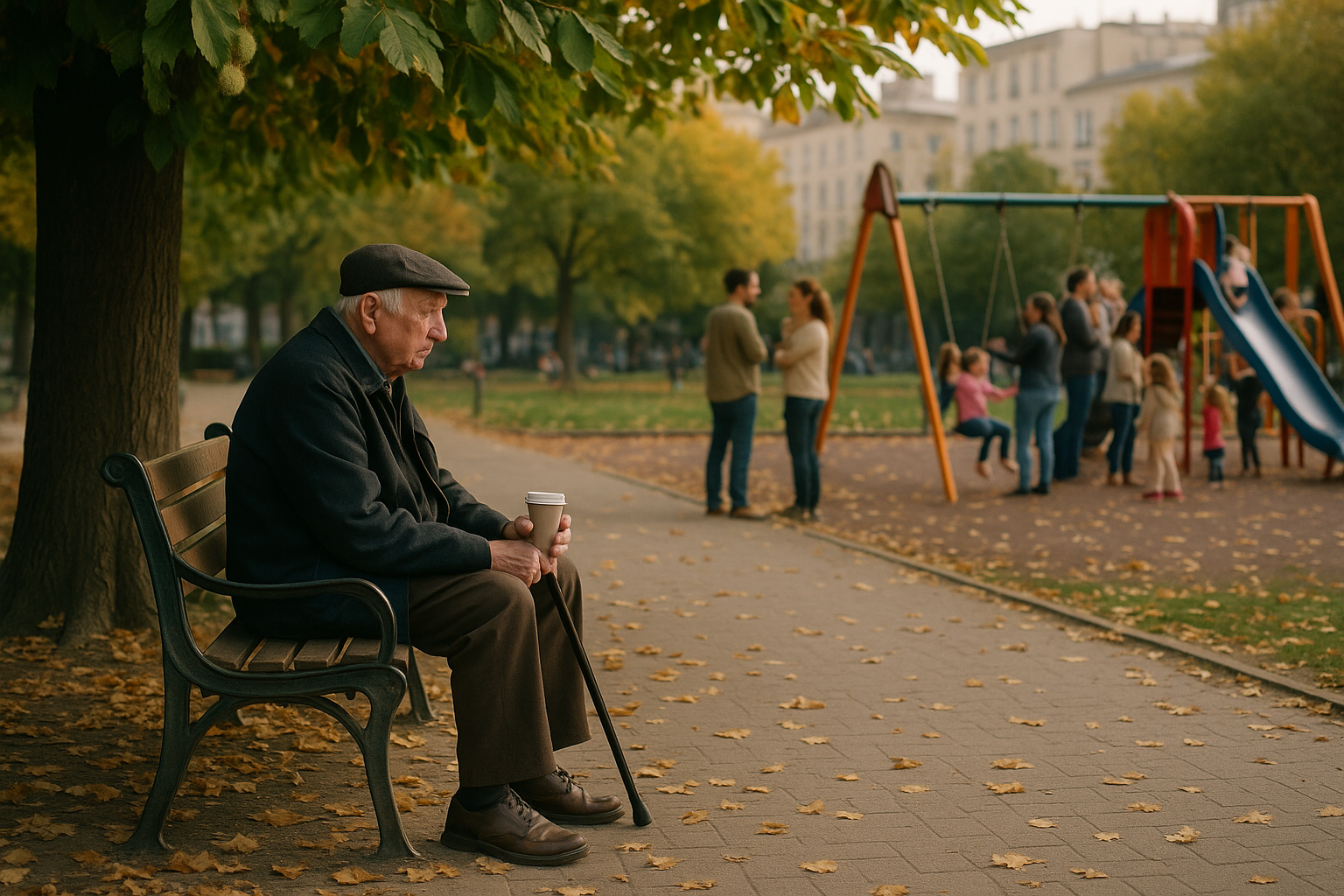
The old man kept sitting on the same bench every day, staring at the playground as if he was waiting for someone who would never come. Children ran past him with colorful balls and sticky ice creams, their laughter flying through the air like bright kites. He didn’t smile. He just followed them with his pale blue eyes, as if searching for a particular face he had once known by heart.

People in the neighborhood had grown used to him. Some waved, some nodded, most just forgot he existed the second they turned the corner. Only Mia, a thin, twelve-year-old girl with tangled hair and a too-big backpack, kept noticing.
She saw him first in early autumn, sitting alone under the chestnut tree. His hands shook a little as he held a paper cup of coffee. The next day he was there again. And the next. Always the same bench, always the same faraway look.
One windy afternoon, when the sky threatened rain, Mia finally walked up to him.
“Hi,” she said, hugging her backpack to her chest.
He blinked, as if someone had turned on a light too suddenly. “Hello,” he answered, his voice rough from disuse.
“Why do you always sit here?” she asked. “You’re here every day.”
He looked at the playground. A little boy was trying to climb the ladder, his mother hovering behind him.
“I’m waiting,” the old man said simply.
“For who?”
“For my grandson.”
Mia hesitated. “Is he late?”
The old man’s mouth twitched. “He’s… very late.”
She sat down on the other end of the bench. “My name is Mia.”
“Daniel,” he replied.
From that day on, Mia started sitting with him whenever she could. After school, before her mother came home from her second job, Mia would drop her backpack by the bench and share her crushed sandwiches with him. He never ate much, just a bite or two, but he always thanked her like she had offered him a feast.
Daniel told her small things at first. That he used to be an electrician. That he had lived in the same city all his life. That his wife, Anna, had loved roses and terrible television shows. Mia laughed at the way he rolled his eyes whenever he mentioned Anna’s favorite soap opera.
“But you watched with her?” Mia guessed.
“Every episode,” he admitted, and for a moment his eyes softened.
One day, when the wind was sharper and Mia’s fingers were red from the cold, she asked, “So where is your grandson? Does he live far away?”
Daniel didn’t answer right away. His hands tightened around his cane.
“He used to live very close,” he said finally. “His name is Leo. When he was small, we came here every weekend. He liked the swings. He… trusted me.”
“Why doesn’t he come now?”
Daniel’s jaw worked. “Because I made a mistake. And his parents decided that meant I shouldn’t see him anymore.”
Mia frowned. “What kind of mistake?”
He exhaled, a slow, painful sound. “I forgot to pick him up from kindergarten. Just once. I was at the hospital with Anna. She… she was dying. I stayed too long. My son and his wife never forgave me. They said if I could forget their child, I didn’t deserve to be his grandfather.”
Mia looked at him, stunned. “But you were with your wife. That’s not—”
“They were scared,” he interrupted quietly. “Maybe they were right to be.”
Rain started to fall in small, cold drops. Still, he kept watching the swings.
“Do you think he remembers you?” Mia asked softly.
“I don’t know,” Daniel whispered. “I remember him. That has to count for something.”
Weeks passed. The air grew colder, and Mia’s mother started scolding her for spending so much time outside.
“You can’t just sit in the park with some stranger,” she said one night, dropping her keys on the kitchen table. “Mia, he’s not your responsibility.”
Mia stared at the steaming pot of instant soup. “He’s alone, Mom.”
“We’re all alone in some way,” her mother replied tiredly. “We can’t fix everyone.”
But Mia kept going back.
One afternoon, she arrived to find the bench empty. For the first time in months, Daniel wasn’t there. The chestnut tree rustled above the deserted bench, and the playground felt suddenly wrong, as if someone had turned off the sound.
She waited until the sky turned orange. No one came.
That night she couldn’t sleep. The next day she rushed to the park straight from school. The bench was still empty.
Something cold settled in her stomach.
After a sleepless weekend and three more empty days, Mia did something she’d never done before: she walked into the small community center near the park. The receptionist, a middle-aged woman with tired eyes, looked up.
“Can I help you?”
“I’m looking for an old man,” Mia blurted out. “His name is Daniel. He sits on the bench by the playground every day. Or he used to.”
The woman studied her. “Why are you looking for him, sweetheart?”
“He didn’t come. For a week. He never missed a day.”
The woman’s expression changed. Slowly, she reached for a folder.
“We had a Daniel in our senior outreach program,” she said. “He lived alone. No family contacts listed.”
Mia’s heart hammered. “Is he okay?”

The woman hesitated. “He passed away last week. In his sleep, they said. Peacefully.”
The room tilted. Mia gripped the edge of the counter.
“Was anyone with him?” she whispered.
“No,” the woman said softly. “No, honey. He was alone.”
Mia swallowed a sharp, burning knot in her throat. “Did… did he have anything? I mean, like… a photo or something?”
The receptionist looked through the folder, then nodded. “He had one picture in his wallet. A little boy on a swing. On the back it says: ‘Leo, three years old, my sunshine.’”
Tears blurred Mia’s vision. “Can I… can I see it?”
The woman hesitated, then slid a copy across the counter. The boy in the photo was laughing at the camera, hair pushed back by the wind.
“His son never visited?” Mia asked, voice shaking.
“There was a phone number once,” the woman said. “But when we called years ago, they asked not to be contacted again.”
Something in Mia hardened and broke at the same time.
“Can I keep this copy?” she asked, wiping her cheeks.
“Of course.”
That evening, Mia sat alone on Daniel’s bench. The playground roared with life around her, but it all felt distant. She placed the photo on her knees, tracing the little boy’s outline with her fingertip.
“I’m sorry,” she whispered to the empty space beside her. “You were waiting for nothing.”
The next day, Mia did something that terrified her more than any exam ever could. She took the photo, put on her cleanest shirt, and went to the city registry office. It took hours of explanations, a sympathetic clerk, and finally a printed address.
The address of Daniel’s son.
Mia stood in front of the neat apartment building, her heart pounding so loudly she could feel it in her throat. She rang the bell.
A tired-looking man in his forties opened the door. He had the same pale blue eyes as Daniel.
“Can I help you?” he asked, guarded.
“Are you Mark?” she asked. “Mark Evans?”
“Yes.”
Mia held out the photo with both hands. “Your father died last week,” she said quietly. “He used to sit in the park. On the bench by the playground. He waited for your son every day.”
Mark froze. His eyes dropped to the picture, then slowly rose to Mia’s face.
“I don’t know who you are,” he said, but his voice was no longer steady.
“I’m just… someone who sat with him,” Mia answered. “He talked about Leo. About how he messed up once and you never forgave him. He died alone, Mr. Evans. Nobody held his hand. Nobody said goodbye.”
Mark’s lips parted, but no sound came out. Behind him, a small boy appeared in the hallway, clutching a toy truck.
“Dad?” the boy asked. “Who is it?”
Mia’s chest tightened. “He looks like him,” she whispered. “Like the photo. Like your father.”
Mark swallowed hard. He looked back at his son, then at the worn edges of the photograph.
“I thought I was protecting my child,” he said hoarsely. “I didn’t realize I was punishing an old man until it was too late.”
Mia took a step back. “I just thought you should know,” she said. “He never stopped waiting.”
She turned, ready to leave, but Mark’s voice stopped her.
“Wait.”
She looked back.
“Which bench?” he asked. “In which park?”
Mia told him.
That weekend, a new plaque appeared on the old bench under the chestnut tree. It was simple, just a small metal plate screwed into the wood. Mia read the words over and over, her fingers tracing each letter:
“Daniel Evans. Who never stopped waiting for his grandson. May no one have to wait alone.”
As she sat there, Leo and his father approached slowly. Leo climbed onto the bench, small legs dangling. Mark stood for a long moment, staring at the plaque, his face crumpling.
“I was too late,” he murmured.
Mia shook her head. “You’re just in time,” she said quietly, nodding toward Leo.
The boy looked up at his father. “Who was he, Dad?”
Mark swallowed. “He was… your grandfather,” he managed, voice breaking. “And I should have brought you here a long time ago.”
The wind rustled the chestnut leaves above them, and for a moment, as the sunlight fell gently on the worn wooden slats, Mia could almost see Daniel’s thin figure sitting there, watching the playground with that quiet, aching hope.
This time, the bench was not empty.