The old man who sat alone on the playground bench every evening wrote a name in his notebook, and one rainy day my son came home with that exact name on a crumpled piece of paper.

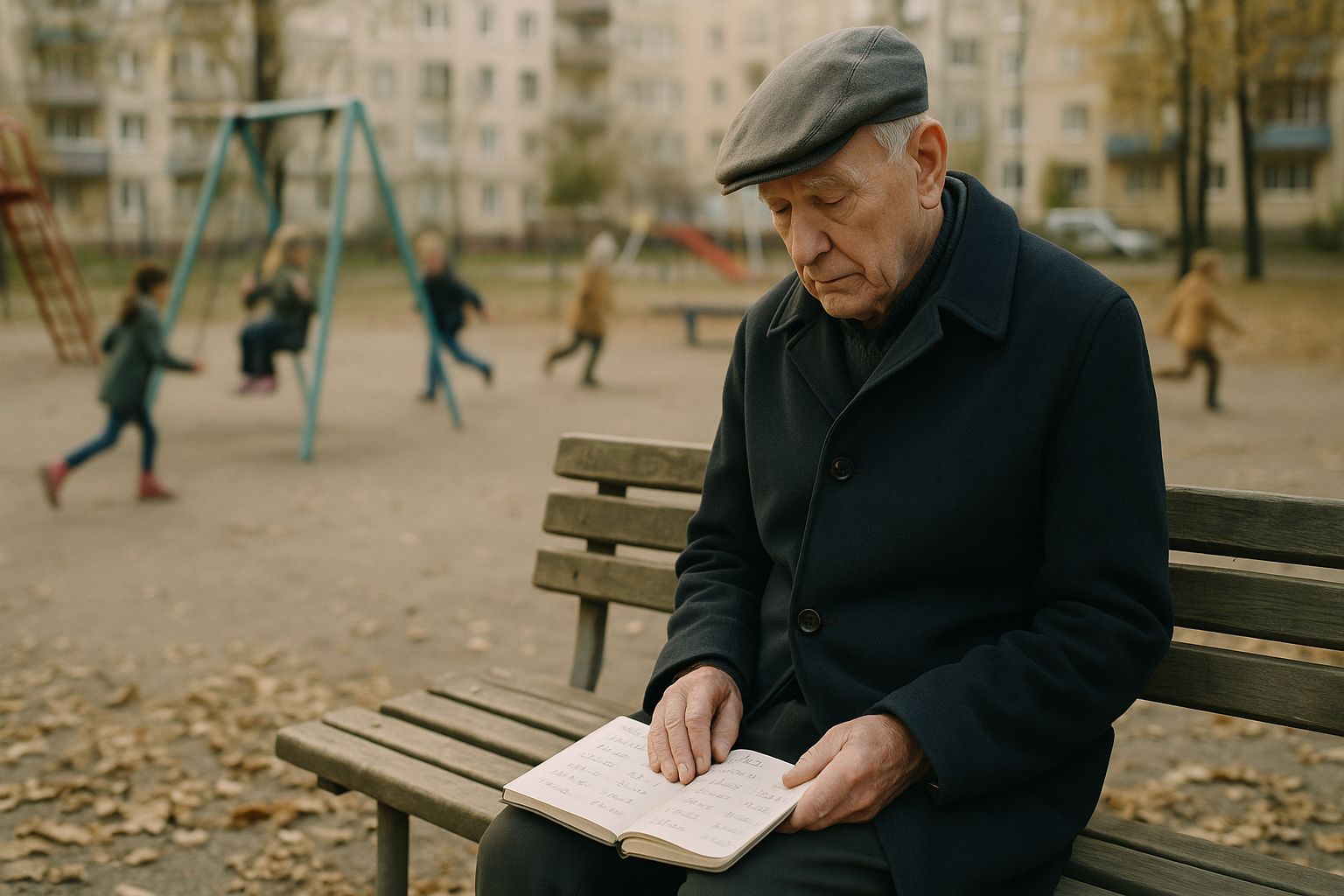
For months I had watched him from our apartment window. Always the same: dark blue coat, gray cap, a wooden cane resting by his leg. He came when the children were already running around, sat on the far bench and silently observed them. Sometimes he smiled, sometimes his lips moved as if he was talking to someone invisible.
Other parents whispered. Some called him weird. Others said he must be lonely. A few times I thought I should go and ask if he needed help, but then my phone rang, or Emma fell, or Leo started crying, and the moment slipped away.
One evening, as I pushed my seven-year-old son Noah on the swing, I noticed the old man was writing something in a small notebook. Slowly, carefully, almost reverently. When a girl laughed nearby, he stopped, looked up, and his eyes filled with such longing that I felt a strange ache in my chest.
“Mom, that grandpa is always here,” Noah said, following my gaze.
“Maybe he likes children,” I answered vaguely, adjusting Noah’s scarf.
“He doesn’t have any,” Noah declared with the confidence of a child who has decided something. “Otherwise they’d be with him.”
I almost laughed, but the words stayed in my throat when I saw the old man’s hands tremble as he closed his notebook.
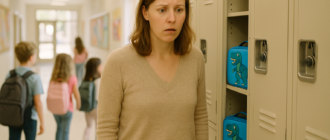
The first real twist came on a Tuesday, when the sky was the color of dirty cotton. It started to rain just as school ended. I rushed to pick up Noah, already imagining wet shoes and a runny nose. Instead, I found him under the awning, clutching a damp piece of paper, his eyes big.
“Mom,” he blurted out the moment he saw me, “do you know a girl named Anna?”
The name hit me like a stone. For a second the corridor tilted. I swallowed hard. “There are many Annas, sweetheart. Why?”
He opened his fist. On the crumpled paper, written in shaky letters, was a single word: ANNA.
“The grandpa from the playground gave it to me,” he explained. “He was standing outside the school gate. He asked my name, then gave me this and said, ‘Please show this to your mother.’ Then he walked away.”
I took the paper, my fingers suddenly cold. The handwriting was thin, unsteady. The same name I had spent seven years trying not to say out loud.
Our daughter, Anna, had lived for exactly three days.
Noah knew he had had a sister “who is in heaven,” as we told him, but we never used her name at home. It hurt too much.
“Mom, are you okay?” he tugged at my sleeve.
“Did he say anything else? What did he look like?” I asked, even though I already knew the answer.
“The same grandpa from the playground. Blue coat, stick. He looked… sad.” Noah frowned. “Did I do something wrong?”
“No, honey,” I whispered, pulling him into a quick hug. “You did nothing wrong.”
That night I barely slept. I kept seeing the old man’s face, the fragile way he held his notebook, the name on the paper burning in my head. Was it a coincidence? Some cruel joke? Or something much worse?
The next day I left work early and went to the playground alone. The wind was sharp, the swings creaked emptily. He was already there, on his bench, the notebook on his knees.
My heart pounded as I walked up to him. Up close he seemed even older, his skin thin like paper, his eyes pale but very clear.
“Excuse me,” I began, my voice trembling more than I expected.
He looked up, surprised, and then recognition dawned. “You are Noah’s mother,” he said softly, with an accent I couldn’t place.
“Yes. Yesterday, at the school… you gave him a paper with this.” I showed him the crumpled note. “Why? Where did you get this name?”
He stared at the paper for a long moment, then at my face. Something in his expression changed, as if he saw through years instead of seconds.
“I am sorry if I frightened the boy,” he said quietly. “I had no right. But I… I thought perhaps you would understand.”
“Understand what?” My patience snapped. “This is my daughter’s name. She died as a baby. Do you think this is some kind of game?”
His hands shook violently now. He pressed them together to still them.
“My granddaughter’s name is Anna,” he whispered. “Was. I do not know anymore. I have not seen her since she was three.”

The world seemed to hold its breath.
“My son,” he continued, swallowing, “left our country many years ago. We argued when his wife was pregnant. I said stupid things, harsh things. He told me to stay away. When little Anna was three, they moved here. He sent one photo. One. Then nothing. Phone changed. Address changed. I have spent ten years looking at children in parks, hoping… hoping to see her face.”
He opened his notebook with painful slowness. Every page was filled with a single name, over and over: ANNA. Some written straight, some crooked, some with ink blurred by what could only be tears.
“I sit here every day,” he said. “I talk to the children in my head. I imagine she is here, that she is laughing. Yesterday, when I saw your boy, something… something in his eyes…” His voice broke. “I thought maybe he had a mother who understands what it is to lose a child you still love.”
My anger dissolved, leaving only a heavy sorrow.
“So you gave him this?” I asked softly.
He nodded, ashamed. “I wanted to ask you… how do you live with this pain? But when I saw you, I lost my courage. I am an old fool.” He tried to smile. It looked like it hurt.
I sat down beside him. For a while we just listened to the empty playground. A bird hopped near the swings, unafraid.
“My Anna died seven years ago,” I said slowly. “I still wake up at night and reach for her. I still avoid baby sections in stores. I still hate the month she was born. But I also have Noah. He laughs, he asks questions, he drags me back into life whether I like it or not.”
A tear slid down his cheek.
“I have no one,” he whispered. “My wife passed away five years ago. My son…” He shook his head. “Sometimes I come here and think: if I sit very still, maybe the past will find me.”
The second twist came then, not from him, but from my own mouth.
“Come tomorrow at three,” I heard myself say. “When school ends. Stand by the gate again. But this time, don’t just give Noah a paper. Talk to him. Tell him about your Anna. He will listen. He always listens.”
He looked at me, startled. “Why would you do this for me?”
“Because,” I answered, feeling my throat tighten, “maybe my Anna would have had a grandfather like you. And because my son needs to learn that old people on benches have stories, not just wrinkles.”
He pressed his lips together, fighting for control. “What is your name?” he asked.
“Laura.”
“Thank you, Laura,” he said, pronouncing it carefully, as if afraid to break it.
The next day, Noah ran out of school and almost collided with the old man at the gate. I watched from a distance. They talked. First shyly, then with growing animation. The old man showed him the notebook; Noah pointed at something, laughed, then suddenly hugged the notebook to his chest as if it were a treasure.
That evening, Noah burst into the apartment.
“Mom!” he shouted. “His name is Viktor! His granddaughter likes yellow balloons, just like I do! And he doesn’t know where she is, so I told him we can share. He can be my extra grandpa and I can be his extra grandson until he finds her. Is that okay?”
My eyes filled with tears so fast I had to turn away.
“Is it okay, Mom?” he repeated anxiously.
I looked at my son, at the hope he carried so lightly, and thought of a little girl whose name we had been afraid to say for seven years.
“Yes,” I said, my voice breaking but steady enough. “Yes, Noah. It’s more than okay.”
From that day on, the old man did not sit alone on the playground bench. He sat next to Noah, sometimes reading, sometimes watching, sometimes just quietly writing a name in his notebook. Not only one name anymore. On the last page, in the same shaky letters, he had added another.
ANNA.
NOAH.
Underneath, in smaller, trembling handwriting, one more word:
FAMILY.