When Ethan Dropped Off His Father at the Care Home “Just for a Week”, He Never Expected the Letter Hidden in the Old Man’s Slipper.

Ethan parked in front of the pale yellow building and turned off the engine, but his hands stayed tight on the steering wheel. Next to him, his father Daniel sat silent, fingers nervously folding the edge of his worn gray cap. The sign above the entrance read: “Maple Garden Senior Residence”. It sounded soft. Safe. Temporary.
“Just for a week, Dad,” Ethan said, forcing a smile that tugged at the corners of his tired face. “Until the project at work calms down and we fix the situation at home. You know how noisy the kids are. You need rest.”
Daniel nodded too quickly, his eyes fixed on the building. He had always been the one who carried heavy boxes alone, who climbed on the roof in winter, who never admitted when his back hurt. Now his hands trembled when he tried to button his coat.
Inside, the reception smelled of disinfectant and something sweet, like overcooked oatmeal. A cheerful nurse named Linda greeted them, talking too brightly about activities, therapy, music evenings. Ethan heard only fragments. “Meals… safe… 24-hour care…”
When the paperwork was done and the room assigned, Ethan followed his father down the corridor. Doors lined both sides, some open, revealing strangers in faded pajamas, eyes turned to the same small television in every room.
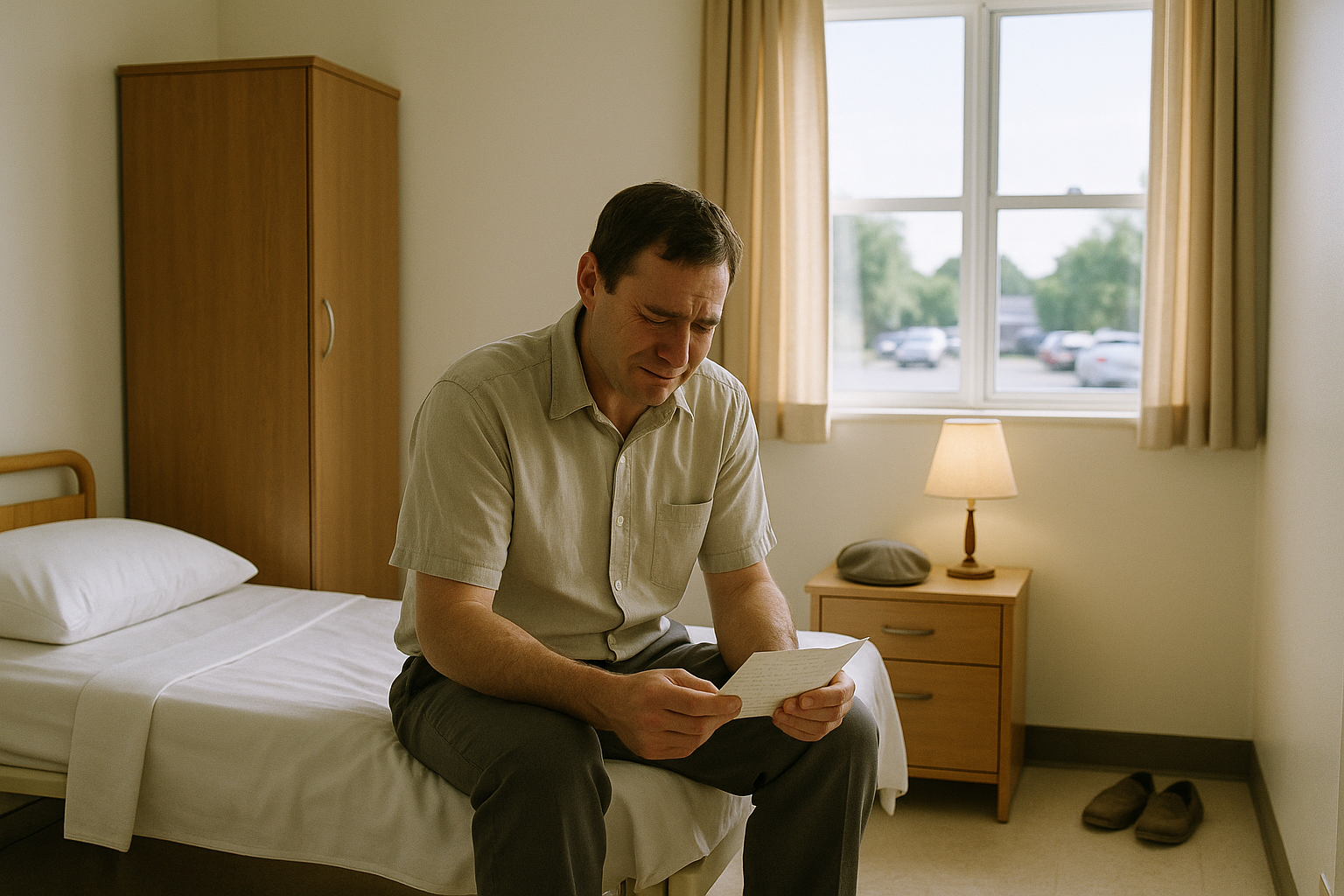
Room 214 had one window, a narrow bed, a wardrobe, and a bedside table with a lamp that hummed faintly. Daniel put his plastic bag on the bed and looked at the window.
“You can see the parking lot,” he said quietly. “I’ll see you arrive.”
Something twisted in Ethan’s chest. “Dad, it’s just for a week. I’ll call every day. And we’ll bring the kids on Sunday, okay?”
Daniel nodded again, the same quick, anxious nod. “Of course. You have your life. Don’t worry about me.”
Ethan hugged him briefly, almost awkwardly, then stepped back. “I’ll be back soon,” he repeated. It felt like a lie, even though he wanted it to be true.
The first week passed in a blur of deadlines and late nights. Ethan called twice. Each time, his father sounded smaller on the phone, but he still asked about the children’s homework, about the leaking kitchen tap he used to fix every year.
Then the project at work didn’t calm down. It exploded. Another contract, another crisis. The kids got sick, his wife Megan argued about bills, the car broke down. One week turned into two, then three. Ethan told himself he would go on the weekend. Every weekend, something “more urgent” came up.
He answered when the care home called at first. It was always a nurse: “Your father is fine, but he seems a bit sad.” Then: “He’s refusing to participate in activities, maybe you could visit soon?”
“I’m coming,” Ethan would say, already typing emails with his free hand. “I promise.”
He didn’t.
The call that finally made him drop everything came on a Tuesday morning. The voice was different. Calm, formal.
“Mr. Miller? This is Dr. Harris from Maple Garden. I’m afraid I have some bad news.”
Ethan didn’t remember how he got to the car, only the sound of his own breathing and the blur of the road. At the care home, they led him to a small, quiet room. His father lay there, hands folded, face strangely peaceful. The gray cap rested on the bedside table.
“We found him this morning,” the doctor said gently. “It was his heart. He went in his sleep. He didn’t suffer.”
Words washed over Ethan without meaning. He stared at the still hands that had once carried him on their shoulders, fixed his bike, clapped the loudest at his school concerts.
“I was going to come this weekend,” Ethan whispered to no one.
Later, when the formalities were done and the body taken away, Linda the nurse approached him with red-rimmed eyes.
“He waited for you every day,” she said, not accusing, just stating a fact that cut deeper than any blame. “He kept his slippers on by the door, said he wanted to be ready when you came.”
She held out a folded piece of paper. “We found this in his slipper this morning. It has your name on it.”
Ethan’s throat tightened as he took the paper. On the outside, in shaky handwriting, was his name: Ethan.

He unfolded it, his fingers clumsy.
“My boy,” the letter began, the ink slightly smudged.
“If you are reading this, it means I went away without seeing you again. I hope you did not come because you were busy living, not because you forgot me.
Do not be angry with yourself. I know life is heavy. I raised you to work hard, to be a good father and husband. If that took you away from me, then I did something right.
I was afraid when you brought me here. Not of the place, but of being a burden. I saw the tiredness in your eyes, the pain in your back when you bent down to tie your son’s shoes. I did not want to add another weight.
Every day I sat by the window and watched the parking lot. I wore my slippers in case you came and I needed to hurry. The nurses laughed at me, but kindly. I liked them. They brought me tea the way your mother used to.
Sometimes I imagined you running in, late and apologizing. I practiced what I would say: ‘It’s okay, I know you love me.’ I wanted to say it first so you wouldn’t have to.
If I could ask one thing, it is this: love your children loudly while you still can. Sit with them even when you are tired. Answer them when they call. One day they will be busy too, and you will sit by a window, and you will understand me completely.
I am proud of you, Ethan. I always was. Even when you did not come.
Please don’t remember me in this bed. Remember me when we fixed the roof and the rain still got in, and we laughed. Remember my bad pancakes and the time I fell in the lake trying to impress your mother.
I forgive you, my boy. If you can, forgive yourself a little.
With love,
Dad.”
The paper blurred as Ethan’s vision filled with tears. He sank onto the empty bed, clutching the letter like a lifeline. The room felt too quiet, too clean, as if nothing important had ever happened there, as if his father’s life had not just ended between these four pale walls.
He thought of all the nights he had sat at his computer, answering emails while ignoring the silent phone on the table. He remembered his father’s missed calls, the short messages: “How are the kids?” “How’s the car?” “Proud of you, son.”
Now there would be no more calls. No more questions about the leaking tap. No more stories told twice because age stole names and dates.
When Ethan finally stood up, he walked to the small window. From there, he could see the parking lot, the place his father had watched every day, slippers ready. His own car was there now, a few minutes too late for the reunion his father had dreamed of.
Ethan pressed his palm against the cold glass and whispered, “I’m sorry, Dad.”
There was no answer, only the faint rustle of leaves outside and the distant hum of life going on.
That evening, back home, Ethan sat on the living room floor while his children, Lily and Noah, built a crooked tower of colorful blocks. His laptop lay closed on the table for the first time in months.
“Daddy, can you help?” Noah asked, holding out a piece.
Ethan looked at their small hands, at their expectant faces, and at the folded letter in his own trembling fingers.
“Yes,” he said softly, pulling them closer. “I’m right here.”
And this time, he stayed.