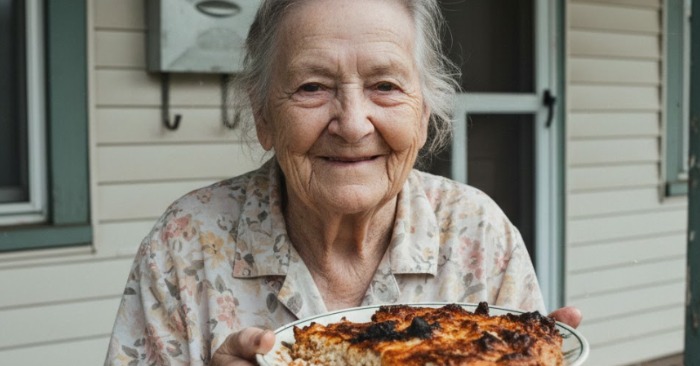
The neighbor brought another burnt dish again, but this time I heard something that changed everything. When I saw her standing in the doorway with that burnt chicken, smiling as if she had just done me a huge favor, I felt a familiar stab of discomfort. It must have been the fifth time already this month. Each time she insisted that she had “baked something especially for me,” and I, not wanting to offend her, only thanked her and promised that I would “definitely try it later.”
I never had the heart to say that those dishes were practically inedible — burnt, oversalted, or downright raw inside. But her face, full of good will, made it impossible for me to refuse. I had the impression that she was trying to tell me something, but didn’t know how herself.
That afternoon, however, there was something different in her gaze. She seemed to be smiling the same way, but it looked like a mask. Her hands were trembling slightly, and when she handed me the plate, I noticed that her sleeves were unbuttoned, as if she had left the house in a hurry
I wanted to ask if everything was okay, but then her husband came out of their house. I rarely saw him, he was always quiet and rather kept his distance. This time, however, he walked straight up to me and looked at me in a way that immediately made me alert.
He asked me to stay for a moment. He said that he had to explain something. That it concerned his wife, me, and all those “gifts” she had started bringing. There was neither anger nor politeness in his voice — only exhaustion. The kind of deep exhaustion you feel in your bones.
I looked at my neighbor. She was still standing in the doorway, looking at me like a child waiting for praise. She was smiling, but her eyes were absent, as if she didn’t fully understand what was happening around her.
And then her husband asked me to step a few steps away with him, “so that she wouldn’t hear this.” I did so, although I felt the tension growing inside me.
When we were far enough away, he took a deep breath and said that his wife used to love cooking. That it was her greatest pride — feeding people. And then she began to forget the simplest things. First names. Then recipes. Later dates. And finally — what she had been doing just a few minutes earlier.
He said that the doctor had used one word that they were both afraid of. That everything she brings is not malice or sloppiness. That it comes on its own. That she truly thinks she is doing something good.
I listened, and my heart was breaking more and more. Suddenly all those burnt dishes stopped being irritating. They became terrifyingly sad.
Her husband also said that she comes to me because we used to meet often in the garden, talk. That in her memory I got stuck as “someone nice, worth cooking something for.”
I wanted to say something, but at that moment the neighbor called him in her quiet, trembling voice.
And he looked at me and added a sentence that changed everything — a sentence I will never forget.
He said: “She brings you these dishes because she thinks you are her daughter.”
In that second all my anger, all the discomfort, all the irritation melted away. I felt as if someone had pulled back a curtain and shown me a completely different truth. The neighbor was not trying to judge me. She was not trying to shame me. She was simply looking for her daughter — in my features, in my home, in my smile.
Her husband said quietly that their real daughter had moved away many years ago and had almost completely cut off contact. That for his wife it was a wound that never healed. And since she started getting ill, the line between memory and reality has been blurring more and more.
He also said that she no longer remembers that her daughter stopped answering calls long ago. But she remembers warmth, she remembers cooking, she remembers care. And that is why she brings those burnt dishes — because she wants to give the love she once gave to someone else.
I returned home with that plate and for a moment I simply stood by the sink, looking at what lay on it. Now I saw in it not burning, but an attempt. One of the last attempts to hold on to a world that was slipping away from her.
The next day I asked her husband if I could come by more often — maybe help, maybe sit with her, maybe cook something simple together. He looked at me as if for the first time in months he had received a little relief from life.
And so we began a new routine. Sometimes we sat together in the kitchen, sometimes she told me stories that mixed the past with the present. Sometimes she just smiled, and that was enough.
I understood that sometimes people give us things that look like a burden, but are in fact their last attempt to hold on to what they love.
This story taught me one thing — before we judge someone’s strange behavior, it is worth thinking about how much pain truly stands behind it.
If you made it to the end, write whether YOU also once discovered that someone’s behavior only made sense when you learned the whole truth.