When a widowed father of four finds a diamond ring in a supermarket aisle, he makes a decision that costs him nothing—but means everything. What happens next is a quiet, powerful reminder that honesty still matters in a world full of conflict. And sometimes life gives back in the most unexpected ways.
It started with a knock at the door—and a man in a suit standing next to a black Mercedes. That morning, I’d been packing lunches with one hand and unclogging the kitchen sink with the other.
Grace was crying over a lost teddy bear. Lily was furious about her crooked braid. And Max was spilling maple syrup all over the floor—for our dog.
So no, I wasn’t expecting anything out of the ordinary.
My name is Lucas, I’m 42 years old. I’m a widower and an exhausted father of four.
Two years ago, shortly after our youngest, Grace, was born, my wife Emma was diagnosed with cancer. At first we thought it was just exhaustion – the kind of tiredness you laugh about six months later when the baby finally sleeps through the night.
But that wasn’t it. It was aggressive, advanced, and cruel. In less than a year, Emma was gone.
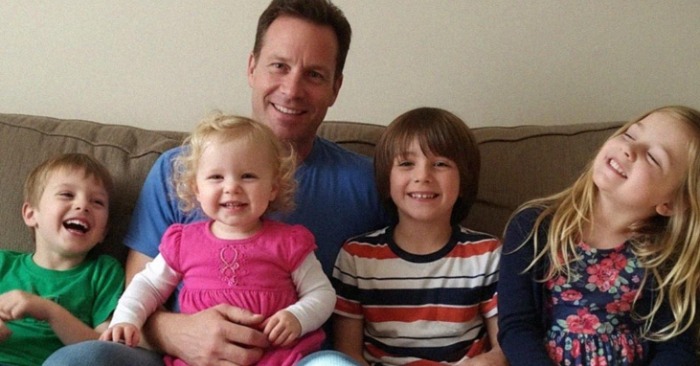
Now it’s just me and the kids—Noah is nine, Lily is seven, Max is five, and little Grace is two. I work full-time in a warehouse, and in the evenings and on weekends, I take any job I can find: fixing appliances, moving furniture, patching walls.
ANYTHING THAT KEEPS THE LIGHT ON AND THE WATER RUNNING.
Anything that keeps the light on and the water running.
The house is old, and it shows. The roof leaks when it rains, and the dryer only works if you kick it twice. Our van develops a new rattle every week, and each time I say a silent prayer that it’s nothing I can’t afford.
But the kids are fed, they’re safe, and they know they’re loved.
That’s all I want.
This Thursday, I picked up the kids from school and daycare, and we made a quick stop at the supermarket. We needed milk, cereal, apples, and diapers. I’d hoped to pick up some peanut butter and broccoli too, but the usual budget stress hit us like an extra passenger.
Max had somehow wedged himself into the lower rack of the shopping cart and was commentating on everything like a race reporter. Lily was endlessly debating which rolls were “crispy enough,” as if she’d suddenly reached a culinary climax.
Noah knocked over a display of granola bars and muttered “my bad” before calmly walking on. And Grace, my little whirlwind, sat in the front seat of the cart, singing “rowboat, rowboat” on repeat, crumbs from some mysterious cookie falling onto her shirt.
“Guys,” I sighed, trying to steer the car with one hand. “Can we please pretend we’ve already been out in public?”
“But Max said he’s the Wagon Dragon, Dad!” Lily exclaimed indignantly—speaking for him.
“Wagon Dragons don’t scream in the produce section, honey,” I said, steering us toward the apples.
And that’s when I saw it.
Something gold and glittering was tucked between two bruised Gala apples. I stopped. My first thought was that it was one of those plastic toy rings kids drop from vending machines. But when I picked it up, I immediately felt its weight.
It was solid. It was real.
A diamond ring—definitely not something you just find in a fruit bowl. My fingers instinctively closed around it.
I looked around. The aisle was empty except for us. No one seemed to be searching for it, no panicked voices, no shouting.
For a moment, I hesitated.
What would a ring like that be worth? What could he pay for? The brakes? The dryer? Groceries for the next few months? Noah’s braces?
The list kept churning in my head.
“Daddy, look! This apple is red and green and gold!” Lily squealed excitedly. “How is that possible?”
I looked at my children—my gaze lingered briefly on Grace’s sticky braids and the proudest smile I’d seen all week—and suddenly I knew.
That wasn’t mine.
And I couldn’t be the man who even seriously considered it for a second. Not while she was watching—not while all four of them were watching.
Not for fear of getting caught. Not because of the punishment. But because one day Grace would ask me what kind of person I wanted her to be—and I would have to answer her with my life, not just words.
I carefully slipped the ring into my jacket pocket, planning to hand it in at the information desk as soon as we got to the checkout. But before I could even take a step, a voice cut through the aisle.
“Please… please, he must be here…”
I turned around.
An older woman came around the corner, her movements jerky, almost panicky. Her hair had slipped out of its clip, her cardigan hung halfway off one shoulder. Things spilled out of her handbag—loose tissues, a glasses case, hand cream.
Her eyes, wide and reddened, scanned the tiles as if she were searching for a lost child.
“Oh God, please not today,” she murmured, half to herself, half to heaven. “Lord, help me. Please.”
I approached her.
“Excuse me,” I asked gently. “Are you all right? Do you need help? Are you looking for something?”
She stopped. Her gaze met mine, then slid down to the ring I had since pulled from my pocket and was holding in my palm.
She gasped—and it struck me right in the heart. It was that sound people make when something they love is pulled back from the brink of final loss.
“My husband gave me this ring,” she whispered, her voice breaking under the weight of the moment. “For our fiftieth wedding anniversary. He died three years ago. And I wear it every day. It’s…it’s the only thing I have left of him.”
Her hand trembled as she reached for it. But she paused for a heartbeat, as if she needed to make sure this was real.
“I didn’t even realize it had slipped off,” she said, swallowing hard. “I only noticed it in the parking lot. Since then, I’ve been backtracking every step.”
When she finally took it, she pressed it to her chest, as if she could force it into her heart. Her shoulders trembled, and yet she managed a breathless, broken “thank you”.
“I’m just glad you have him back,” I said. “I know what it’s like to lose the love of your life.”
“That’s a different kind of pain, my boy,” she said, nodding slowly. “You have no idea what this means to me. Thank you.”
She looked past me at the children, who had suddenly become unnaturally quiet. They watched her the way children sometimes look when they sense something momentous is happening—wide-eyed, calm, and awestruck.
“Are these yours?” she asked, her voice softer now.
“Yes, all four of them,” I said.
“They’re beautiful,” she said. “And I can see they’re growing up with love.”
I saw Lily reach out to Grace, kiss her fist, and make her laugh. Noah and Max made dinosaur noises to entertain her.
The old woman briefly placed her hand on my forearm. Not for support—but as a connection.
“What’s your name, my boy?” she asked.
“Lucas,” I said.
She nodded slowly, as if etching the name into her memory.
“Lucas… thank you.”
Then she turned, the ring clutched tightly in her fist, and disappeared around the corner. We paid for our shopping—every single item squeezed into the last $50 I had left for the month—and drove home.
I really thought that was the end of it.
It wasn’t. Not even close.
The next morning, it was the usual symphony of spilled cereal, missing hair ties, and tangled ponytails. Max spilled orange juice all over his homework. Grace insisted on eating her berries by squashing them between her fingers. Noah couldn’t find his baseball glove, and Lily was on the verge of tears because her braid looked “lumpy and sad.”
I was making sandwiches and reminding Max to wash his hands before eating when there was a knock at the door.
Not a casual knock. Sharp, definite.
All four children froze amidst the chaos.
“I hope it’s not Grandma,” Noah said, making a face.
“We’re not expecting Grandma,” I said, amused. “Look after Grace, okay? I’ll be right back.”
I wiped my hands and went to the front door. I was expecting a package or maybe a neighbor.
It was neither.
A tall man in a charcoal-gray coat stood on the porch, impeccably dressed despite the wind. Behind him, a black Mercedes was parked at the curb, idling as if it definitely didn’t belong on our street with its cracked sidewalks.
“Lucas?” A slight frown flickered across his face.
“Yes, can I help?”
He held out his hand.
“I’m Andrew,” he said with a polite smile. “You met my mother, Marjorie, yesterday. At the supermarket. She told me what happened.”
“Yes… she found her ring.” I nodded slowly. “I’m glad. If I lost my wedding ring, I’d be devastated. My wife is gone… and I… I’m glad your mother has hers back.”
“She didn’t just find it, Lucas,” Andrew said. “They gave it back to her. And at a time when she’s… falling apart. Since my father died, she’s been keeping herself afloat with routines. She washes and folds his clothes as if he were coming home to wear them. She makes two cups of coffee every morning. That ring was the last gift he gave her. She wears it every day, and losing it… it almost broke her.”
His voice didn’t break, but there was something behind his words—something held too tightly.
“She remembered your name,” he added. “She asked the store manager if he knew who you were.”
“And he did?” I asked.
Andrew smiled and nodded.
“He said you’re a regular here. And he mentioned your daughter’s giggling. He said she turns heads in the cereal aisle, and it brings joy to the store.” Andrew paused briefly. “My mom asked about the security cameras, and I have a friend who’s tech-savvy. And thanks to that parking ticket you once got, it wasn’t hard to find your address.”
He glanced past me and saw the backpacks against the wall, Grace wobbling into view—wild curly hair, berry mush on her face. Behind me, it was pure family chaos: loud, messy, alive.
“You’re busy, I see,” he grinned.
“Every single day,” I said, managing a smile despite my tiredness.
“My mom asked me to give you this, Lucas.”
He pulled an envelope from his coat.
“Look,” I said, holding up my hands. “I didn’t return the ring for some kind of reward, Andrew. I briefly considered pawning it—for a split second. But then I knew four pairs of eyes were watching me. I was going to take it to the information desk anyway.”
“Lucas, my mother said I should tell you that your wife would be very proud of the man you are,” Andrew continued, as if he hadn’t even heard me.
Those words hit me like a punch to the gut. I swallowed, but no sound came out.
Andrew took a step back, nodded to the children who were still standing in the hallway watching us, then turned and walked to his car. When he reached the driver’s side door, he paused and looked back at me one last time.
“Whatever you do with this,” he said gently, “just know that…it meant something.”
Then he got in and drove off. The Mercedes glided down our street as if it were a visitor from another world—a world without cracked sidewalks and flickering porch lights.
I didn’t open the envelope right away. I waited until the children had been dropped off and I had five rare minutes of silence. I sat in the driver’s seat in the parking lot in front of Grace’s daycare, my hands still dusty with flour from Lily’s breakfast bagel.
I unfolded the envelope, expecting a thank-you card in Marjorie’s handwriting.
Instead, there was a check for $50,000.
I stared at it, counting the zeros once, then again. My hands were shaking. Behind the check was a small, folded note:
“For your honesty and kindness. For reminding my mother that good people still exist. For reminding my mother that there is life and hope after loss…
Use this for your family, Lucas.
— Andrew.”
I leaned forward and pressed my forehead against the steering wheel, my eyes burning.
For the first time in ages, I simply breathed.
A week later, the van’s brakes were finally fixed. Grace got new sheets—soft and clean, just as her pediatrician had recommended to help with her eczema. The refrigerator was full—so full that the background noise of worry I’d lived with for years finally subsided.
That Friday night, I ordered pizza. Lily bit into her slice and gasped as if she’d never tasted melted cheese before.
“This is the most exquisite night of my life,” she declared.
“We’ll have more nights like this, baby,” I laughed, kissing her on the head. “I promise.”
Later, we made a vacation jar out of an old mason jar and colored paper. Noah drew a roller coaster. Lily sketched a lake. Max painted a spaceship. Grace? Just a purple swirl.
But I think she meant joy.
“Are we rich now?” Max asked.
“Not rich, but we’re safe,” I said. “We can do more now.”
He nodded and smiled at me.
I said nothing. I simply pulled them all close—each and every one of my children—and held them tight as if my life depended on it.
Because sometimes life takes more from you than you think you can bear. It strips you bare. But sometimes, when you least expect it, it gives something back.
Something you didn’t even know you were secretly hoping for.