The old man kept coming to the kindergarten fence every evening, and one day the teacher followed him and found out who he was waiting for.

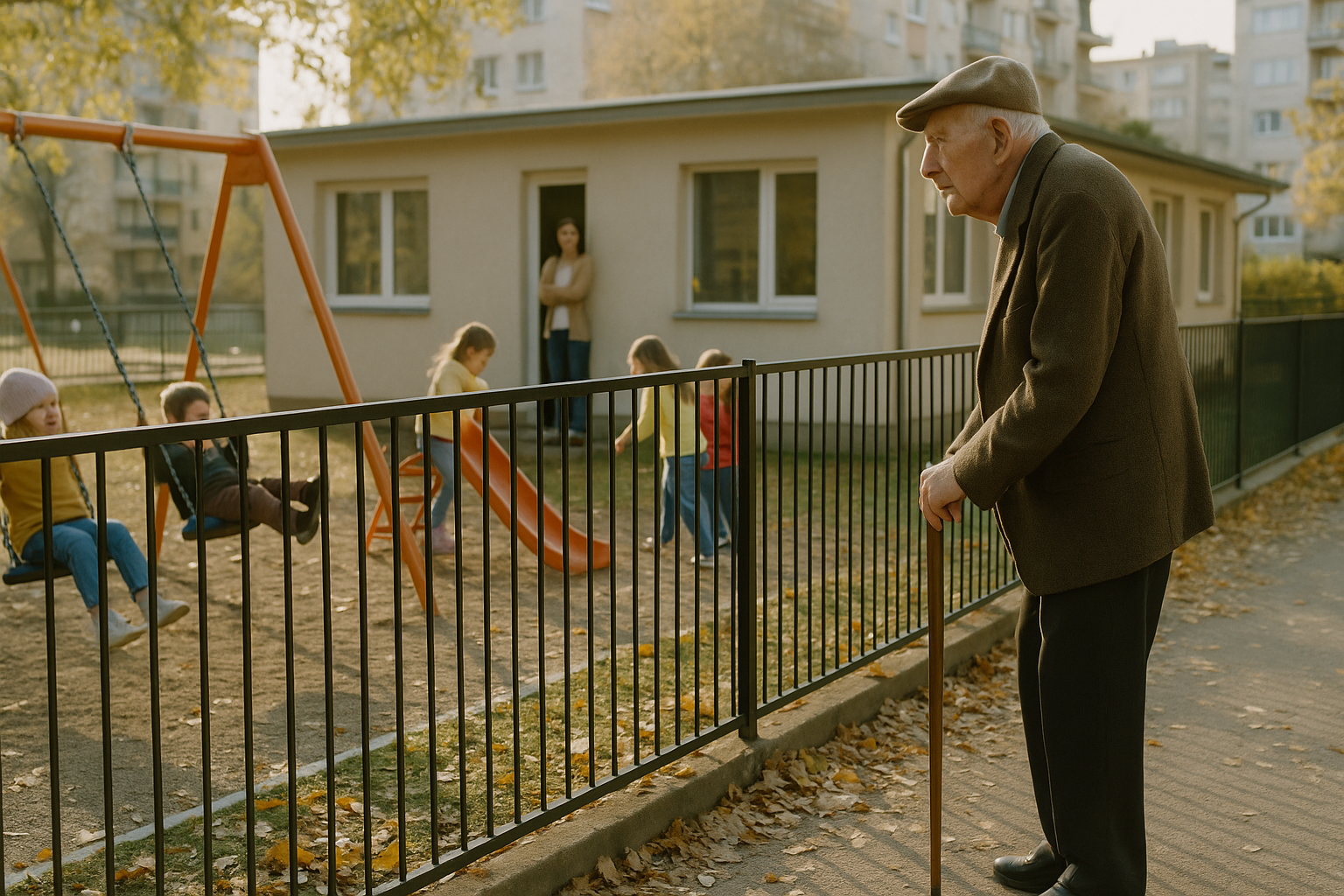
At first Emma thought he was just a lonely neighbor. He stood a few meters from the gate, hands folded on the handle of a worn cane, gray jacket too thin for the wind. While parents rushed in and out, he only watched the playground, blinking often, like the late afternoon sun hurt his eyes.
The children noticed him first. “The fence grandpa is here again!” little Mia shouted one Tuesday, pressing her nose to the glass. Some kids waved at him from the window. The old man raised his hand, awkwardly at first, then more confidently, the hint of a smile appearing under his white mustache.
For a week Emma just observed. He never approached the gate, never spoke to anyone, never tried to enter. He only came around 5 p.m., stood there for twenty minutes, then slowly walked away, pulling his left leg, as if every step cost him.
One evening, when almost all the children had gone home, only David remained, sitting alone on the low bench by the door, backpack on his knees. His mother was late again. Emma poured him some tea in a small paper cup and sat down beside him.
“Do you see that grandpa over there?” David asked suddenly, without looking up.
“Yes,” Emma answered cautiously. “Do you know him?”
David shrugged, staring at his shoes. “He looks like someone.”
“Who?”
He bit his lip. “Like my grandpa. But my mom says I don’t have one.”
The words stuck in Emma’s chest. In her file, David’s “family” line had only two names: mother and child. Father: a short dash.
That night, when the old man turned to leave, Emma stepped outside.
“Excuse me, sir,” she called, wrapping her cardigan tighter around herself.
He stopped, turned slowly. Up close, she saw how tired his eyes were. Pale blue, washed out like an old photograph.
“Is something wrong?” His voice was quiet, polite.
“I see you here almost every day,” Emma said. “Do you have a child in this kindergarten?”
He lowered his gaze. For a moment she thought he would pretend not to understand. Then he pulled a crumpled photo from his pocket and held it out.
A young woman in a hospital bed, sweaty hair stuck to her forehead, laughing and crying at the same time. In her arms, a newborn baby, red and tiny. Next to her sat a man in a worker’s jacket, still in dusty boots, his hands clumsy but careful on the blanket.
“That’s my daughter Anna,” he said. “And my grandson. I held him for ten minutes before they… asked me to leave.”
Emma looked at the date printed in the corner. It was almost five years ago.
“What’s his name?” she asked.
The old man hesitated, as if the answer could hurt him. “David,” he whispered.
Emma felt the wind turn colder. “You are David’s grandfather?”
He flinched at the name, like it was forbidden.
“I think so,” he said. “I haven’t seen him since that day. Anna… she was angry. Said I was the reason his father left. She told me never to come near them again. I thought she would calm down. But then she changed her number, moved. I only found this kindergarten because I recognized Anna in the street. She was holding a boy by the hand. My boy.”
He swallowed, looking at the fence as if it were a wall of stone.
“I don’t want to disturb them. I just want to see that he is… okay.” His voice broke on the last word.
Emma felt something twist painfully inside. She imagined the old man walking here every day, just to catch a glimpse of a small backpack, a jumping silhouette, a laugh carried by the wind.
“Why don’t you talk to your daughter?” Emma asked softly.
He shook his head quickly. “She would take him away again. I’m old. I can stand here. It’s enough.”
The next day Emma could not stop looking at David. At how he carefully arranged pencils by color, how he checked if other kids had snacks before opening his own, how his eyes always searched the gate when it creaked.
At 5 p.m., the old man appeared again. This time the sun was brighter, casting a golden glow over the playground. The children ran around, shouting and laughing. David stood near the slide, his backpack already on.
“David,” Emma called. “Look at the fence.”
He turned. The old man was there, as always, trying to be invisible.
“My mom says not to talk to strangers,” David murmured.
“You won’t talk,” Emma replied. “Just… wave. If you want.”
David hesitated, then slowly lifted his hand. The old man froze. His face changed in a second: confusion, fear, then such fragile hope that Emma had to bite her lip.
He raised his trembling hand in return. For a moment, two palms hung in the air, separated by metal rods and five meters of distance. Then parents’ cars blocked the view, and the moment was over.
That evening, when the yard was empty, Emma found the old man still standing there, wiping his glasses with the corner of his sleeve.
“He waved at you,” she said.
“I know.” He smiled, and it made him look younger. “Thank you, miss…?”
“Emma.”
“Thank you, Miss Emma. Today was… a good day.”
For two weeks, everything went on like that. A secret ritual in the open. Every evening, David pretended to tie his shoelaces by the fence, then quickly waved. The old man nodded back, hiding his joy behind the cane. Neither of them knew the other’s name; officially, they were strangers.
The twist came on a rainy Thursday.
Anna burst into the kindergarten soaked and angry. “Why is that man at the fence again?” she almost shouted.
The children jumped. David froze in the corner, clutching his backpack.
Emma felt her stomach drop. “Anna, please, let’s talk in my office.”

“No,” Anna hissed. “He’s following my child. He has been doing it for weeks. I saw him again just now. I’m calling the police.”
David’s lips trembled. “Mom, he’s not—”
“You don’t talk, David!” she snapped, then immediately covered her mouth, ashamed of her own tone.
Emma took a breath. “Anna, that man is your father.”
Silence hit the room like a slap. Anna went pale.
“He told you that?” she whispered.
“He showed me a photo,” Emma said. “Of you and David in the hospital.”
Anna’s eyes filled with tears, but they were angry tears.
“He wasn’t there when I needed him,” she said. “He said I ruined my life by keeping the baby. When David’s father left, he just… disappeared to his job, to his friends, anywhere but with us. And now he stands there like some tragic hero?”
Emma listened, feeling the weight of years in every word.
“He comes every day,” Emma said quietly. “He doesn’t ask for anything. He just watches to see if his grandson is okay. He thinks he deserves nothing more.”
Anna sank into a chair. David slowly came closer, cautious as a kitten.
“Mom,” he asked in a small voice, “do I really have a grandpa?”
Anna pressed her hands to her face. For a long moment, the only sound was the ticking of the cheap wall clock.
Finally she whispered, “Yes. You do.”
David looked at Emma, then at the window blurred by rain.
“Can I… at least see him closer?” he asked.
Anna opened her mouth to say no. The word hovered there, heavy with old hurt. Then she exhaled, like she was letting go of years of bitterness in one breath.
“Five minutes,” she said hoarsely. “And I’m there with you.”
They went out together. The rain had turned to a fine drizzle. The old man already stood up to leave, shoulders hunched.
“Dad,” Anna called.
He stopped as if the ground had grabbed his feet. Slowly he turned around. When he saw Anna and the boy beside her, he dropped his umbrella. It rolled into a puddle, forgotten.
“I told you not to come near us,” Anna began, but her voice cracked. “And yet you came. Every day.”
“I only wanted to see if… if you were both alive,” he said, eyes never leaving David’s face. “I know I was wrong. I know I don’t deserve anything. But I couldn’t not come.”
David stepped forward, hiding half behind his mother’s coat.
“Are you really my grandpa?” he asked.
The old man nodded, afraid to breathe.
David thought for a moment, then said the simplest, cruelest, kindest sentence:
“Then you can stand closer. It’s cold there by the fence.”
Anna closed her eyes. Two tears finally escaped.
“Five minutes,” she repeated, but there was no anger left.
The old man came closer, every step unsure. He stopped at arm’s length, not daring to reach out.
“You’ve grown,” he said stupidly, and then laughed at himself. “Of course you’ve grown. You were this big.” He showed a tiny gap between his hands.
David smiled. “I’m five now. I can read ‘mama’ and ‘bus’.”
It was nothing and everything. Words about nothing that meant everything they had lost.
Emma watched from the doorway, arms crossed over her chest. The drizzle turned the playground into a blurry watercolor, but in the middle of it three figures stood sharp and real: a woman still fighting her anger, a child discovering family, and an old man learning how to stand without the fence.
When they finally left, they walked slowly toward the bus stop. Not together yet, but close enough that, from a distance, they almost looked like a family.
The next day, the place by the fence was empty.
At first Emma’s heart sank, then she noticed something on the gate: a small envelope with her name, held by a strip of worn tape.
Inside, there was a single photo. The old hospital picture, carefully flattened. On the back, a shaky line:
“Thank you for letting me stand a little closer. — Mark.”
That evening, when David’s mother came for him, he ran ahead and turned back to shout:
“Grandpa is picking me up on Saturday! We’re going to the park. He said he’ll stand next to me all day, not behind the fence.”
Emma smiled and nodded, feeling something warm and painful spread through her chest.
Sometimes, she thought, the biggest distance between people is not a continent or a city. It is five meters of asphalt and a metal fence that no one dares to cross first.
This time, a child crossed it with one simple sentence: “It’s cold there by the fence.”
And for one old man, the whole world moved a little closer.