The boy knocked on the door exactly at midnight and asked, “Does Mrs. Miller still live here, or is it too late to say I’m sorry?”

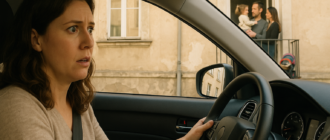
Emma froze in the hallway, her hand still on the light switch. The old house held its breath with her. Mrs. Miller. No one had called her that in years.
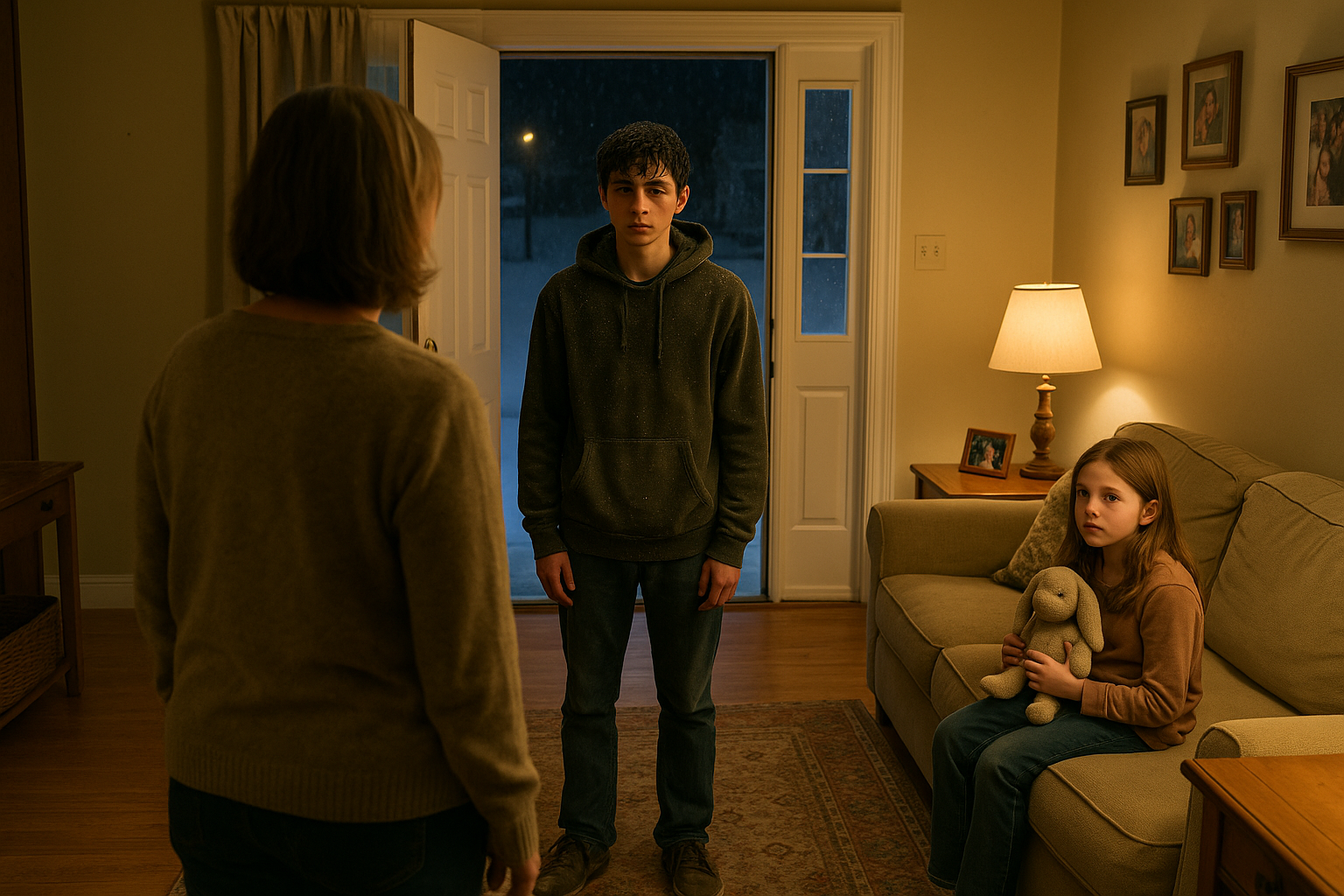
Another knock, timid but stubborn. Emma’s daughter, Lily, stirred on the couch, half-asleep, hugging the frayed stuffed rabbit that was once not hers.
Emma opened the door.
On the porch stood a teenager in an oversized hoodie, his face pale under the streetlamp. Wet snow clung to his hair. He couldn’t be more than fifteen, but his shoulders were hunched like an old man’s.
“Are you Mrs. Miller?” he repeated, voice cracking.
“Yes,” Emma answered slowly. “Who are you?”
He swallowed. “I’m Noah. Noah Carter. I… I think you used to be my foster mom. When I was little.”
The name hit her like a forgotten photograph pulled from a drawer. Five years blurred into that single word: Noah. Small hands, night terrors, the blue dinosaur shirt he refused to take off.
“I think you have the wrong—” she began out of habit, the old defense rising.
But then he shifted, and the porch light caught the faint white scar above his eyebrow, a thin crescent. She remembered the day—coffee table, a chase, his sobbing into her T-shirt.
Her fingers gripped the doorframe.
“Oh my God,” she whispered. “Noah.”
Lily sat up on the couch behind her. “Mom?”
He flinched at the word.
“I shouldn’t have come,” Noah said quickly. “Sorry. I just… I needed to see if you were real. I’ll go.”
“Wait,” Emma said, too fast. “It’s freezing. Come inside.”
He hesitated, glancing past her at the warm hallway, at Lily’s curious face, at the framed pictures on the wall where his never hung. “I don’t want to cause trouble.”
“You already walked through the snow at midnight,” she said, fighting the tremor in her voice. “At least let me make you some tea.”
He stepped in, careful not to track slush on the faded rug, the same rug he had once spilled orange juice on and cried for an hour about. Emma’s chest tightened.
Lily whispered, “Who is he?”
Emma’s mouth went dry. “This is Noah,” she managed. “He… he stayed with us. A long time ago.”
“Like a brother?” Lily asked, eyes wide.
Noah flinched again. “Not really,” he said quietly.
In the kitchen, the kettle screamed too loud in the silence. Emma poured hot water, her hands shaking so badly the cups rattled. Noah sat at the table, shoulders pulled in, fingers wrapped around the mug as if around something he could still lose.
“I’m sorry,” he blurted suddenly. “For that night. For hiding in your car. For making them mad.”
The room tilted. Old terror, sharp as broken glass, rushed back.
He remembered.
“Noah,” she said slowly, “what… what did they tell you?”
“That you gave me back,” he said, eyes fixed on the steam. “Because I was too much. Because I broke things and cried too much and you didn’t want me anymore. I thought…” His voice cracked. “I thought maybe if I found you, I could say I’m better now. So you don’t feel bad.”
The chair scraped as Emma stood up so fast it toppled.
“You think I sent you away?” she whispered.
His shoulders shrank. “Didn’t you?”
She grabbed the back of the chair to keep from falling. “Noah, they took you. The agency. They said there was a complaint. That I wasn’t following rules. That I was confusing you, letting you call me ‘Mom.’ They said it was harming your attachment.”
He finally looked up, eyes glassy. “But they told me you signed the papers.”
“I signed,” she said, her throat burning, “because they said if I didn’t, they’d move Lily too. And blacklist me from ever fostering again. I thought… I thought if I agreed, they might keep you close. I called, I wrote, I begged. They said it was best for you. Then they stopped answering.”
The kitchen clock ticked, too loud.

“For all these years,” she went on, voice shaking, “I’ve been afraid you believed I didn’t fight for you. I kept your dinosaur shirt. I… I still set a plate for you on your birthday, after you left. Lily thought it was a game. I couldn’t tell her it was for a ghost.”
“Mom?” Lily’s small voice came from the doorway. “Why are you crying?”
Noah stood abruptly. “I should go,” he muttered. “I shouldn’t have come. I’m making everything worse.”
Emma stepped between him and the door. “Tell me where you’re staying.”
He hesitated. “Nowhere. Just tonight. The shelter was full. It’s fine, I’m used to it.” He tried to smile, and the attempt was more painful than tears. “I just needed to see you were okay. That I didn’t ruin your life.”
The twist came like a punch: not only had he spent years believing she’d abandoned him, he’d also been carrying the idea that he was dangerous to love.
“You didn’t ruin anything,” she said, every word pulled from a wound. “They did. The people who moved you like furniture. The ones who told a scared little boy he was the problem.”
His lip trembled. “They said you never asked about me.”
“I went to their office,” she said. “They threatened to call security. I sat in the parking lot for hours. Lily was in the back seat, coloring. I thought if I just stayed, someone would give me news. No one did.”
For a moment, the three of them just breathed the same warm kitchen air: the woman who had signed the paper with shaking hands, the boy who thought he’d been thrown away, the girl who had grown up on stories carefully edited to protect them all.
Lily stepped closer, clutching her rabbit.
“Did you read him bedtime stories too?” she asked Noah.
He wiped his nose with his sleeve. “She tried,” he said hoarsely. “I was scared of the dark. Sometimes I slept on the floor next to her bed.”
Lily blinked at her mother. “You never told me that part.”
“I couldn’t,” Emma whispered. “It hurt too much.”
Noah glanced at the clock. “It’s late. I really should go. The bus station is open all night. I’ll be fine.”
Emma took a breath that felt like a jump off a cliff.
“Stay,” she said. “At least for tonight. The couch pulls out. Tomorrow we can call someone who isn’t paid to forget you. A lawyer, maybe. Or at least a social worker who still remembers your name.”
His eyes filled, then overflowed. “Why would you do that? After all this time?”
“Because,” she said, “I never stopped being your almost-mom. And you never stopped being my almost-son. They can take papers. They can’t take that.”
Lily stepped between them, serious and small. “If he was almost my brother,” she declared, “can he be my real brother now?”
Noah let out a sound that was half-laugh, half-sob.
“I don’t know if it works like that,” he whispered.
Emma looked at his thin jacket, the red marks on his wrists where a backpack had dug in, the way he flinched at the word ‘Mom’ like it was a hot stove.
“It does in this house,” she said softly.
She handed him a blanket that still smelled faintly of lavender. When he lay down on the couch, he kept his shoes on, as if ready to run. Lily sat on the floor nearby, drawing something with fierce concentration.
“Look,” Lily said after a while, holding up the paper. Three stick figures, badly drawn but unmistakable: a woman, a girl, and a boy, all holding hands.
Noah stared at it as if it were something he didn’t dare touch.
“You can keep it,” she added, almost shy.
He pressed the picture to his chest.
Later, when the house finally dimmed and the snow outside thickened into silence, Emma stood in the doorway, watching his chest rise and fall in sleep. For the first time in years, the living room didn’t feel like it was missing someone.
She knew tomorrow would be complicated—calls, questions, forms, maybe more disappointment. But tonight, she had one small, undeniable victory.
The boy who once cried over a spilled orange juice, who had been told he was too much and not enough in the same breath, was not outside in the cold believing he’d ruined her life.
He was here.
And as the old clock ticked toward one in the morning, Emma allowed herself to believe that sometimes, the children we lose find their way back—not because the system is kind, but because love, stubborn and bruised, keeps a porch light on long after everyone else has gone to bed.