My son called me from a number I didn’t know and said, “Dad, why did you lie about the hospital?”

I was in the office, staring at a spreadsheet, when the unknown number popped up. I almost declined it. It was the voice that froze me.
“Dad, it’s Leo. Don’t hang up.”
I hadn’t heard his voice in nine years. Not since the family court hallway, where he clung to his mother’s arm and refused to look at me.
He was sixteen now. The last time I saw him, he was a small boy with a backpack bigger than his body. Now голос was lower, heavier. But there was the same quick breathing when he was nervous.
“I’m at the station,” he said. “Can you come?”
He named a station on the other side of the city. No explanation. Just that.
I didn’t ask anything. I just grabbed my jacket, mumbled something about a meeting to my manager, and left.
On the train, my hands shook so much I had to hold the pole with both. I tried to remember what I had promised myself: if he ever reaches out, no accusations, no stories about his mother, no tears. Just listen.
He was waiting outside the station, under the timetable board. Tall, too thin, hoodie with the sleeves pulled over his hands. Same brown eyes. Same small scar on his chin from when he fell off the bike.
He didn’t hug me. I didn’t move towards him. We just stood there, measuring each other like strangers.
“You look… different,” he said.
“So do you,” I answered. It was a stupid line, but it was all I had.
We went to a cheap café across the street. Bright lights, metal chairs, smell of burnt coffee. Perfect place to talk about nothing important. But he didn’t want nothing.
He pulled a folded paper from his pocket and put it on the table between us.
“I found this in Mom’s drawer,” he said. “Last week.”
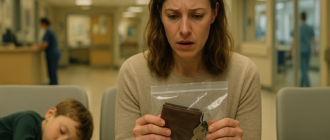
It was the hospital bill. My name, his name, date, diagnosis. The same paper I had begged his mother to give me a copy of years ago, when she said, “If you cared, you would have been there.”
“Mom always said you didn’t come,” he continued. “That you knew and you didn’t come.”
His fingers were white around the cup. He didn’t drink.
I looked at the paper. I knew every line. I still had the original in a folder at home. I had spent that night in a plastic chair by his bed, watching his chest rise and fall after the surgery, afraid to blink.
“She said you didn’t pay,” he added. “That her parents had to cover everything. That you just disappeared.”
The words hit like something physical. For a second I thought I would be sick.
“Leo,” I said quietly, “I was there. I signed that paper. I slept on the floor by your bed. I paid what I could and then spent a year paying the rest.”
He stared at me, unblinking.
“She showed me messages,” he said. “From you. You said you were too busy to come. That you had a new family now.”
“I don’t have a new family,” I said. “Never did.”
He shook his head, almost angry.
“But I saw them. The messages.”
“Do you still have them?”
He pulled his phone out, scrolled, pushed it across the table. There were screenshots. My name. My photo. Words I never wrote.
“I was in the hospital that day,” I said. “My phone was dead. That’s why your grandmother called my work. Your mother was furious I hadn’t been answering. We fought in the hallway. That part is true.”
He looked from the phone to the paper, then back at me.
“So you’re saying she…?” He didn’t finish.
“I’m saying I don’t know how those messages appeared,” I answered. “But I know where I was. In that room. With you.”
Silence stretched between us. In the next booth, someone was laughing at a video on their phone. The sound felt wrong in the air.
He reached into his backpack and took out a small notebook. The cheap kind, spiral at the top.
“I started writing things down this year,” he said. “Things that didn’t make sense.”
He flipped through pages covered in tight handwriting. Dates, sentences, fragments of conversations with his mother. Times she said I didn’t call. Times she said the court took away my rights because I was dangerous. Times she said I chose a girlfriend over him.
“I checked the court site,” he said. “At school. They have a free computer. Your name is there. It says you asked for visits. For years.”
He looked up.
“You went to court for me,” he said. It wasn’t a question.
“Yes,” I said. My voice came out hoarse.
“Nobody told me,” he whispered.
He shut the notebook and pressed his fist against his mouth. He stayed like that for a long time.
“I hated you,” he said finally. “Every birthday, every New Year. I imagined you with some new kid, some new wife. I thought you forgot me.”
“I called every birthday,” I said. “The number was always changed, or blocked. I sent gifts. They came back or disappeared. I stopped when the lawyer said I had no chance. But I never forgot you.”
He rubbed his eyes with the back of his hand, quick, almost angry at himself.
“Why didn’t you come to the house?” he asked.
“I did. Twice. Your grandfather told me he would call the police if I came back. Your mother sent me a letter through her lawyer. Said I was harassing you. Next time it would be a restraining order.”
He let out a small, broken laugh.
“Grandpa said you never tried,” he said quietly.

We sat in that bright, ugly café, under buzzing lights, with the truth spread out on the table like cheap napkins.
“Why now?” I asked finally. “Why did you call today?”
He took a breath.
“She’s sick,” he said. “Mom. She had some tests. They think it’s serious. She told me if something happens, I shouldn’t look for you. That you have your own life and don’t want problems.”
He looked straight at me.
“That was when I knew she was lying,” he said. “Because even if everything she said was true, no one repeats it like that. Word for word. Like a script.”
He swallowed.
“I went through her things when she was at the clinic,” he continued. “I found the bill. Your name. The court letters. The returned packages. She kept them all. Hidden. For years.”
The image of my birthday gifts stacked in some dark closet made my throat tighten.
“She lied so much she had to hide the proof from herself,” he said. “Not just from me.”
He glanced at the clock on the wall.
“I have to go back soon,” he added. “She doesn’t know I’m here.”
I nodded. There was nothing to say to that.
“So,” he said slowly, “what do we do now?”
I wanted to say: we start again. We erase nine years of silence. We go to the park, the cinema, my old apartment full of photos of you.
Instead I said, “Whatever you want. We move at your speed. You call when you can. I’ll pick up.”
He studied my face, like he was trying to find the man from all the stories. The selfish one. The coward. The stranger.
“Can I see that folder?” he asked suddenly.
“The one with the papers. The originals. I want to see them.”
“Of course,” I said.
He hesitated, then added:
“And your place. I want to see… how you live. If that’s okay.”
I felt something loosen in my chest.
“It’s small,” I said. “And messy.”
He gave a quick, crooked smile that looked exactly like mine.
“I don’t care,” he said. “I just want to see if there’s… anything of me there.”
There were sixteen photo frames on my shelves. Twelve with his face. Drawings from kindergarten on the fridge. A birthday card with a superhero, still standing on the table by the door. A bed I never changed from the day I bought it for his weekend visits that never happened.
“I think you’ll find something,” I said.
We finished our coffee in silence. Then we walked back to the station.
On the platform, he looked at me for a long time, like he was memorizing my face.
“I don’t know how to forgive all of this,” he said. “Her. You. The years.”
“You don’t have to today,” I said. “You don’t have to ever. Just… don’t let more years pass because of someone else’s story.”
The train arrived. Doors opened with a hiss.
He stepped in, then turned back.
“Dad,” he said. Just that one word. Testing how it felt in his mouth.
I nodded.
The doors closed. The train left.
On my phone, an unknown number stayed on the screen. I added it to contacts under one word: Leo.
That night he sent a photo. A small boy in a hospital bed, wires on his chest. And in the corner, half-cut off, my own hand, holding his.
No words. Just the photo.
Then another message came.
“Mom said you left early that day,” he wrote. “But your jacket is on the chair in the last photo. Same as in the first.”
A pause.
“I think I remember you reading something to me,” the next message said. “Maybe I didn’t make you up.”
I put the phone on the table and sat in the dark kitchen, watching the screen.
When the next message came, it was simple.
“Good night, Dad.”
I wrote back two words.
“Good night.”
Then I left the phone face up on the table and went to make the bed in the small room at the end of the hallway.