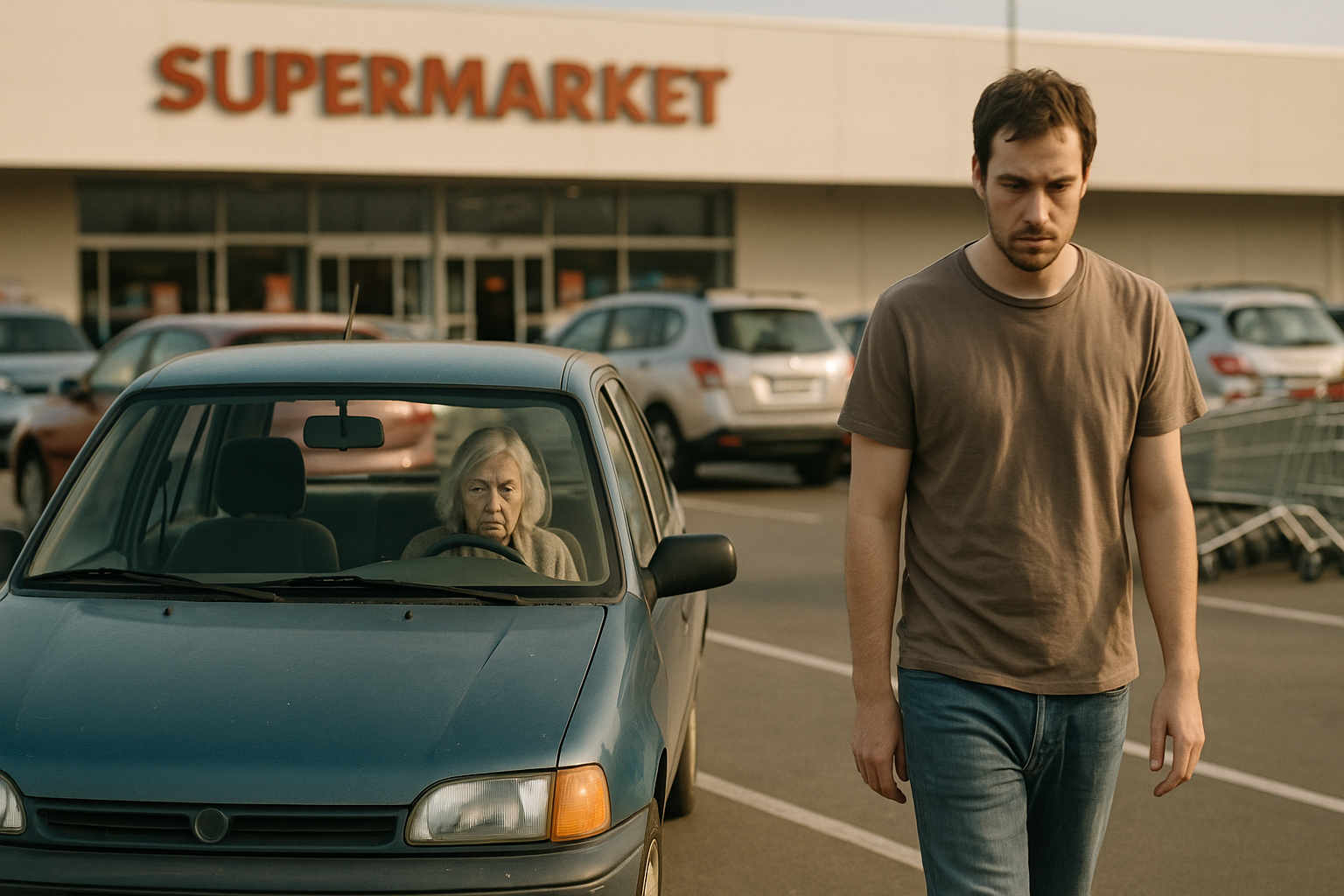
The day Daniel left his mother in the supermarket parking lot, he told himself it was only for an hour.
She sat in the passenger seat, her thin hands folded over a faded canvas purse. The late afternoon sun turned her gray hair almost silver. Anna blinked at the store sign, confused, then looked at her son.
“You stay here and rest, Mom,” Daniel said, forcing a smile that made his cheeks ache. “I just need to… handle some paperwork inside. It’s noisy. You’ll be more comfortable in the car.”
She frowned a little. “Will it take long? We still need to buy apples. You like apples, Danny.” The old childhood nickname slipped out. It always did when she was tired.
Daniel swallowed. “Not long. I’ll be right back. Lock the door if you get cold, okay?”
He placed her worn cardigan over her lap like a blanket, though it was warm outside. The car smelled faintly of the lavender soap she still insisted on using, even if she forgot whether she had washed her hands one minute ago or one hour ago.
He closed the door gently, then stood there for a moment, his hand on the handle, watching her through the glass. She was already turning her head, trying to remember why they were there.
His phone buzzed. A message from his landlord: LAST WARNING. RENT OR OUT.
Behind that, a voicemail from the care facility he’d visited two weeks ago, the one he’d hoped would take her under a subsidized program. “We’re sorry, Mr. Harris, but your mother’s condition requires more supervision. We cannot accept her without full payment.”
Full payment. A number that had chased him into his dreams, that smelled like burnt coffee and overtime and the hollow echo of his own failures.
He stepped away from the car, each step heavier than the last. He wasn’t going to abandon her, he told himself. He just needed to make a point. Maybe someone would notice, maybe social services would finally see how desperate they were. Maybe the system would do something since he clearly couldn’t.
He walked to the edge of the lot and sat on a bench near the shopping carts. From there, he could still see the car, a small blue island in a sea of metal and glass.
Minutes stretched. He checked his watch. 10 minutes. 20. His chest felt tight. He remembered the nights she’d stayed up with him when he had asthma attacks, walking circles in their tiny living room, counting his breaths out loud so he wouldn’t panic.
Thirty minutes. He stood up, ready to go back, apologize to her, apologize to himself.
Then he saw the woman.
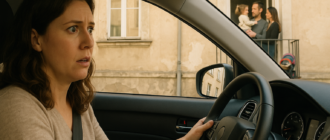
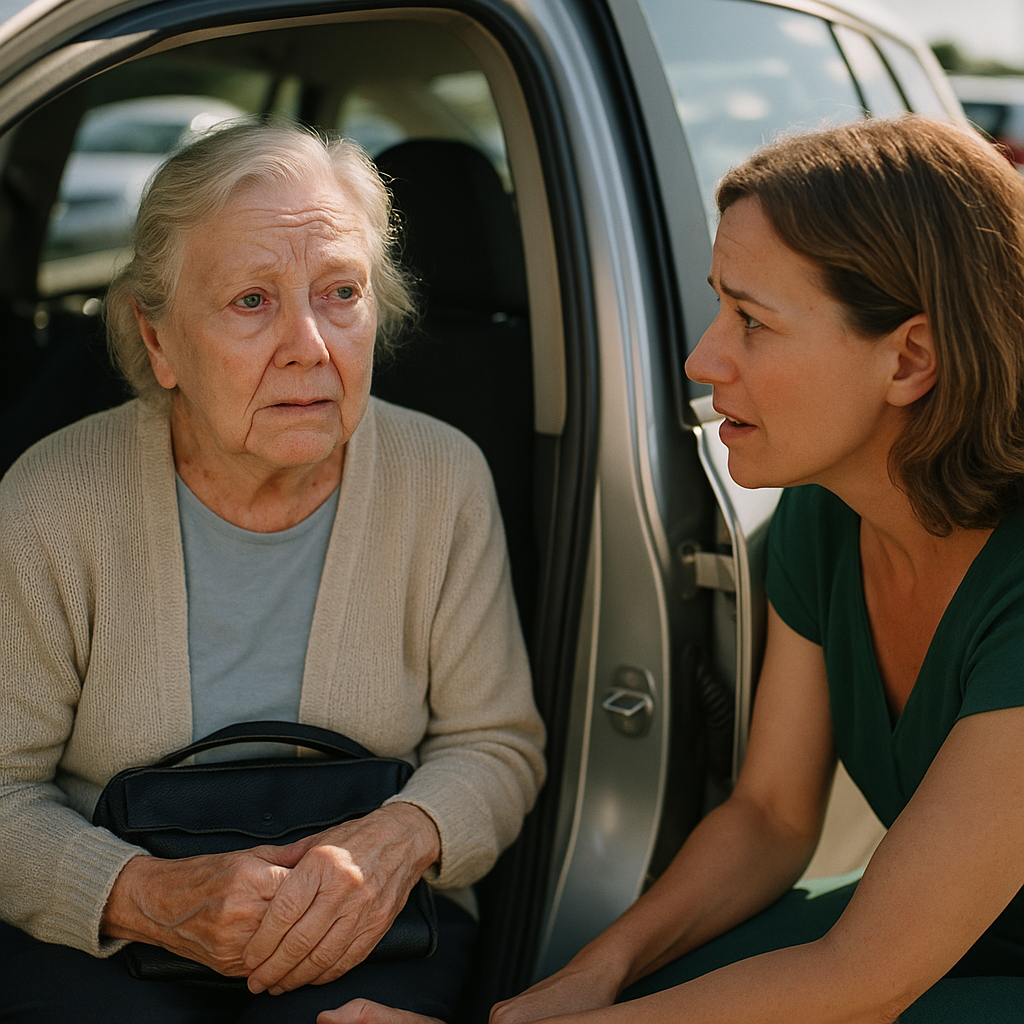
She was in her fifties maybe, in a simple green dress, carrying two grocery bags. She slowed as she passed the car, peering in through the window. His mother’s face turned anxiously toward her, lips moving.
The woman hesitated, then put the bags down and knocked lightly on the glass. Anna startled, then smiled with a strange, lost politeness.
Something in the woman’s shoulders changed. Daniel could see it even from where he stood. Concern hardened into decision. She opened the car door—he’d forgotten to lock it in his turmoil—and crouched beside the seat.
Daniel’s heart pounded. What if she called the police? What if they took his mother away and charged him with neglect? What if… what if this was exactly what he had secretly wanted?
He took two steps toward them, then stopped when he heard his mother’s voice carried by a gust of wind.
“Have you seen my boy?” she was asking. “He was just here. He went inside for apples. He’s a good boy. He works so hard.”
Her voice cracked on the last words.
The woman put a hand on the door frame, steadying herself. “How long has he been gone, ma’am?” she asked gently.
Anna blinked. “Oh…” She looked at the clock on the dashboard as if she remembered how to read it, then at the store entrance, then down at her hands. “I… I don’t know. Maybe… just a moment. He wouldn’t leave me.”
Daniel felt something inside him tear. All the excuses he’d built—system’s fault, no money, no help—crumbled in the space between those three words: He wouldn’t leave me.
He started walking faster, then running. His breath came in shallow bursts, his vision blurring with hot shame.
As he approached, he heard the woman say, “Do you remember his name?”
“Daniel,” his mother said without hesitation. Her eyes brightened for a second, clarity cutting through the fog. “My Daniel. When he was little, he was afraid of the dark. I used to sit by his bed and sing. I told him I’d never leave him alone in the dark. Never.”
Daniel stopped so suddenly his shoes squeaked on the asphalt.
The promise came back to him in a flash: his small hand clutching her sleeve, the shadow of the hallway stretching like a monster, her tired voice whispering, “I’m here, Danny. I’m not going anywhere. Not ever.”
He realized with a cold, absolute certainty that he was the dark now.
The woman turned and noticed him standing there, pale and shaking. She straightened slowly, studying his face.
“Are you her son?” she asked.

He nodded, shame burning his throat. “Yes. I… I am. I was just… I—”
“Danny,” his mother breathed, relief flooding her features. She reached her hand toward him, fingers trembling. “There you are. I told her you’d come back. I told her you’re a good boy.”
The words hit harder than any accusation.
Daniel stepped closer, dropping to a crouch so he was at her eye level. Up close, he could see the thin blue veins beneath her skin, the small food stain on her collar from the yogurt he’d fed her that morning. She smiled at him with the same tenderness she had when he was five, even though she no longer remembered how old he was, or sometimes who he was.
“Mom,” he whispered. “I’m sorry. I’m so, so sorry.”
She brushed his cheek clumsily, the way you’d soothe a crying child. “Why are you sorry? We’re going to buy apples.” She looked past him to the shop. “It’s a nice day, isn’t it?”
Daniel swallowed back a sob and nodded. “Yeah. It is.”
The woman in the green dress watched them, her expression a mix of suspicion and sympathy. “She seemed very confused,” she said quietly. “I was about to call someone.”
“You should have,” Daniel answered, his voice raw. He stood, facing her fully. “I left her alone. I thought… I thought someone else would fix our life for us if I just… showed how bad it was.”
The woman held his gaze. “There isn’t always someone else,” she said. “Sometimes it’s just us.”
Her words were not cruel, just painfully true.
“Do you have any help?” she added more softly.
Daniel shook his head. “I tried. The waiting lists are long. They say we don’t qualify, or we need money I don’t have. I work nights. I fall asleep standing up. I…” His voice broke. “I don’t know how to be her son and her nurse and still be a person.”
The woman’s face softened. She glanced at his mother, who was humming a tuneless song, lost again in some quiet memory.
“My father had dementia,” the woman said. “I know that kind of tired. There’s a community center two blocks from here. They have a social worker. They helped us find respite care, volunteers, food deliveries. It’s not perfect, but it’s something.” She dug into her purse and pulled out a crumpled flyer. “Go there. Today. Before you talk yourself out of it.”
Daniel took the paper like it was a lifeline. The address blurred as tears filled his eyes.
“Why are you helping me?” he asked.
She shrugged. “Because once, in a parking lot, I wanted someone to help me. No one did. I still remember how that felt.” She looked at him, really looked, and her voice softened further. “Don’t leave her again. Not like this. You’ll never forgive yourself.”
He nodded, the truth of it sinking into his bones.
He opened the back door and helped his mother out slowly. Her knees wobbled and he steadied her, careful, almost reverent.
“Where are we going, Danny?” she asked, clutching his arm.
He looked at the supermarket, then at the street beyond, where somewhere between buses and brick buildings there was a place that might help them breathe again.
“First,” he said, “we’re going to buy apples. Then we’re going to ask for help. Real help.”
She smiled, satisfied with this simple plan. “You always did like apples,” she repeated.
As they walked toward the entrance, he turned back. The woman in the green dress was already picking up her grocery bags. Their eyes met. He mouthed, “Thank you.” She nodded once, then moved on, disappearing into the blur of everyday life.
Inside the store, under too-bright lights and the hum of refrigerators, Daniel chose the reddest apples he could find and placed them gently in a bag while his mother watched, swaying slightly, humming to herself.
He knew nothing was magically fixed. The bills were still waiting. The long nights, the confusion, the forgetting—they were all still there.
But as his mother slipped her arm through his and leaned on him, trusting him completely in her small, shrinking world, he understood one thing with painful clarity.
The system might fail them. His strength might fail him. But if he walked away again, it would not be because there was no other choice.
It would be a choice.
And this time, as they stepped back into the sunlight together, he chose to stay.