Rachel, my daughter, hadn’t answered a single one of my calls for three weeks, and every message I sent remained unread. I kept telling myself it was just grief. After James’s death, she must have needed space, silence—that paralyzing quiet that settles over a person after a loss.
I left her gentle voice messages, sent short, undemanding texts: that I loved her, that I was here, that we could talk whenever she was ready. But as the days passed, her silence no longer felt like simple mourning. It felt more as if Rachel had erased herself from the world entirely.
James’s mother, Helen, also called from Michigan. She sounded tense, sharp, and didn’t believe what I was still trying to convince myself of. She said Rachel wasn’t answering her calls either, and had even blocked James’s younger brother.
Even the funeral itself hadn’t sat right with her: a closed casket, no viewing, no real farewell. I still tried to defend my daughter, but after we hung up, my eyes fell on the spare key hanging from my keychain—the one Rachel had given me years ago “just in case.” Back then, I thought it was simply her being careful.
I had no idea what kind of emergency it would actually be needed for.
The next day, Mrs. Chen, Rachel’s neighbor, called me. She spoke quietly, but there was a tremor in her voice, as if what she was about to say frightened even her. She told me she had been watching the house because she was worried about Rachel and James, and had seen strange cars arriving late at night and at dawn.
They never pulled into the driveway—always parked farther down the street, looked around before approaching the house, as if they didn’t want to be seen. She also mentioned she hadn’t seen Rachel’s SUV for days. By then, I could no longer calm myself.
I called Rachel again. Straight to voicemail. I sent one last message: “I’m coming over today. I love you.” No reply came.
I GOT INTO MY CAR AND HEADED TOWARD RIVERSIDE. THE DRIVE IS FORTY MINUTES IF TRAFFIC IS KIND, BUT THAT DAY EVERY RED LIGHT, EVERY SLOWDOWN FELT AS IF SOMETHING WAS DELIBERATELY HOLDING ME BACK.
I still tried to come up with explanations—she’s probably sleeping, her phone must be lost, maybe she went somewhere—but these were no longer comforting thoughts, just desperate bargaining. By the time I turned onto Maple Drive, my heart was pounding wildly.
Rachel and James’s house already felt wrong from the outside. The lawn was neglected, weeds creeping along the edges. The driveway stood empty. Rachel’s SUV was nowhere in sight, but James’s old pickup sat in its usual place, coated with a thin layer of pollen.
The mailbox was stuffed full. A flyer was caught in the screen door. Nothing moved behind the curtains. I sat in my car for a long time, staring at the house, feeling more and more that something was terribly, terribly wrong.
I walked up to the porch and knocked—more than once. No answer. The handle was locked. I took out the spare key, inserted it, turned it, and the door opened with a soft click. The stale, trapped air hit me immediately.
It wasn’t the smell of a lived-in home, but of closed rooms untouched for days. At first glance, the living room looked normal: the same gray couch, the same throw blanket, family photos on the mantel. But then I saw the dust. A thick layer covered everything—even the wedding photo. Rachel would never have let it get like that.
The kitchen greeted me with the same unnatural silence and a sour smell. The fridge was full, but when I checked, everything had expired: milk, eggs, cold cuts—even the pre-sliced fruit had begun to soften. In the sink sat a bowl with dried cereal stuck to its sides.
In the pantry, an open cereal box, a half-crushed bag of chips on the floor, and a gap in the row of canned goods. The entire house looked as if someone had vanished in the middle of an ordinary moment.
THEN I HEARD THE SOUND. A FAINT, RHYTHMIC SCRATCHING CAME FROM THE HALLWAY, AS IF SOMEONE WAS TRYING TO STAY QUIET, YET DESPERATELY SIGNAL FOR HELP. MY MIND FIRST SEARCHED FOR ANIMALS AS AN EXPLANATION—MICE, RACCOONS, PIPES—BUT WHEN IT CAME AGAIN, I KNEW THIS WAS NOT AN ANIMAL. I WALKED TO THE BASEMENT DOOR, AND THAT’S WHEN I LITERALLY FROZE IN PLACE.
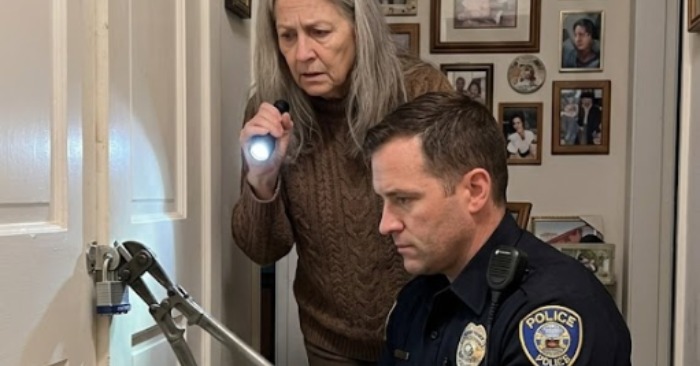
A thick industrial padlock sealed it from the outside. Not a small, simple lock—but a new, heavy-duty one, mounted onto a freshly installed latch. The screws looked new, the wood around them pale and raw.
The scratching came again. Then a barely audible whisper: “Please.” I leaned closer, pressing my ear to the door. I heard it again. I knew that voice. With trembling hands, I grabbed my phone and dialed emergency services, rushed through the address and said someone was locked in the basement, padlocked from the outside.
Then I whispered to the door: “James? Is that you?” The scratching stopped. After a brief second of silence, a weak whisper came back: “Margaret.” My legs nearly gave out beneath me.
We had held a funeral. Rachel said James was dead. And now he was whispering my name from behind the basement door.
I couldn’t just stand there and wait. I yanked at the lock, but it didn’t budge. I ran into the garage, grabbed James’s hammer, rushed back, and started striking the lock. The metal rang, my arm shook, but the padlock held.
Again and again I struck it, crying, telling James to hold on. The dispatcher tried to calm me, but I could barely hear. The twelve minutes until the police arrived felt like an eternity.
Officer Valdez and his partner immediately saw something was very wrong. One look at the fresh screws and the lock, and they were already bringing bolt cutters. When the metal snapped and the door cracked open, the smell hit us first: damp air, unwashed body, sour moisture—the scent of a place not meant for human life. The basement stairs led into darkness. Valdez went down first with a flashlight, then stopped halfway and breathed, “Jesus.”
I COULDN’T STOP MYSELF. I RAN DOWN AFTER HIM, AND THE LIGHT FELL ON A FIGURE LYING IN THE CORNER. IT WAS JAMES. CHAINED TO A COLUMN. EMACIATED, WITH AN UNKEMPT BEARD, SUNKEN EYES, IN A STATE AS IF HE HAD AGED TWENTY YEARS IN A MATTER OF WEEKS. BESIDE HIM A THIN MATTRESS ON THE CONCRETE, AN EMPTY BOTTLE, A BUCKET. THAT WAS ALL. THAT WAS EVERYTHING HE HAD. I DROPPED TO MY KNEES NEXT TO HIM AS THEY CALLED FOR PARAMEDICS. JAMES LOOKED AT ME AND BARELY AUDIBLY WHISPERED: “RACHEL… SHE DID THIS.”
At the hospital, it became clear how close he had been to death. He was severely dehydrated, malnourished, infections had formed where the chains and restraints had been. The doctor said that if he had remained down there any longer, he wouldn’t have survived. They estimated he had been in the basement for at least three weeks—exactly as long as Rachel had claimed he was dead. As I sat in the waiting room, everything I had believed to be reality began rearranging into something far darker.
Detective Morrison quickly made it clear this wasn’t a sudden breakdown, not confusion, not some misguided “protection.” This was a plan. He questioned me in detail about the funeral, the suspicious elements, the death certificate, Rachel’s behavior.
It turned out James had a half-million-dollar life insurance policy, Rachel was the beneficiary, and the thirty-day waiting period on the claim would have expired in two days. The name of the doctor who signed the death certificate became suspicious, and the documents increasingly appeared to be falsified.
Slowly, the full picture came together. Rachel had been having an affair with a man named Derek Moss, her personal trainer. James was in the way. Later, when he was strong enough to speak, James said he had suspected the affair and confronted Rachel. She didn’t break down, didn’t cry—she coldly told him she deserved more, and that he was holding her back.
One day she gave him coffee, and shortly after, James lost consciousness. When he woke up, he was already in the basement. Rachel brought papers down to him, demanded signatures, and gave him just enough water to keep him alive as long as she needed him.
Derek came down sometimes too. James heard footsteps above, music, laughter, while he tried to survive in the darkness.
Meanwhile, upstairs, Rachel played the role of the grieving widow. She created a fake farewell letter on James’s laptop. Paid a doctor for forged documents. Paid someone at the funeral home to rush everything through.
SHE ORGANIZED A CLOSED-CASKET FUNERAL AND DELIBERATELY USED GRIEF AS A SHIELD, BECAUSE SHE KNEW EXACTLY HOW EASILY PEOPLE BELIEVE WHAT A BROKEN WIDOW SAYS. JAMES EVEN SAID THAT ONCE SHE PLAYED THE SOUND OF HIS OWN FUNERAL FOR HIM IN THE BASEMENT—AND LAUGHED THAT NO ONE WOULD EVER KNOW THE TRUTH.
Rachel and Derek were eventually arrested in a hotel in Los Angeles. Among their belongings, police found completed life insurance forms, a burner phone containing messages about the plan, and a laptop with the fake farewell letter. They also found a receipt from a hardware store: padlock, chain, screws—dated three weeks earlier. Rachel’s handwriting was on the back. From that point on, there was little doubt left.
The trial lasted three weeks. I sat through it all, feeling as though my life had split into two separate stories. In one, Rachel was still the little girl who used to rest her head on my thigh during long drives, the young woman who cried when James proposed.
In the other, she was the woman who put a lock on a door and saw a human life as an obstacle.
Mrs. Chen testified about the suspicious cars, doctors spoke about James’s condition, financial experts about payments and money transfers. Derek, in exchange for a plea deal, described in detail how Rachel had planned everything—even the dates.
James’s testimony was the most devastating. Slowly, fragilely, he spoke about waking up in the basement, about trying to stay alive, conserving his strength, and scratching at the basement door when he finally heard someone in the house. When it was my turn, I spoke about the silence, the dust, the expired milk, the lock—and that quiet whisper: “Please.”
The defense tried to frame Rachel’s actions as a mental breakdown, but I had worked in crisis situations my entire life. I knew the difference between panic and planning. This was not panic. This was intent.
In the end, the jury found Rachel guilty of kidnapping, fraud, forgery, conspiracy, and attempted murder. She was sentenced to thirty-five years in prison. Derek received fifteen. The doctor who signed the false documents lost his license and got ten years. The funeral director got five. As I listened to the sentences, I felt neither triumph nor relief—only a vast emptiness where my understanding of motherhood had once lived.
JAMES BEGAN TO RECOVER SLOWLY. HIS PHYSICAL WOUNDS HEALED FASTER THAN THE DARKNESS LEFT INSIDE HIM. THERE WERE NIGHTS WHEN HE WOKE UP GASPING, CERTAIN HE WAS BACK IN THE BASEMENT. I MOVED HIM INTO MY HOME, SET UP A GUEST ROOM FOR HIM, PLACED A SMALL LAMP BY HIS BED SO HE WOULD NEVER HAVE TO WAKE UP IN COMPLETE DARKNESS.
We built a routine: breakfast in the kitchen, short walks, therapy, quiet time together. Helen visited regularly, Tom kept in touch. Slowly, James learned how to breathe again without flinching at every shadow.
Later, he found a new job, started attending a support group, and there he met Sarah. Sarah was a quietly kind woman who also knew what it meant to climb back from a shattered life. Their relationship grew slowly, but it was real. Eventually, they married in a small, simple ceremony in my garden, under white string lights. Helen baked the cake,
Tom was the witness, Sarah’s little daughter scattered flower petals. When James said “I do,” his hand trembled—not from fear, but from the weight of choosing hope after such a past.
After the ceremony, he came over to me, hugged me, and said he was grateful not only because I had saved him, but because I hadn’t given up on him even when everyone else believed he was dead.
Because I went. Because I paid attention. Because I used that key. That’s when I truly understood what remained of all this. I lost my daughter. But I saved a son.
The spare key from Maple Drive is still in the drawer of my desk today. I don’t keep it because I ever want to use it again, but as a reminder. That sometimes the ones who need help the most are those everyone thinks it’s already too late for. That a mother’s love cannot erase evil, but it can help heal the wounds of someone almost destroyed by it.
And also this: if you hear scratching from a basement, if you see a lock where it should never be, and your instincts are screaming that something isn’t right—listen to them. Because someone’s life may depend on it.