I helped a shivering boy, who had been thrown out of a café, buy some food, thinking it was just a small act of kindness. But when he disappeared and the next day I learned his true story, my world changed in a way I never expected.
After thirty years as a teacher, you learn to recognize wounded children. There’s something in their eyes – this quiet despair they hide behind forced smiles and cautious words. On that November evening, I saw that very look through a café window, and I knew I couldn’t just walk on by.
My name is Grace. I’m 56 years old and I’ve spent most of my life guiding young minds – in a classroom that’s seen more tears, victories, and changes than I could ever count. Teaching isn’t just my profession… it’s my identity.
When my husband Robert passed away nine years ago, after a long illness that took him piece by piece, the life we knew left me with one thing above all: my work. It was the only thing that kept me from sinking into the silence.
We never had children. Not because we didn’t want them – but because life had other plans.
That evening, the wind cut through the streets like a knife. The sky hung low and heavy, that gray-dark promise of rain before dawn. I pressed my briefcase to my chest as I walked home from school, and my coat barely managed to keep the cold out of my bones.
The streets were nearly empty, just a few people hurrying past the warm light of shop windows and cafés. And then I saw him.
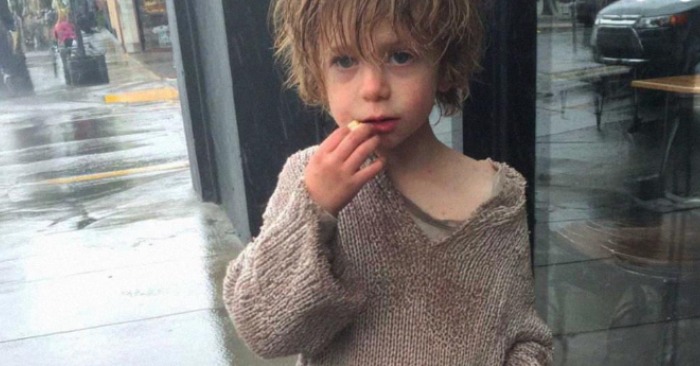
A small boy stood in front of the entrance of a café called “The Corner Bean.” He couldn’t have been older than seven or eight. His sweater was thin and torn at one elbow. His jeans clung damply to his thin legs, and his shoes looked like they’d long since given up trying to fit.
BUT IT WASN’T HIS CLOTHES THAT TOOK MY BREATH AWAY.
But it wasn’t his clothes that took my breath away. It was how he stood there – completely still – staring through the window at the people holding steaming cups and eating pastries.
His lips were slightly bluish, and his small hands clutched a single coin. He trembled, but didn’t move. He just stared… as if he were looking at something he already knew he didn’t deserve.
Something tightened hard in my chest. I knew that look from my classroom. Children who came without breakfast and pretended they weren’t hungry. Boys and girls who wore the same clothes for three days in a row and deflected questions with rehearsed lies. This boy had that look – only worse.
I stepped closer and crouched down to his level. “Sweetheart, are you okay? Where’s your mom?”
He flinched and looked at me – with such large, brown, sad eyes that I wanted to cry right then and there. For a moment, he just blinked, and on his small face, fear and exhaustion were written clearly.
“My mom’s coming soon,” he said quietly. “I just wanted to come in and warm up. But they said I couldn’t sit if I didn’t order anything.”
My heart twisted. “Who said that?”
He pointed to the window. “The woman behind the counter. I wanted to buy a cookie, but I didn’t have enough. I asked if I could just sit by the heater because it’s so cold, but she said I couldn’t stay if I didn’t buy anything.”
THE WORDS BURNED IN ME.
The words burned in me. A child standing in the freezing wind, with a coin that might be worth fifty cents, being sent away because he wanted warmth. I looked around, searching for a mother, for anyone – but the street was empty. Just the two of us.
“How long have you been waiting for your mom?”
He shrugged and avoided my gaze. “Not long.” But his voice cracked just slightly – just enough to tell me he was lying.
I didn’t hesitate for a second. I reached out my hand. “Come with me, sweetheart. We’ll get you something warm to eat.”
As soon as we were inside, the warmth of the café wrapped around us like a blanket. I felt his shoulders relax slightly beside me. It smelled like coffee and cinnamon, and several heads turned to look at us.
I felt the glances – curious, suspicious, questioning – but I didn’t care. I led him to a table in the corner, right next to the radiator, and told him to stay seated while I ordered.
The cashier – a woman in her early thirties, tired eyes, red hair – looked visibly uncomfortable when we approached the counter.
“I’d like a hot tea and a grilled cheese sandwich,” I said. “And a chocolate muffin.”
SHE TYPED EVERYTHING IN WITHOUT LOOKING AT ME.
She typed everything in without looking at me. When I returned with the tray, the boy was still exactly where I’d left him, his hands folded as if he were afraid to touch anything.
“Go ahead, sweetheart,” I said softly, pushing the plate toward him. “It’s all for you.”
He stared at the food for a moment, then took the sandwich with trembling hands. With the first bite, he closed his eyes, and I saw a single tear roll down his cheek. He fought so hard not to cry that it broke my heart.
Between bites, he started talking. His name was Eli. Seven years old, just like I had thought.
“I’ve been at different people’s places,” he explained, wrapping his hands around the warm cup. “Mostly friends of my mom’s. But right now, I don’t have a place.”
“Eli,” I said cautiously, “where did you sleep last night? And… what about your mom?”
Again, the shrug. “There’s a place under the bridge by the park. It’s not so bad if you have a blanket. My mom…” He paused – and then didn’t say anything more.
I pressed my hand to my mouth to stop myself from sobbing. This child had slept under a bridge and spoke about it as though it was just an inconvenience.
“I DIDN’T WANT TO DISTURB ANYONE,” ELI SAID QUICKLY, AS IF HE HAD TO DEFEND HIMSELF.
“I didn’t want to disturb anyone,” Eli said quickly, as if he had to defend himself. “I just wanted to warm up. I was going to leave soon.”
“You didn’t disturb me,” I said firmly. “You didn’t do anything wrong, do you hear me?”
He gave me a cautious, small smile. “You sound like my old teacher. She’s nice too.”
We talked a little more. His favorite book was “The Little Prince,” and my heart ached even more because it’s a story about loneliness, love, and seeing with the heart. He’d once had a dog, a scruffy mutt named Buddy, who died when Eli was five. And his voice became very soft when he talked about his mom, how she used to sing to him at night, and how much he missed her.
I didn’t press him. I could see how much it hurt him to remember.
When he’d eaten the last crumb of the muffin and finished his tea, I stood up. “Stay right here, okay? I’ll be back in a minute.”
I was gone for maybe two minutes – but when I turned around from the counter, the chair was empty. On the table, there were only slight imprints of small hands. The café door swung slightly in the cold wind.
I ran outside, my heart pounding. “Eli! Eli!”
BUT HE WAS GONE. THE STREET HAD SWALLOWED HIM UP, AND ALL THAT WAS LEFT WAS THE BITTERNESS OF THE COLD AND THE DARKNESS THAT SETTLED OVER EVERYTHING.
But he was gone. The street had swallowed him up, and all that was left was the bitterness of the cold and the darkness that settled over everything.
“Eli… where are you?”
That night, I didn’t sleep. Every time I closed my eyes, I saw his face. Those sad brown eyes. That trembling smile. And the way he clutched that coin as though it was all he had left.
I called every children’s home and shelter in the city, gave a description, and begged them to look out for a seven-year-old boy with brown hair and a torn sweater. I even called the police, though I knew they could hardly do anything without more information.
The next morning, I arrived at school early, my head still full of panic. I was just hanging my coat in the teacher’s lounge when the intercom crackled.
“Ms. Grace, could you please come to the principal’s office?”
I felt a wave of unease. After thirty years of teaching, I still got nervous when the principal called me unexpectedly. I walked down the hall, clutching my folder to my chest, wondering if I’d done something wrong.
When I entered the office, Mr. Hargrove wasn’t alone. A young woman in a blazer sat beside his desk, a folder open on her lap.
“GRACE,” MR. HARGROVE SAID GENTLY, “PLEASE SIT DOWN.”
“Grace,” Mr. Hargrove said gently, “please sit down.”
I sank into the chair, my heart pounding in my throat. “What’s going on?”
The woman leaned forward. “My name is Jennifer. I’m a social worker for the county. Did you help a boy last night? About seven years old, brown hair, torn sweater?”
“Yes,” I whispered. “Is he okay? Please tell me he’s okay.”
“He’s safe,” Jennifer said, and all the tension in my body broke at once. “The police found him late last night near the river. He told them about a kind woman who bought him food at the café – and that he ran away without saying thank you. We saw the surveillance video, and a staff member said you were a regular and that you work at the school.”
“Where is he now?” I asked.
“At a children’s shelter. We’re trying to find a placement.”
“And his parents?”
JENNIFER’S GAZE SOFTENED.
Jennifer’s gaze softened. “Grace… Eli’s parents died in a car accident last year. He was living with a distant aunt and uncle, but they just left him three weeks ago. He’s been fending for himself ever since.”
I felt dizzy. I gripped the armrests, forcing myself to breathe. “But he said his mom was coming. He… ”
“He lied. Children who’ve experienced trauma often do that. He was probably afraid you’d call the authorities if he told the truth.”
“Does he have anyone else?” I whispered. “Anyone?”
“No. We’ve checked all possible family contacts. He’s completely alone.”
The words were out of my mouth before I could stop them. “Then I’ll take him in.”
Mr. Hargrove’s eyes widened. “Grace…”
“I mean it,” I said, tears running down my face. “I don’t have much, but I have a home. And I have love. This boy deserves someone who’ll fight for him. I want to be that person.”
JENNIFER LOOKED AT ME FOR A LONG TIME.
Jennifer looked at me for a long time. “This is a big decision. Not something to be taken lightly.”
“I’ve been teaching children for thirty years,” I said. “I know when a child needs love. And Eli needs it. Desperately.”
She smiled – a real smile that reached her eyes. “If you really want this, we can start the paperwork today.”
“I really want it.”
Three weeks later – after background checks, home visits, and more paperwork than I’ve ever seen in my life – I brought Eli home. He stood in the doorway of his room, staring at the freshly painted walls and the new bed with the blue blanket I’d picked out just for him.
“Is this… really mine?” he asked.
“Every inch of it,” I said.
The first few days, he was silent. He moved through the house like he was afraid to break something or do something wrong. But slowly, very slowly, he relaxed. He started humming while drawing at the kitchen table. He slept through the night without waking up screaming from nightmares. And he smiled more often – real smiles that lit up his whole face.
ONE EVENING, AS I TUCKED HIM IN, HE LOOKED UP AT ME AND WHISPERED: “GOOD NIGHT, MOM.”
One evening, as I tucked him in, he looked up at me and whispered: “Good night, Mom.”
I froze. “Good night, my darling,” I managed to say, with burning eyes.
In that moment, I knew. It wasn’t just about giving a child a home. It was about both of us finding our way back to life.
A month after Eli moved in with me, a man in a dark suit knocked on my door. He introduced himself as the lawyer for Eli’s deceased parents.
“The social workers told me where to find you,” he explained. “Before they died, Eli’s parents set up a trust fund for him. According to the terms, it was to be paid to the legal guardian once Eli turned seven – provided he’s in a safe environment. Eli turned seven last month. It’s time to transfer the funds.”
He handed me an envelope. Inside was a letter in neat handwriting: “To the person caring for our son, should we no longer be able to: May this help him have the life he deserves. We set this aside for safety and hoped we’d never need it. If you’re reading this, our greatest fear has come true. Thank you for loving our boy when we can’t be there.”
I stood in my doorframe, clinging to that letter and crying. I hadn’t helped Eli because I wanted something in return. I helped him because no child should be standing alone in the cold – hungry, scared, and unwanted.
And yet… by helping him, I had saved myself.
TODAY, MONTHS LATER, OUR LIFE HAS FOUND A RHYTHM.
Today, months later, our life has found a rhythm. We bake cookies on Saturdays, read together at night, and feed ducks by the pond. We make up stories about pirates and astronauts.
Every evening, we say what we’re thankful for. Eli always says: “I’m thankful for my mom.” And I always say: “I’m thankful for my son.”
My house is no longer quiet. It’s full of laughter, music, and little feet running down the hall. The dinners aren’t lonely anymore. The nights don’t feel endless. And when I sit by the window, Eli by my side, his head on my shoulder, I understand something I’ve been teaching my students for years, but only now truly grasp:
Sometimes, the greatest lessons don’t come from books or lesson plans. They come from a single moment, when you choose humanity – and don’t look away.
On that cold November evening, I thought I was saving a little boy. But the truth is: he saved me just as much. He gave me back my purpose, my joy, and my belief that love always finds its way home, even in the darkest times.