My daughter called another woman “mom” in our own kitchen.

It was Sunday, around noon. I was making pancakes, Mark was scrolling his phone, our 6-year-old Emma was coloring at the table.
The doorbell rang. Mark froze for a second, then said too quickly, “I’ll get it.”
I didn’t think about it. I flipped a pancake, wiped my hands, and heard quiet voices in the hallway.
A woman’s voice. Young. Soft. Not familiar.
Then Emma’s chair scraped on the floor. She jumped down and ran out of the kitchen.
I heard her laugh. That high, excited laugh she usually kept for Mark coming home from work.
“Mom!” she shouted. Not “Daddy”. Not “Auntie”. Very clearly: “Mom.”
My hand stopped mid-air with the spatula. The pancake burned.
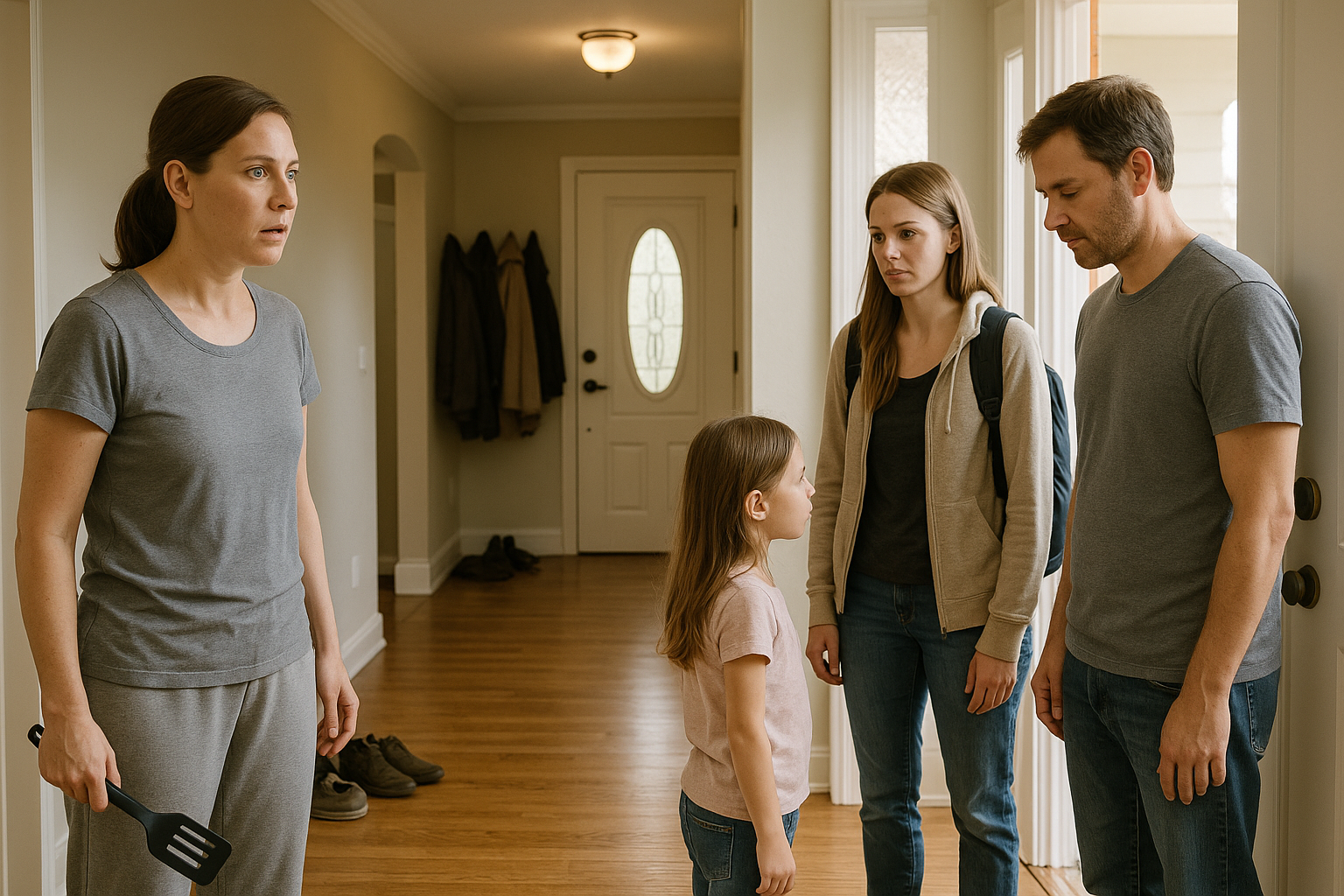
I walked into the hallway, still holding the spatula. It felt stupid, but I couldn’t put it down.
There she was.
A woman in her late twenties, maybe thirty. Dark jeans, beige sweater, small backpack. No makeup, tired eyes. She looked like any regular person you’d see in a supermarket.
Emma had her arms halfway stretched to her, then froze when she saw me.
The woman’s face went white. Mark stood between them, like he’d tried to block the view, then failed.
For a second nobody spoke. We just breathed in the same narrow hallway.
Emma looked at me, then at the woman. Her eyes filled with confusion.
“I thought…” she mumbled. “I thought it was…”
Mark put a hand on her shoulder. “Em, it’s okay. Go to your room for a second, honey.”
She didn’t move. She looked at him like he’d betrayed her by saying that.
The woman took a tiny step back. “Maybe I should come back later,” she whispered.
“No,” I said. My voice sounded strangely calm. “You’re already here.”
I looked at Mark. “Who is she?”
His mouth opened, closed. I watched his throat move when he swallowed.
“This is Laura,” he said finally. “She’s… we worked together. She just needed to talk.”
Emma tugged at his sleeve. “Why did I think she was my other mom?” she asked.
The hallway went quiet again.
The woman—Laura—closed her eyes for a second. Then she crouched down to Emma’s height, careful not to touch her.
“Because I’m stupid,” she said softly. “And your dad is a coward.”
Mark snapped, “Laura, stop.” His voice cracked at the end.
I heard my own heartbeat in my ears. The spatula felt heavy.
“Emma,” I said, forcing my voice to stay steady. “Go to your room and put on your headphones. You can watch cartoons. I’ll call you when breakfast is ready.”
She looked at me like she wanted to argue, then saw something in my face and just nodded.
We listened to her small steps up the stairs. The click of her bedroom door.
I pointed to the living room. “There.”
We sat. I took the armchair. They sat on the couch, with an empty cushion between them.
Up close, I saw Laura’s hands shaking. No rings. Chewed nails.
“Someone needs to start,” I said.
Mark covered his face for a second, then dropped his hands.
“I made a mistake,” he said. “A long time ago. Before Emma started school.”
“That’s four years,” I said. “Your ‘long time ago’ is four years.”
He nodded once. Didn’t argue.
“I thought he would tell you,” Laura said quietly. “He kept saying, ‘after this project’, ‘after we move’, ‘after Emma starts school’. There was always something.”
“Tell me what?” I asked.
She took a breath like she was about to dive underwater.
“We have a son,” she said. “He’s three.”
Something inside my head just… stopped. The words were clear, English, simple. They just didn’t land.
I looked at Mark. His eyes were wet. He nodded like he was confirming a weather report.
“You have a son,” I repeated. “With her.”
He nodded again.
“And my daughter,” I said, “just called her ‘mom’ in my hallway.”
Laura shook her head quickly. “She heard my boy on the phone once. Mark was talking to him, and I… I think he said something stupid. Like ‘your other mom’. As a joke. I told him not to. I told him it would confuse her.”

Mark stared at the coffee table. “It was once,” he muttered. “I didn’t think she’d remember.”
“She remembered,” I said.
Silence settled over the room, heavy and practical.
“How many people know?” I asked.
He blinked. “What?”
“How many people know you have two families?”
He winced at the word, but didn’t correct me.
“My brother,” he said slowly. “My boss. And… that’s it.”
“So your boss knows more about my life than I do,” I said. “Interesting.”
Laura wiped her face with the back of her hand. “I didn’t come to break your home,” she said. “It’s already broken. I came because he stopped sending money two months ago, and I can’t pay rent. He says he’s ‘figuring things out’. My son needs food. I’m tired of waiting for him to become brave.”
The word “money” hit me in a different place. Cold, practical.
“How much?” I asked.
They both looked at me.
“How much do you send her?” I clarified.
“Three hundred a month,” Mark said. “Sometimes more. When I can.”
I did the math automatically. Roughly what was always “missing” for our vacations. The debts that never quite went down.
I realized I wasn’t shaking. I wasn’t crying. I was just… taking inventory.
“Okay,” I said. “Here’s what’s going to happen today.”
Both of them straightened.
“Laura,” I said, “you and your son are getting money today. Enough for at least three months of rent and food. Not from me. From him. If he doesn’t have it, he sells the car. That’s his problem, not yours.”
Mark opened his mouth. I raised a hand.
“Then you go home,” I continued. “You don’t bring your child here. Ever. This house is not his problem to solve. He didn’t ask for any of this.”
She nodded slowly. “Okay.”
“As for us,” I said, turning to Mark, “you’re packing a bag after breakfast. You’re going to your brother’s place, or a hotel, or a bench in the park. I don’t care. Emma eats her pancakes with you still in the house. After that, you’re gone.”
His face crumpled. “Can we at least talk? Just you and me? Without—” he gestured toward the hallway.
“We are talking,” I said. “This is it. Lawyers can talk next.”
Upstairs, a cartoon theme song started playing. Emma laughed at something on the screen. It cut through the room like a knife.
“Does she know about him?” I asked quietly. “Your son.”
Laura shook her head. “No. I tell him his dad works far away. I didn’t want to give him a name that could disappear.”
I stood up. My legs felt heavy, but they worked.
“I’m going to finish breakfast,” I said. “You,” I looked at Mark, “transfer the money. Now. Show her the confirmation.”
He nodded, already reaching for his phone with shaking hands.
Laura stood. “I’m sorry,” she said. Not dramatic. Just a sentence.
“I believe you are,” I answered. “But being sorry doesn’t put anything back where it was.”
I walked to the kitchen. The pancake in the pan was black on one side.
I flipped it onto a plate, turned off the stove, and made a fresh batch.
When I called Emma down ten minutes later, my voice sounded normal.
She ran in, climbed on her chair, and asked if we could have syrup.
Mark sat across from her, eyes red, trying to smile like any other Sunday.
I watched them eat, listened to their small talk about school and cartoons.
On the counter, between the coffee maker and the fruit bowl, his phone lit up with a notification: “Transfer successful.”
I didn’t touch it.
After breakfast, he went upstairs to pack a bag.
Emma asked me, with her mouth full of pancake, why Daddy looked like he was going on a trip.
I told her the truth I could manage in one sentence.
“He made a big mistake,” I said. “So he has to stay somewhere else for a while.”
She thought about it, then nodded slowly.
“Will you still make pancakes?” she asked.
“Yes,” I said. “I’ll still make pancakes.”
That was the only promise I knew I could keep that morning.