The day Daniel left his seven-year-old son in a hospital corridor and walked away, he promised himself it was only for an hour. Just enough time to sign two papers at work, pick up some food, and come back before Noah even noticed. The boy was busy coloring the dinosaurs on his cast, tongue sticking out in concentration. “I’ll be right back, buddy,” Daniel had said, already half-turned toward the elevator.

Noah looked up, his brown eyes too big for his pale face. “You promise you won’t be long?”
“Cross my heart.” Daniel forced a smile, tapped two fingers to his chest, then to Noah’s. His son nodded and went back to his drawing.
He really did intend to return.
But the city decided otherwise. A stalled subway, a dead phone battery, and an urgent meeting that his boss swore would “take five minutes” stretched into three hours. By the time Daniel fought his way out of the office, it was dark outside. His phone blinked to life on the charger in the lobby, exploding with missed calls and messages.
He opened the first voicemail, and the world tilted.
“Mr. Lewis, this is Dr. Patel from City Children’s Hospital. Noah’s condition has changed, please call us immediately…”
There were three more messages, each more urgent than the last. His hands shook so badly he could barely press the call button.
The nurse’s voice was gentler than the words it carried. “Mr. Lewis, I’m so sorry. We tried to reach you. Noah had a sudden complication. We did everything we could.”
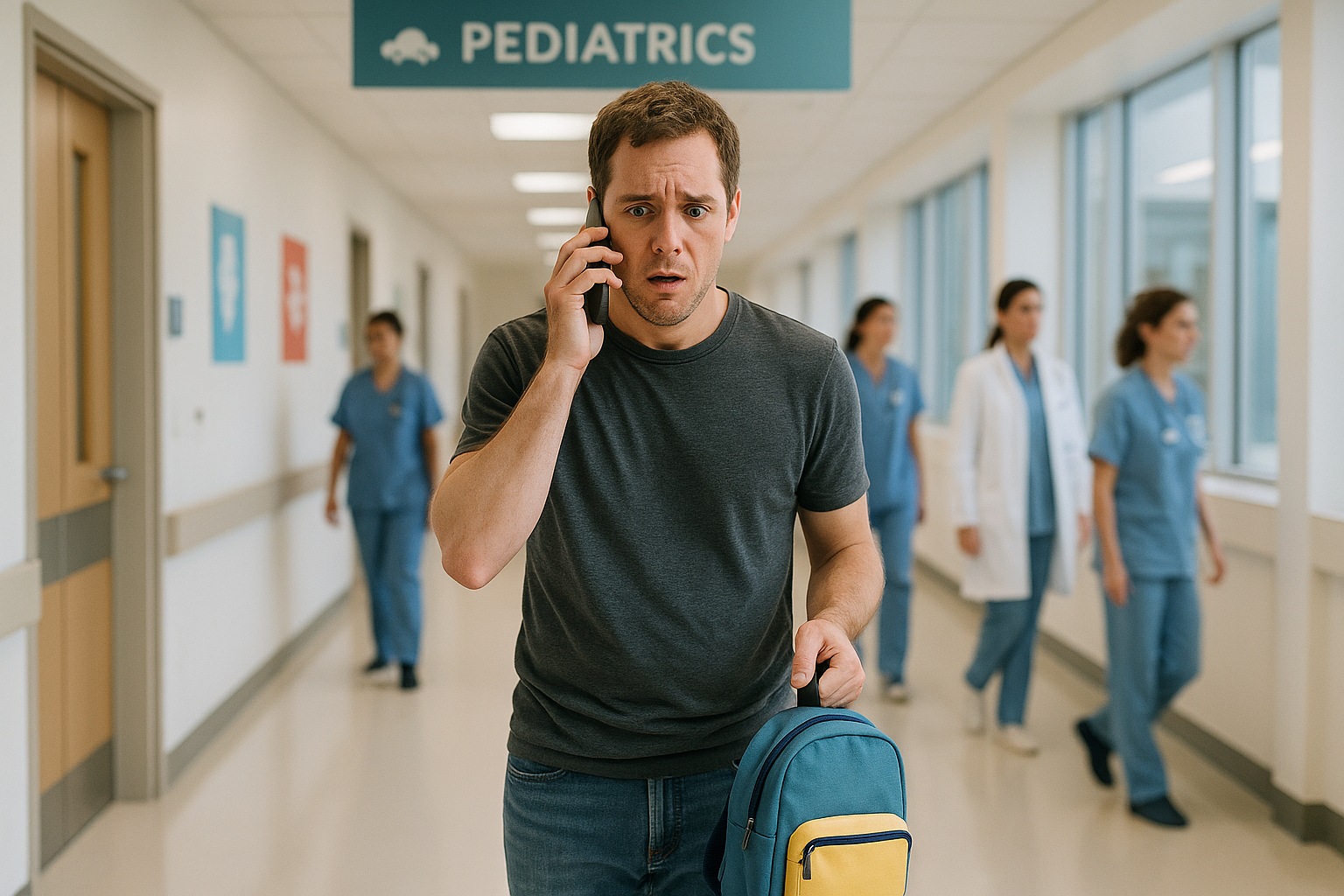
Everything blurred. The bright hospital hallway. The smell of antiseptic. The soft, apologetic eyes of strangers. Daniel ran, shoes sliding on the polished floor, heart pounding with a single, desperate thought: They’re wrong. They must be wrong.
But Noah was still.
The room that had been filled with cartoons and beeping machines an hour earlier was now quiet. Too quiet. His little hand lay open on the sheet, fingers still smudged with green marker from the dinosaur drawing. Someone had removed the cast. The leg that had been broken when the car hit them lay straight, useless.
Daniel dropped to his knees beside the bed. “I’m here, buddy. I’m here now,” he whispered, as if the boy could simply open his eyes and say, “You were late, Dad.”
He remembered the accident like a flickering nightmare. The red light. The driver who didn’t stop. The screech of metal and Noah’s thin, terrified scream. The doctors had said the surgery went well. They had used words like stable and recovering. “A few weeks of rest, and he’ll be running again,” they’d said.
They hadn’t said anything about sudden complications.
The guilt arrived before the tears. Heavy, oily, settling in his chest. If he hadn’t gone to work. If he’d charged his phone. If he’d ignored his boss. If he’d stayed, just stayed in that uncomfortable plastic chair with the bad coffee and stale air.
He had left his son alone.
The hospital chaplain tried to talk to him. Nurses offered tissues and soft words. Daniel heard none of it. He sat on the floor of the empty room long after they took Noah’s body away, staring at the wrinkled sheet where his boy had been.
“I was only supposed to be gone an hour,” he kept repeating. It sounded pathetic, stupid even to his own ears. As if time obeyed promises.
Days bled into each other. The apartment shrank around him, every corner shouting Noah’s name. The blue toothbrush in the bathroom cup. The little sneakers lined up by the door, one shoelace forever half-tied. A half-finished jigsaw puzzle on the coffee table—dinosaurs again.
On the third night, Daniel found Noah’s backpack under the couch. Inside, a crumpled drawing from the hospital. Two stick figures: one tall, one small. The tall one had messy brown hair like his, the small one had a bright yellow cast. Above them, in shaky letters: ME AND DAD. TOGETHER.
That word—together—split something open inside him. He sank to the floor, clutching the paper, sobs tearing out of him in hoarse, broken sounds he didn’t recognize as his own.
The twist came a week later, wrapped in an envelope he almost threw out. A letter from the hospital. He opened it mechanically, expecting another bill.
“Dear Mr. Lewis,
We wish to inform you that, prior to his passing, your son Noah was evaluated for organ donation. With your signed consent form on admission, we proceeded. We understand this is difficult to hear at such a painful time, but we believe you may find some comfort in knowing that Noah’s heart and liver have already saved the lives of two children…”
He stopped reading. The words swam.
He remembered the stack of forms the nurse had given him on that first chaotic night. Insurance, consent, privacy. He had signed where they pointed, barely looking. Somewhere in that tired blur, he had agreed to this.
Noah’s heart was still beating. Just not in his chest.

The letter continued, detailing a boy of six in another city, a girl of nine who had waited months. They were unnamed, faceless, but suddenly very real. Two families who had gone to bed expecting funerals and instead were planning futures.
Daniel pressed the paper to his face and cried again, differently this time. The guilt didn’t vanish, but it shifted, making room for something else—something small and fragile, like the first pale leaf pushing through winter soil.
A month later, he stood in the hospital lobby again, hands clenched at his sides. He had called the transplant coordinator three times before finding the courage to ask if he could meet one of the recipient families. He didn’t know what he wanted from them. Forgiveness, maybe. Or punishment.
He almost left before they arrived.
The boy was smaller than Noah, with dark curly hair and huge, curious eyes. His name was Liam. He wore a bright red T-shirt with a rocket on it and clutched his mother’s hand, looking around the lobby like it was a foreign planet.
“Mr. Lewis?” the woman asked softly.
Daniel nodded, unable to speak.
“This is Liam,” she said. “He… he got your son’s heart.” Her voice shook on the word son.
Liam studied Daniel for a long moment. Then, without being told, he stepped a little closer and put a hand over his own chest.
“It was broken,” he said matter-of-factly. “The doctors fixed it. They said a brave boy shared his heart with me.”
Daniel’s throat closed. He stared at that small hand, at the slight rise and fall beneath the red fabric. Somewhere under there, Noah’s heart was working, beating steadily, stubbornly refusing to stop.
“I’m not brave,” Daniel managed. “Noah was. I… I left him alone.” The confession slipped out before he could stop it.
Liam frowned, thinking hard in the way only children do. Then he shook his head. “You’re here now,” he said simply.
Three words. Not forgiveness, not absolution. Just a fact.
You’re here now.
Daniel exhaled, a shaky, trembling thing. For the first time since that horrible night, he felt his own heart clearly, pounding in his chest. Beating in time, he imagined, with the one inside this little boy.
He knelt slowly so his eyes were level with Liam’s. “Can I… can I listen?” he asked.
Liam glanced at his mother, who nodded through tears, then stepped forward. Daniel placed his ear gently against the small chest, afraid to breathe.
There it was. Lub-dub, lub-dub. Strong. Alive. Familiar in a way that hurt and healed at the same time.
He stayed like that for a long moment, listening, memorizing.
Later, walking home through the city streets, Daniel passed a father lifting his laughing daughter onto his shoulders, a boy racing ahead of his mom on a scooter, a family arguing over ice cream flavors. Each scene used to be a wound. Now, painfully, slowly, they became something else: a reminder.
He couldn’t get Noah back. No amount of self-punishment would rewind that one catastrophic decision to leave for “only an hour.” The guilt would never fully leave; it had carved its home inside him.
But somewhere, because of a rushed signature on a form he barely remembered, two children were alive. Somewhere, a small boy with a red T-shirt and a serious expression carried a heart that knew the rhythm of dinosaur cartoons and bedtime stories.
That night, Daniel took Noah’s last drawing from the fridge and slid it into a frame. Under the shaky words ME AND DAD. TOGETHER, he added one more, almost illegible through his shaking hand:
STILL.