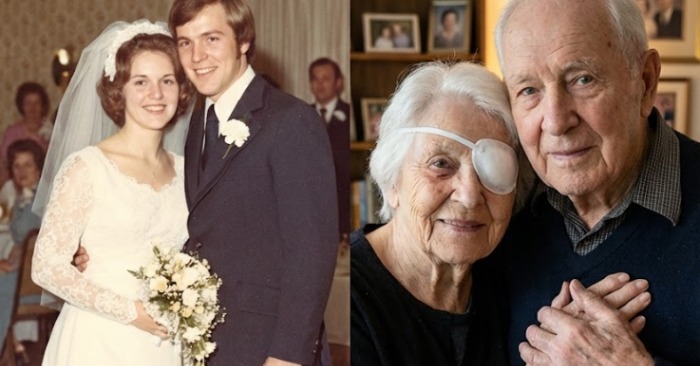
Every year, on her birthday, Helena returns to the same table in the restaurant where it all began and where she has kept her promise for almost 50 years. But when a stranger appears in her husband’s place with an envelope with her name on it, everything Helena thought was over begins quietly anew.
When I was younger, I used to laugh at people who said birthdays made them sad.
I thought it was just a dramatic way to get attention, like sighing too loudly or wearing sunglasses indoors.
Back then, birthdays meant cake, cake meant chocolate… and chocolate meant life was good.
But now I understand.
TODAY’S BIRTHDAYS MAKE THE WEATHER HEAVIER.
Today’s birthdays make the weather heavier. It’s not just candles, silence in the house, or pain in the knees. It’s knowing.
The kind of knowledge that only comes when you’ve lived long enough to lose people who seemed like forever.
Today I turn 85.
As I have every year since my husband Peter died, I got up early and got ready.
I braided my thinning hair into a soft braid, painted my lips the color of wine, and zipped my coat up to the top.
ALWAYS UP TO MY CHIN.
Always up to my chin. Always the same coat. I don’t usually like nostalgia, but this is different.
It’s a ritual.
Now it takes me about 15 minutes to walk to Marigold’s. It used to take seven. It’s not far, just three turns, past a drugstore and a small bookstore that smells of carpet cleaner and regret.
But every year the walk seems longer.
And I go at noon, always.
BECAUSE THAT’S WHEN WE MEET.
Because that’s when we met.
“You can do this, Helen,” I told myself as I stood in the doorway. “You’re a lot stronger than you think.”
I met Peter at Marigold’s when I was 35. It was a Thursday, and I was there only because I missed my bus and needed a warm place to sit.
He was sitting at a corner table, struggling with a newspaper and a cup of coffee that he had already spilled once.
“I’m Peter. I’m clumsy, awkward, and a little embarrassing.”
HE LOOKED AT ME LIKE I WAS THE END OF A JOKE HE WASN’T FINISHING.
He looked at me like I was the end of a joke he wasn’t finished telling. I was suspicious; he was charming in a way that seemed too polished, but I sat down next to him anyway.
He told me I had the kind of face that people write letters about. I told him that was the worst flirtation phrase I had ever heard.
“Even if you leave here never to see me again… I’ll find you, Helena. Somehow.”
And the strangest thing was, I believed him.
We got married the next year.
THE RESTAURANT BECAME OUR LITTLE TRADITION.
The restaurant became our little tradition. We went there every year for my birthday, even after he was diagnosed with cancer, even when he was too tired to eat more than half a cupcake. And when he died, I kept going. It was the only place where I still felt like he could walk through the door and sit across from me, smiling like he used to.
Today, as always, I opened the door to Marigold’s. The familiar smell of burnt coffee and cinnamon toast greeted me like an old friend, and for a moment I felt like I was 35 again.
I was 35, and I was walking into that same coffee shop for the first time, not knowing that I was about to meet the man who would change everything.
But this time, something was wrong.
I stopped after two steps. My eyes went straight to the table by the window—our table—and there, in Peter’s place, sat a stranger.
HE WAS YOUNG, MAYBE TWENTY.
He was young, maybe twenty. Tall, his shoulders were tense under his dark jacket. He was holding something small in his hands, an envelope. And he kept looking at his watch, as if waiting for something he didn’t quite believe in.
He noticed me looking and quickly stood up.
“Ma’am,” he said, incredulously at first. “Are you… Helena?”
“Yes, do we know each other?”
My name on the stranger’s lips made me flinch. He took a step forward, holding the envelope out in both hands.
HE TOLD ME YOU WOULD COME,” HE SAID.
“He told me you would come,” he said. “This is for you. You must read it.”
His voice trembled a little, but he held the envelope carefully, as if it were more important than either of us.
I didn’t answer right away. My gaze fell to the paper in his hands. The edges were frayed. My name was written in a handwriting I hadn’t seen in years. But I knew it instantly.
“Who told you to bring this?” I asked.
“My grandfather.”
THERE WAS SOMETHING UNCLEAR AND ALMOST APOLOGICAL ON HIS FACE.
There was something unclarified and almost apologetic on his face.
“His name was Peter,” he added quietly.
I didn’t sit down. I grabbed the envelope, nodded once, and left.
The air hit my face like a wave. I walked slowly, more to calm myself than to age. I didn’t want to cry in public. Not because I was ashamed, but it seemed like too many people had forgotten how to look at a person in grief.
When I got home, I made myself some tea, which